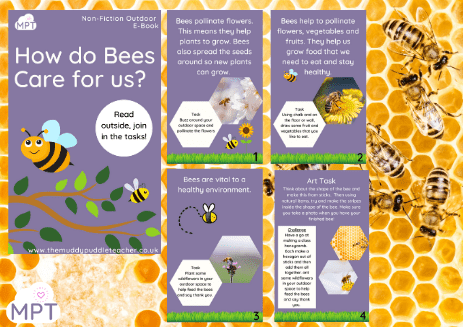

Outdoor eBooks are downloadable teaching resources designed to help children learn through movement, practical activity and real outdoor experiences.
Unlike traditional eBooks that are simply read on a screen, outdoor eBooks give teachers and parents ideas, prompts, games and challenges that children complete outside.
They can support maths, English, science, geography, history, wellbeing, early years learning and SEND. A child might use an outdoor eBook to complete a number scavenger hunt, practise times tables through movement, explore habitats, build shapes with sticks or collect vocabulary for poetry.
The aim is not to take screens outdoors.
The aim is to use a simple digital resource to guide meaningful learning away from the desk.
Outdoor eBooks can be downloaded, viewed on a device or printed selectively where needed. They are designed to reduce preparation, lower reliance on worksheets and make curriculum learning more active.
Explore our Outdoor Learning Hub, Outdoor Maths Resources and Early Years Outdoor Learning Hub for more practical ideas.
Access the full library through our 60-Day Free Trial.
What Is an Outdoor eBook?
An outdoor eBook is a digital teaching resource that contains activities intended to be completed outdoors.
It may include lesson ideas, scavenger hunts, challenge cards, observation prompts, games, discussion questions, recording sheets or practical instructions.
The adult reads the guidance, prepares any simple equipment and then takes the learning outside.
Children do not usually need to sit and read the whole eBook themselves. The resource supports the teacher, teaching assistant, parent or home educator in delivering the activity.
For example, an outdoor maths eBook might ask children to find numbers in the environment, create quantities with natural objects or build a giant number line.
An outdoor English eBook might encourage children to collect descriptive words, act out a story or explore alliteration using objects found outside.
The digital format makes the resource easy to store, reuse and access when needed.
How Are Outdoor eBooks Different from Traditional eBooks?
Traditional eBooks are generally designed to be read on a screen.
They might contain stories, information or written activities.
Outdoor eBooks are designed to lead into action.
The resource may begin on a laptop, tablet or phone, but the main learning happens outdoors.
Children move, search, talk, build, measure, compare, observe and solve problems.
A traditional maths eBook may present calculations on a page. An outdoor maths eBook may ask children to create those calculations using hoops, cones, chalk or natural materials.
A traditional science eBook may explain habitats through pictures. An outdoor science eBook may guide children to investigate a real microhabitat.
Outdoor eBooks connect digital convenience with practical learning.
Are Outdoor eBooks Just Printable Worksheets?
No.
Some outdoor eBooks may include optional recording pages, but they are not intended to be another collection of worksheets.
The main purpose is to help children experience learning physically.
Children may demonstrate understanding by collecting objects, building a model, completing a route, matching cards, explaining an idea, creating a pattern or working with a partner.
Recording can happen afterwards through photographs, short notes, drawings or discussion.
The practical experience comes first.
This is particularly useful for children who find repeated desk-based tasks difficult or who learn more effectively through movement, talk and sensory experience.
Explore our eBook Diversity Range and eBook Outdoor Bee Range for more examples.
Why Use Outdoor eBooks?
Outdoor eBooks give teachers a clear starting point.
Many educators want to take learning outside but feel unsure about what to do, how to link activities to the curriculum or how to manage preparation.
A ready-made eBook removes some of that pressure.
It provides an objective, instructions, suggested resources and practical ideas in one place.
Outdoor eBooks can help teachers reduce planning time, use fewer printed worksheets, introduce more movement, provide memorable learning experiences and make better use of school grounds.
They can also support consistency across a school because staff can use shared resources and adapt them for different year groups.
Outdoor eBooks Can Reduce Teacher Workload
Taking learning outside should not create hours of additional preparation.
A strong outdoor eBook should make the process easier.
Teachers can select an activity, gather a small number of reusable resources and deliver the lesson without creating everything from scratch.
Many activities use equipment schools already have, including chalk, hoops, cones, rope, buckets, clipboards and number cards.
Natural and existing features of the school grounds can also become resources.
A playground line can support measurement. Steps can support counting. Doors and windows can support shape learning. Leaves and stones can support sorting and number.
The eBook provides the structure while the environment provides much of the equipment.
Outdoor eBooks Can Reduce Printing
Outdoor eBooks can help schools move away from printing large quantities of single-use worksheets.
Teachers may display the activity on a screen, read the instructions from a device or print only the pages required.
Some resources can be laminated and reused.
Children can record learning through photographs, chalk, practical models, talk, drawings or a shared class display.
This does not mean schools must stop printing altogether.
It means printing becomes purposeful rather than automatic.
Reducing unnecessary printing can lower costs, reduce waste and help teachers focus more on the quality of the learning experience.
Outdoor eBooks Make Learning More Active
Children are not designed to spend every lesson sitting still.
Outdoor eBooks create opportunities for movement that remains linked to the curriculum.
Children may jump to number answers, walk around shapes, search for vocabulary, measure distances, collect data or act out a process.
Movement can support attention, engagement and memory.
A child may remember a maths concept more clearly after physically building or moving through it.
The activity remains educational. It is simply taught through a more active approach.
Outdoor eBooks Make Abstract Ideas More Concrete
Some concepts are difficult for children to understand when they only see them represented on a page.
Outdoor eBooks can turn abstract ideas into practical experiences.
A child learning about 20 can collect and organise 20 objects.
A child learning perimeter can walk around the boundary of a shape.
A child learning habitats can observe a real sheltered space.
A child learning alliteration can collect objects beginning with the same sound.
These experiences help children connect vocabulary and symbols with something real.
The practical activity can then lead into more formal recording and explanation.
What Subjects Can Outdoor eBooks Cover?
Outdoor eBooks can support nearly every area of the curriculum.
Outdoor maths eBooks may cover number, counting, multiplication, shape, fractions, measurement, data, perimeter and problem-solving.
Outdoor English eBooks can support phonics, spelling, vocabulary, poetry, storytelling, reading and speaking and listening.
Science eBooks may focus on plants, animals, habitats, seasonal change, forces, materials or scientific enquiry.
Geography activities may include mapping, fieldwork, direction, weather and observation of the local area.
History eBooks can use timelines, role play and practical challenges.
They can also support art, design and technology, music, wellbeing, physical development and outdoor play.
Outdoor eBooks for Early Years
In Early Years, outdoor eBooks can help practitioners create simple activities linked to play, movement and exploration.
Children might hunt for colours, count natural objects, explore minibeasts, make marks with chalk, investigate water or collect items by size and texture.
The activities can support Communication and Language, Physical Development, Personal, Social and Emotional Development, Literacy, Mathematics, Understanding the World and Expressive Arts and Design.
Early Years outdoor eBooks should use simple instructions and allow children to explore at their own developmental level.
They can be used within continuous provision, adult-led sessions, small groups or home learning.
Explore our Early Years Outdoors Hub and Nature Activities for Early Years.
Nature Activities for Early Years – Minibeasts & their habitats
Outdoor eBooks for KS1
KS1 outdoor eBooks can support children as they move into more structured curriculum learning.
Activities might include number hunts, phonics games, shape investigations, simple mapping, nature poetry and science observation.
The practical format can help children maintain the movement and exploration they experienced in Early Years while developing more formal knowledge.
Teachers can use the eBooks for whole-class lessons, small groups, interventions or short practical sections within a longer lesson.
A Year 1 class may use an outdoor eBook to practise numbers to 20.
A Year 2 class might use one to explore equal groups, habitats or descriptive writing.
Visit our KS1 Outdoor Learning Resourceshttps://themuddypuddleteacher.co.uk/category/resources/lks2/ for more ideas.
Outdoor eBooks for KS2
Outdoor eBooks are not only for younger children.
KS2 pupils can use them to explore more complex mathematics, writing, science and geography.
Activities may include times-table games, area and perimeter investigations, coordinates, data collection, poetry, scientific enquiries and local fieldwork.
Older children still benefit from movement, teamwork and practical problem-solving.
An outdoor eBook can provide enough structure to keep the learning focused while allowing pupils to work independently.
Children can also use the eBook as a starting point before creating their own challenges or investigations.
Explore our KS2 Outdoor Learning Hub, Outdoor eBook Comprehension
Outdoor eBooks for Children with SEND
Outdoor eBooks can be adapted to support children with a range of needs.
Practical activity may help children who benefit from movement, repetition, visual support and concrete resources.
Children can demonstrate understanding without always relying on lengthy writing.
They might point, match, collect, build, photograph, sort or explain verbally.
However, outdoor learning is not automatically accessible for every child.
Some children may need fewer instructions, visual schedules, a quieter area, familiar equipment or support with transitions.
Activities can be simplified by reducing the number range, limiting the search area or completing one challenge at a time.
Children should be able to participate in different ways.
Explore our SEND Outdoor Learning Hub, 10 Outdoor Ideas to Regulate Children.
Do Outdoor eBooks Require a Woodland?
No.
Outdoor eBooks can be used in school playgrounds, courtyards, gardens, fields, local parks or small grassy spaces.
The Muddy Puddle Teacher® approach is designed for ordinary educational settings.
You do not need a forest, mud kitchen or expensive outdoor classroom.
A simple playground can support number, shape, measurement, phonics, writing, science and geography.
Walls, fences, steps, markings, shadows and existing equipment can all become learning resources.
The quality of the lesson depends on its purpose and delivery, not on having a perfect natural setting.
Do Outdoor eBooks Need Lots of Equipment?
Most outdoor eBooks can be delivered with simple, reusable resources.
Useful equipment may include chalk, hoops, cones, rope, buckets, beanbags, clipboards, number cards and bamboo canes.
Some activities use natural objects such as sticks, leaves and stones where appropriate.
Others rely mainly on observation, movement and discussion.
The resource should tell the adult what is needed before the lesson begins.
The strongest activities do not require teachers to purchase large amounts of specialist equipment.
Can Outdoor eBooks Be Used at Home?
Yes.
Parents and home educators can use outdoor eBooks in gardens, parks, playgrounds or on local walks.
The activities can offer a structured way to practise curriculum skills without recreating a classroom at home.
A child might complete a number hunt, measure objects in the garden, collect words for a poem or investigate signs of seasonal change.
Parents can choose one short activity rather than trying to complete the whole eBook at once.
The focus should remain playful, practical and manageable.
Can Outdoor eBooks Be Reused?
Yes.
Digital resources can be saved and used repeatedly.
Teachers can adapt the same activity by changing the number range, vocabulary, subject objective or level of challenge.
A number scavenger hunt can begin with numbers to 10, progress to numbers to 20 and later include calculations.
A shape hunt can focus on circles and triangles for younger children, then angles and properties for older pupils.
Reusable resources such as cards and prompts can be laminated.
This makes outdoor eBooks a practical investment for schools, nurseries and families.
How to Use an Outdoor eBook
Begin by choosing an activity that matches the learning objective.
Read the instructions before the lesson and decide which pages are needed.
Gather any simple equipment and check the outdoor space.
Explain the learning clearly before children begin.
Keep the number of instructions manageable and demonstrate the activity where necessary.
During the lesson, listen to children’s explanations and ask questions that deepen their thinking.
Afterwards, bring the group together to discuss what they found, created or learned.
Written recording can be added where it supports the objective.
Try This Tomorrow
Choose one subject you are already teaching.
Use an outdoor eBook to take one small part of that lesson outside.
For maths, try a number or shape hunt.
For English, collect vocabulary or act out a story.
For science, observe a habitat or investigate natural materials.
Keep the activity to around 10 or 15 minutes.
Ask children to explain what they noticed before returning to the classroom.
Starting with one manageable activity helps both teachers and children build confidence.
How Outdoor eBooks Support Assessment
Teachers can assess learning during outdoor activities by observing, listening and questioning.
Children can show understanding by sorting objects, building a model, following a sequence, solving a challenge or explaining their choices.
Photographs can provide evidence of the activity.
Children may also complete a short reflection, diagram or calculation afterwards.
Assessment should match the learning objective.
For example, if the objective is to recognise numbers to 20, children can demonstrate this by finding, ordering and matching numerals outdoors.
A completed worksheet is not the only evidence of understanding.
What Makes a Good Outdoor eBook?
A useful outdoor eBook should have a clear learning purpose.
It should use simple instructions, manageable equipment and realistic outdoor spaces.
Activities should be adaptable for different ages and needs.
The resource should support meaningful learning rather than taking children outside for the sake of it.
A strong outdoor eBook will also reduce teacher preparation, encourage mathematical or subject-specific language and provide ideas for extending or simplifying the activity.
It should recognise that schools have different spaces, budgets and levels of staff confidence.
Are Outdoor eBooks Environmentally Friendly?
Digital resources can reduce the need for repeated printing, but their environmental value depends on how they are used.
Teachers can display pages digitally, print selectively and reuse laminated materials.
Practical tasks can replace piles of single-use worksheets.
Natural materials should be collected responsibly and returned where appropriate.
Outdoor learning can also help children develop a stronger connection with their environment.
When children observe habitats, seasons and living things regularly, they are more likely to understand why outdoor spaces should be cared for.
Outdoor eBooks and Screen Time
Outdoor eBooks are not intended to increase children’s screen time.
The screen is mainly used by the adult to access instructions or introduce the activity.
The children’s learning then moves outside.
Some resources may include a short teaching video, but this should act as a starting point for practical exploration.
The purpose is to use technology to support real-world learning rather than replace it.
Children should spend most of the session moving, talking, observing and creating.
Why The Muddy Puddle Teacher® Creates Outdoor eBooks
The Muddy Puddle Teacher® creates outdoor eBooks to help teachers take curriculum learning outside without creating more workload.
Our resources are designed by teachers and intended for real schools, nurseries, SEND settings and families.
They focus on practical learning using simple equipment and accessible outdoor spaces.
We are not Forest School.
We help teachers take maths, phonics, English, science, geography and other curriculum subjects outside.
Our outdoor eBooks give children more movement, richer conversations and memorable learning experiences while helping schools reduce printing and preparation.
Explore Our Outdoor eBook Collection
Our collection includes outdoor eBooks for number, counting, multiplication, shape, scavenger hunts, English, science, nature learning and SEND.
You can find resources for Early Years, KS1 and KS2.
Explore our Outdoor eBook Collection and Outdoor Learning Resource Hub.
Access the full library through our 60-Day Free Trial.
Join our Free Weekly Outdoor Learning Magazine for new activities, seasonal inspiration, SEND support and outdoor learning ideas.
Start Using Outdoor eBooks
Outdoor eBooks offer a simple bridge between digital resources and real-world learning.
They give teachers the structure they need while giving children the movement and practical experiences they often need.
The eBook does not become the lesson.
It helps the lesson happen.
Children can count, measure, investigate, create, observe and communicate outdoors while still working towards clear curriculum objectives.
Start with one resource, one activity and the outdoor space you already have.
Learning does not always have to stay on the page.
Frequently Asked Questions
What is an outdoor eBook?
An outdoor eBook is a downloadable teaching resource containing activities, prompts and challenges designed to be completed outside.
Are outdoor eBooks worksheets?
No. They may contain optional recording pages, but the main learning takes place through movement, discussion, observation and practical activity.
Do children need a tablet outside?
No. The adult can read or print the relevant instructions before the session. Children usually complete the activity without using a screen.
Can outdoor eBooks be used without a woodland?
Yes. They can be used in playgrounds, courtyards, gardens, fields and other accessible outdoor spaces.
Are outdoor eBooks suitable for children with SEND?
Yes. Activities can be adapted using visual prompts, fewer instructions, smaller working areas and different ways for children to communicate their understanding.
What subjects can outdoor eBooks support?
Outdoor eBooks can support maths, English, science, geography, history, art, wellbeing, Early Years learning and SEND provision.
Written by Sarah Seaman PGCE MA
Founder of The Muddy Puddle Teacher®
Teacher for over 19 years
Bloomsbury author
Trainer of thousands of teachers across the UK