

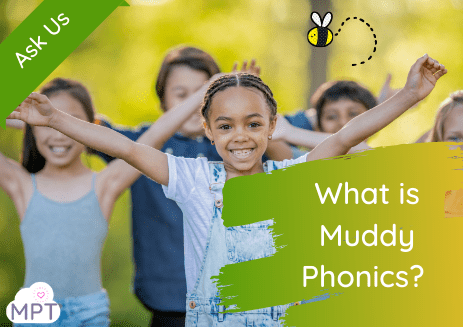
What Is Muddy Phonics®?
Muddy Phonics® is The Muddy Puddle Teacher® approach to teaching phonics through movement, outdoor play, practical activities and memorable real-life experiences.
It helps children practise sounds, oral blending, segmenting, letter recognition, word building, reading and spelling beyond the worksheet or phonics screen.
Children might jump between sounds, build words with natural materials, search for graphemes around the playground, move through a sound trail or use chalk, cones, hoops and reusable cards to practise phonics outside.
Muddy Phonics® does not replace a school’s chosen systematic synthetic phonics programme. Instead, it helps teachers bring that programme to life through active, practical opportunities.
The same sounds, words and phonics skills are taught, but children are given another way to experience and practise them.
It is suitable for Nursery, Reception, KS1, phonics interventions, SEND support, home education and children who benefit from learning through movement and repetition.
Explore more practical ideas through our Outdoor Phonics Resources, Early Years Outdoors Hub and Outdoor Learning Hub.
Download all Outdoor Phonics resources – explore a 60-day free trial.
What Does Muddy Phonics® Mean?
Muddy Phonics® means teaching and practising phonics through outdoor, active and hands-on learning.
The word “muddy” does not mean children have to be covered in mud.
It reflects The Muddy Puddle Teacher® belief that children benefit from real experiences, movement, play, curiosity and learning beyond the desk.
A Muddy Phonics® lesson might take place on a playground, field, courtyard, garden or small grassy area.
Children do not need access to woodland.
Teachers can use chalk, cones, hoops, ropes, reusable sound cards, buckets, beanbags and natural materials.
The activities are designed to work in ordinary schools and settings using the spaces and resources already available.
Is Muddy Phonics® a Phonics Scheme?
Muddy Phonics® is not intended to replace a validated systematic synthetic phonics programme.
Schools should continue to follow their chosen phonics progression and teach sounds in the correct sequence.
Muddy Phonics® provides practical ways to reinforce that teaching.
For example, if children are learning the sound represented by “s”, the teacher can use Muddy Phonics® activities to help them recognise the grapheme, hear the phoneme, blend words containing the sound and practise forming it.
The outdoor activity follows the school’s phonics teaching rather than creating a separate sequence.
This means schools can use Muddy Phonics® alongside their existing phonics programme.
It can support daily teaching, continuous provision, interventions, catch-up work and additional practice.
Download all Outdoor Phonics resources – explore a 60-day free trial.
Why Teach Phonics Outdoors?
Phonics requires repetition.
Children need repeated opportunities to hear sounds, recognise graphemes, blend phonemes and segment words.
However, repetition does not always need to mean completing the same style of worksheet or flashcard activity.
Taking phonics outside gives children opportunities to repeat essential skills through movement, play and practical experience.
A child may jump on graphemes while blending a word, collect objects beginning with a target sound, run to the correct sound card or build a word using sticks and stones.
The learning objective remains focused.
The experience simply becomes more active.
This can be particularly helpful for children who find sitting still difficult, lose concentration during paper-based activities or need extra practice in a lower-pressure format.
Muddy Phonics® Makes Sounds Memorable
Children are more likely to remember learning when it is connected to an experience.
A sound may become easier to recall when a child has searched for it, jumped to it, built it or used it during a game.
Movement can create additional memory cues.
For example, children learning “ch” might move along a chalk path, say the sound at each stop and collect picture cards containing “ch”.
Children learning to blend might step on separate phonemes before jumping into a hoop containing the complete word.
The physical action helps make the process visible.
Children can see that individual phonemes combine to create a word.
Muddy Phonics® Supports Oral Blending
Oral blending is the ability to hear separate phonemes and combine them into a word.
This skill can be practised outdoors without any written resources.
An adult might say “c-a-t” and ask children to run to a picture of a cat.
Children could move one step for each phoneme and then jump forwards as they blend the complete word.
Objects or picture cards can be placed around the outdoor area for children to find.
The focus should remain on listening carefully to the sounds and combining them in the correct order.
Outdoor oral blending activities can feel playful while still providing valuable phonics practice.
Muddy Phonics® Supports Segmenting
Segmenting means breaking a spoken word into its individual phonemes.
Children can practise segmenting by moving one object for each sound they hear.
For the word “dog”, they could place three stones into a hoop while saying “d-o-g”.
They might jump three times, tap three cones or take three steps.
The movement helps children understand that a word can be broken into separate sounds.
Teachers can then connect those sounds with the corresponding graphemes.
Practical segmenting activities can be especially helpful for children who need to experience phoneme counting physically before attempting written spelling.
Muddy Phonics® Supports Grapheme Recognition
Children need to recognise graphemes quickly and accurately.
Reusable sound cards can be placed around a playground for children to search for, match and identify.
The teacher might say a phoneme and ask children to move to the correct grapheme.
Children could follow a sound trail, sort grapheme cards or match pictures with their initial sounds.
Chalk can also be used to write large graphemes on the ground.
Children can walk along their shape, trace them with a finger or follow the correct formation using a stick or paintbrush with water.
Activities should always model the correct sound pronunciation and letter formation used by the setting.
Muddy Phonics® Helps Children Build Words
Word building becomes more concrete when children can physically move the graphemes.
Place sound cards inside hoops, buckets or along a chalk line.
Give children a spoken word and ask them to select the graphemes needed to build it.
They can stand beside each sound and blend the word together.
The activity can be adapted for simple CVC words, digraphs, trigraphs and more complex words.
Children can also use pebbles, sticks or reusable letter tiles.
The important part is that they hear each phoneme, choose the correct grapheme and place the sounds in the correct order.
Muddy Phonics® and Tricky Words
Tricky words contain parts that children may not yet be able to decode using the phonics knowledge they have been taught.
Outdoor games can support repeated recognition and reading of these words.
Tricky word cards might be placed around the playground for children to find, read and match.
Children could create a chalk pathway and read each word as they travel along it.
They might throw a beanbag towards a word and read the card it lands beside.
Keep the number of words manageable and linked to the school’s phonics progression.
Children still need explicit teaching about which parts of each word are decodable and which parts are currently tricky.
Is Muddy Phonics® Just Playing Outside?
Muddy Phonics® activities are playful, but they also have a clear learning purpose.
The teacher should know which sound, word or phonics skill children are practising.
Outdoor play can support learning, but a Muddy Phonics® session is not simply unstructured time outside.
A strong activity has a clear objective, simple instructions, purposeful repetition and opportunities for adults to assess understanding.
Children might appear to be jumping, searching or collecting, but they are also recognising graphemes, hearing phonemes, blending words and developing vocabulary.
The movement supports the phonics rather than distracting from it.
Muddy Phonics® in Early Years
Muddy Phonics® can begin with listening, sound discrimination, rhythm, rhyme and oral language.
Nursery children might listen for environmental sounds, copy rhythms, identify rhyming words or collect objects beginning with the same sound.
Reception children can develop these skills alongside systematic phonics teaching.
They can recognise graphemes, practise oral blending, build words and explore letter formation outdoors.
Activities can be included within continuous provision or used as short adult-led sessions.
The outdoors provides more space for large-scale movement and opportunities to connect sounds with real objects.
Muddy Phonics® in KS1
In KS1, Muddy Phonics® can reinforce increasingly complex sounds and words.
Children might practise digraphs, trigraphs, alternative graphemes, adjacent consonants, common exception words and spelling patterns.
A Year 1 class could follow a word trail containing the week’s focus sounds.
A Year 2 group might sort words according to spelling patterns or use outdoor stations to practise common exception words.
The activities can support whole-class teaching, small groups and phonics screening preparation.
Outdoor phonics should not become focused only on speed or testing.
Children need opportunities to apply their knowledge, explain choices and experience success.
Muddy Phonics® for Children with SEND
Muddy Phonics® can offer valuable support for children who benefit from practical, visual and movement-based teaching.
Children can point, match, move, collect, sort or build rather than relying only on written responses.
The outdoor space may allow children more freedom to move and regulate.
However, outdoor learning is not automatically suitable or calming for every child.
Some children may need a smaller area, visual timetable, familiar adult, quieter activity, clear boundaries or fewer sounds presented at once.
Children with motor difficulties may need seated or tabletop alternatives.
Children who communicate non-verbally can select or match grapheme cards, use symbols or indicate answers through eye pointing or gesture.
The activity should adapt to the child rather than expecting the child to adapt to one fixed method.
Can Muddy Phonics® Support Dyslexia?
Children with dyslexia may benefit from phonics teaching that is explicit, structured, cumulative and multi-sensory.
Muddy Phonics® can provide additional opportunities to practise sounds and words through movement, visual prompts and physical resources.
A child might build words, step through phonemes, trace large graphemes or repeat sounds during a practical game.
These activities should complement high-quality structured phonics teaching.
They should not be used as a replacement for specialist assessment, intervention or individual support where this is required.
The aim is to give children another route into literacy and help phonics practice feel accessible and successful.
Download all Outdoor Phonics resources – explore a 60-day free trial.
What Equipment Is Needed for Muddy Phonics®?
Muddy Phonics® does not require expensive equipment.
Teachers can use chalk, cones, hoops, ropes, beanbags, buckets, sound cards, picture cards, reusable letters and clipboards.
Natural materials such as sticks, leaves and stones can also be used where appropriate.
The most useful resources are flexible items that can be used with different sounds and year groups.
A set of hoops could support oral blending one day and tricky word reading the next.
Chalk can create graphemes, sound trails, word-building areas and letter-formation paths.
The focus should remain on simple, reusable equipment and manageable preparation.
Does Muddy Phonics® Require a Forest?
No.
Muddy Phonics® is not Forest School and does not require woodland.
It can be used on a playground, courtyard, field, path, garden or small outdoor space.
A school with limited green space can still teach phonics outdoors successfully.
The built environment can provide useful learning opportunities.
Children can search for letters and words on signs, use walls for water painting, follow playground markings or move between sound stations.
Accessibility matters more than having a beautiful natural space.
How Long Should a Muddy Phonics® Activity Last?
A Muddy Phonics® activity does not need to take up the whole phonics lesson.
A focused activity lasting 10 or 15 minutes can provide useful practice.
The teacher might introduce the sound indoors, practise it outside and then return to the classroom for reading or writing.
Alternatively, the full session can take place outside where appropriate.
The length should depend on the learning objective, children’s attention and the needs of the group.
Short, repeated activities are often more effective than an overcomplicated lesson containing too many challenges.
Your Muddy Phonics® Mission
Choose one sound your children are already learning.
Write or place the grapheme in several locations around the playground.
Add a small selection of other familiar graphemes.
Say the target phoneme and ask children to move to the correct card.
Once they arrive, ask them to say the sound and suggest one word containing it.
More confident children can identify whether the sound appears at the beginning, middle or end of the word.
Keep the activity brief, repeat it several times and observe which children recognise the grapheme independently.
Phase Two Phonics Nature Posters
Try This Tomorrow
Take three hoops outside.
Place one grapheme card inside each hoop.
Say one of the phonemes and ask children to move towards the matching grapheme.
Repeat the sound together.
Then show a picture or object and ask children whether its name contains the target sound.
This requires very little preparation and can be adapted for any phonics phase.
How Teachers Can Assess Muddy Phonics®
Outdoor phonics provides many opportunities for observation.
Teachers can notice which children recognise sounds quickly, which children copy others and which children need additional processing time.
They can listen to oral blending, observe segmenting and check whether children select the correct graphemes.
Children can demonstrate understanding by moving, matching, sorting, building or saying sounds.
Written evidence is not always required.
Teachers can make brief notes, take photographs of completed word-building tasks or ask children to explain their choices.
Assessment should remain linked to the phonics objective rather than the child’s speed or physical confidence.
Muddy Phonics® and Teacher Workload
Muddy Phonics® should make phonics teaching more practical without creating unnecessary work.
Activities can be adapted from the sounds and words teachers are already using.
The same basic resources can be reused throughout the year.
A set of sound cards can support recognition, blending, segmenting, sorting and word building.
Teachers do not need to create elaborate themed lessons.
One clear objective and one simple movement-based task can be enough.
The Muddy Puddle Teacher® provides ready-to-use outdoor phonics resources to help teachers save planning time and reduce repeated printing.
Muddy Phonics® Resources
Our Muddy Phonics® collection includes outdoor phonics activities, sound games, word-building ideas, spelling challenges, phonics planning and practical resources for EYFS, KS1 and SEND.
The resources are designed to complement existing phonics teaching and help children practise through movement and real experiences.
Explore our Muddy Phonics® Resource Collection and Outdoor English Hub.
Access the complete library through our 60-Day Free Trial.
Join our Free Weekly Outdoor Learning Magazine for practical phonics ideas, seasonal activities, SEND support and outdoor learning inspiration.
Why Schools Use Muddy Phonics®
Schools use Muddy Phonics® because it offers a simple way to make phonics active without abandoning structure or progression.
It helps teachers provide repeated practice through movement, practical resources and memorable experiences.
It can support children who thrive in traditional phonics lessons and those who need another way to access the same skills.
Muddy Phonics® is not about taking children outside for the sake of it.
It is about asking whether movement, space and practical experience can help children hear, recognise, blend and apply sounds more confidently.
Phonics does not always have to stay at a desk.
Frequently Asked Questions
What is Muddy Phonics®?
Muddy Phonics® is The Muddy Puddle Teacher® approach to practising phonics through outdoor movement, games, practical resources and real experiences.
Is Muddy Phonics® a complete phonics scheme?
Muddy Phonics® is designed to complement a school’s existing systematic synthetic phonics programme. Schools should continue to follow the sequence and teaching guidance of their chosen programme.
Does Muddy Phonics® require a woodland?
No. Activities can take place on a playground, field, courtyard, garden or small outdoor area.
Is Muddy Phonics® suitable for children with SEND?
Yes. Activities can be adapted using movement, visual cards, practical objects, reduced instructions and different ways for children to communicate their understanding.
What age is Muddy Phonics® suitable for?
It is particularly suitable for Nursery, Reception and KS1. Activities can also support older children who need additional phonics practice or literacy intervention.
Do children need to get muddy?
No. Muddy Phonics® can be taught on any suitable outdoor surface. The name reflects practical, playful outdoor learning rather than a requirement to use mud.
Written by Sarah Seaman PGCE MA
Founder of The Muddy Puddle Teacher®
Teacher for over 19 years
Bloomsbury author
Trainer of thousands of teachers across the UK


