
a

Training & Resources

muddy puddle teacher logo

The Muddy Puddle Teacher ®

Leading with Outdoor Learning and Outdoor Play

Home 9 Outdoor Learning Resources 9 Reception 9 Communication and Language (Reception) 9 Let’s Play Outside with Greg Bottrill
Let’s Play Outside with Greg Bottrill

Let’s Play Outside with Greg Bottrill

Download

Let’s Play Outside with Greg Bottrill

What happens when adults step back, trust children and give play the time and space it deserves?

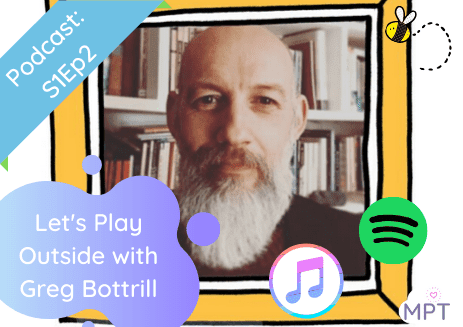
In this inspiring episode of the Outdoor Learning Podcast, Sarah Seaman speaks with early years author, trainer and childhood advocate Greg Bottrill about the magic of play and why children need more opportunities to explore, imagine, create and lead their own learning. New to this area? Start with our Beginners’ guide to outdoor play. 

Greg is widely known for his Can I Go and Play Now? approach, which places children, play and the wonder of childhood at the centre of early years practice. His work encourages educators to move beyond adult-led outcomes and recognise the rich learning already taking place when children are deeply involved in play. (“CAN I GO AND PLAY NOW..?”)

Together, Sarah and Greg explore what meaningful outdoor play can look like, why adults sometimes make play unnecessarily complicated and how practitioners can create spaces where children feel curious, confident and free.

This episode is ideal for early years practitioners, teachers, teaching assistants, childminders, parents, school leaders and anyone who believes that play should remain a central part of childhood.

Explore our Outdoor Play Hub, discover practical support in our Early Years Outdoor Learning Hub and listen to more episodes of Let’s Talk All Things Muddy!

Listen to Let’s Play Outside with Greg Bottrill today.

Who Is Greg Bottrill?

Greg Bottrill is an education author, trainer and advocate for childhood and play.

A former early years leader and assistant headteacher, Greg has written extensively about creating an education system that works with children rather than simply doing things to them. His books include Can I Go and Play Now? and School and the Magic of Children. (creativeeducation.co.uk)

His work focuses on the richness of children’s play and the powerful learning that happens when adults value imagination, curiosity, choice and creativity.

Greg’s approach encourages educators to notice the possibilities already present within play.

Rather than beginning with a tightly controlled adult outcome, practitioners can watch, listen and respond to children’s interests.

This does not mean adults become passive.

Adults still create safe, stimulating environments, model new possibilities, introduce language and skills and know when to join or extend play. The difference is that children remain active participants rather than simply following instructions.

Greg is also known for his Play Projects approach, which has been used to support choice, creativity, collaboration, mathematics, mark-making, invention and independence within early years practice. (sjcs.co.uk)

Why Is Outdoor Play So Important?

Outdoor play gives children experiences that cannot always be recreated indoors.

Outside, children can move more freely, experiment on a larger scale and interact with changing weather, surfaces, sounds and natural materials.

They can run, climb, transport, construct, balance, dig, invent, negotiate and test their ideas.

These experiences support physical development, communication, problem-solving, creativity and social confidence.

Outdoor play also gives children greater freedom to transform their environment.

A stick can become a wand, a fishing rod, a spoon or part of a shelter. A chalk line can become a road, river, boundary or imaginary doorway.

The value does not always lie in the final product.

It lies in the decisions, conversations, ideas and relationships created during the process.

Greg’s philosophy places this imaginative world of children at the centre of meaningful learning. His official approach describes real play as a route into possibility, magic and learning that is genuinely connected to children. (“CAN I GO AND PLAY NOW..?”)

New to learning outside? Begin with our Beginner’s Guide to Outdoor Learning and explore our Free Level 1 Outdoor Learning Course.

Play Does Not Need to Be Complicated

Adults often believe that effective outdoor provision requires expensive equipment, elaborate themed areas or hours of preparation.

Children frequently need far less.

A collection of boxes, rope, chalk, fabric, containers, mud, water and natural loose parts can inspire far more creativity than a highly prescriptive activity.

The key is not simply what is placed outside.

It is whether children are given enough time and freedom to explore it.

When every activity has a fixed result, play can quickly become another adult-directed task.

A child may be told to use a stick to make a particular letter, use leaves to complete a picture or build an adult-designed model.

These activities can still have value, but they are not the same as child-led play.

During genuine play, children decide what an object represents, how the experience develops and when the rules need to change.

The role of the adult is to protect that possibility rather than continually interrupt it.

What Does Child-Led Outdoor Play Look Like?

Child-led outdoor play begins with children’s ideas.

They may begin by moving objects, collecting materials, creating a game or entering an imaginary world.

The activity may change several times.

A den might become a shop, then a veterinary surgery, then a spaceship.

This flexibility is part of the learning.

Children are making decisions, combining ideas, communicating their intentions and responding to one another.

Strong child-led play may include sustained concentration, repeated actions, negotiation, experimentation, storytelling, problem-solving and physical challenge.

It may also appear messy, noisy or difficult for adults to immediately interpret.

That does not mean learning is absent.

Practitioners can observe more carefully and ask what the children are exploring rather than immediately directing them towards a predetermined outcome.

For more support, visit our Child-Led Outdoor Learning Guide and Outdoor Continuous Provision Ideas.

The Adult’s Role in Children’s Play

Adults have an important role in play, but joining in successfully requires sensitivity.

Sometimes children need an adult to model a possibility, introduce vocabulary or help them access a resource.

At other times, adult involvement can interrupt concentration and pull the play back towards an adult agenda.

Before entering the play, pause and observe.

Ask yourself whether the children need support, whether your involvement will deepen the play or whether they are already managing independently.

Adults can support play by providing time, protecting uninterrupted engagement, offering open-ended materials, noticing children’s interests, modelling without taking control and helping children solve problems when necessary.

They can also use simple comments rather than a stream of questions.

Instead of asking, “What are you making?” or “What colour is that?” adults might say, “You have worked hard to move all of those pieces,” or, “I wonder what might happen next.”

This leaves more room for children to decide the direction of the interaction.

Make a start: Outdoor Learning Maths HubOutdoor SEND HubForest School Hub. 

Letting Go of Adultness

One of the ideas connected with Greg Bottrill’s work is the need for adults to reconnect with play and loosen some of their adult expectations.

Adults often want to know what the objective is, what the finished result should look like and how progress will be measured.

Children may be far more interested in the immediate experience.

They are exploring what something can become, how it feels and what happens when they change it.

Letting go of adultness does not mean abandoning responsibility or ignoring the curriculum.

It means recognising that children’s play has its own value and internal logic.

It also means being willing to share joy, imagination and humour with children.

Greg has described play as something deeply connected to who we are, rather than something that simply ends when childhood is over. (Stronger Practice Hubs)

When adults are comfortable with play, they are more able to recognise it, protect it and join it without dominating.

Outdoor Play and the Curriculum

Outdoor play and curriculum learning do not need to compete.

Rich play naturally involves communication, mathematics, physical development, creativity and understanding of the world.

Children count, compare, estimate, measure, negotiate and sequence as part of their ideas.

They develop language while explaining rules, creating stories and resolving disagreements.

They explore scientific concepts when combining materials, investigating movement or observing changes in the natural world.

The curriculum can be present without the adult turning every moment into a formal lesson.

A thoughtful practitioner notices the learning, records meaningful observations and considers what resources or experiences might extend it later.

The Muddy Puddle Teacher® approach also helps schools take specific curriculum areas outside through active, practical activities.

Try a Free Level 1 Outdoor Learning Course.

Play, Joy and the Magic of Childhood

Joy is sometimes treated as an optional extra in education.

However, joy can create connection, motivation and a sense of belonging.

Children are more likely to become deeply involved when an experience feels meaningful to them.

Greg’s work asks practitioners to protect the magic of childhood and create environments where children have genuine opportunities to make choices.

His Can I Go and Play Now? model is presented as an early years approach that uses play and the magic of childhood to place children at the heart of learning. (“CAN I GO AND PLAY NOW..?”)

This does not mean every moment will be easy or harmonious.

Play can include disagreement, frustration, risk and uncertainty.

These moments are also part of learning.

With supportive adults nearby, children can practise persistence, compromise, communication and recovery when ideas do not go to plan.

Outdoor Play for Children with SEND

Outdoor play can offer valuable freedom and sensory experiences for children with SEND, but it should never be assumed that every child will automatically feel comfortable outside.

Some children may enjoy space and movement.

Others may find noise, wind, mud, insects, unfamiliar surfaces or unpredictable play overwhelming.

Inclusive outdoor provision begins with knowing the child.

Adults may need to use visual prompts, introduce the outdoor space gradually, create predictable routines or offer access to a quieter area.

Some children may benefit from repeating a familiar play pattern before exploring something new.

Others may need adults to help them enter shared play, communicate their ideas or manage changes introduced by peers.

The aim is not to force participation.

It is to remove unnecessary barriers and give each child an accessible route into play.

Try a Free Level 1 Outdoor Learning Course.

Try This Tomorrow

Take a small collection of open-ended materials outside.

Use objects such as boxes, fabric, rope, tubes, containers, chalk and safe natural materials.

Place them in an accessible area without demonstrating a finished result.

Tell the children that they can explore, combine and transform the materials in their own way.

Watch what happens before joining in.

Notice which children lead, which children observe, how ideas change and what language or problem-solving emerges.

Time: twenty to thirty minutes.

Preparation: low.

Best for: imagination, communication, collaboration, physical development and child-led learning.

At the end, reflect on what the children showed you rather than judging whether they made a recognisable product.

Questions to Reflect on After Listening

After listening to Greg and Sarah’s conversation, consider how much uninterrupted play children currently receive and how often adults enter play with their own agenda.

Think about whether your outdoor resources have fixed purposes or can be transformed by children.

Notice whether children are encouraged to make choices, solve problems and change direction.

You may also want to explore how staff respond when play becomes messy, noisy or unpredictable.

The aim is not to completely change your provision overnight.

Choose one practical adjustment.

You might protect a longer period of play, remove an unnecessary adult instruction or introduce more open-ended materials.

Small changes can create more space for children’s ideas.

Use This Podcast for Early Years Staff Development

This episode can be used as a starting point for an early years staff meeting or professional development discussion.

Invite staff to listen before the meeting or play a selected section together.

Discuss what meaningful play currently looks like in your setting, when adults join play successfully and when adult involvement may interrupt it.

Teams could also review their outdoor environment and identify areas that are overly adult-directed.

Agree on one change to test over the following week.

This might include extending uninterrupted playtime, offering fewer but more versatile resources or observing children before deciding how to intervene.

Explore our  Emotional Regulation Activities and Sensory Circuit Ideas for further support.

Listen to Let’s Play Outside with Greg Bottrill

This episode is an invitation to place play back at the centre of childhood.

It reminds us that children do not always need adults to create the magic for them.

Often, they need us to provide time, trust, responsive environments and permission to follow their own ideas.

Listen as Sarah and Greg discuss outdoor play, child-led learning and the role adults can play in protecting curiosity, creativity and joy.

Listen to Let’s Play Outside with Greg Bottrill now.

Discover more honest conversations through the Let’s Talk All Things Muddy Outdoor Learning Podcast.

The podcast can also complement formal Outdoor Learning Training, whole-school development and The Muddy Puddle Teacher® online courses.

Frequently Asked Questions

Who is Greg Bottrill?

Greg Bottrill is an education author, trainer and childhood advocate. He is known for Can I Go and Play Now?, his work around Play Projects and his focus on protecting the magic, creativity and richness of children’s play. (sjcs.co.uk)

What is the podcast episode about?

The episode explores outdoor play, child-led learning, adult involvement, imagination and why schools and early years settings should protect children’s opportunities to play.

What are Play Projects?

Play Projects are associated with Greg Bottrill’s approach to early years practice. They encourage children to use choice, imagination, creativity and collaboration while adults support and extend the play sensitively. (sjcs.co.uk)

Is this episode suitable for primary school teachers?

Yes. Although much of Greg’s work focuses on early years, the discussion about play, creativity, choice and child-led learning is also relevant to reception, KS1, school leaders and professionals supporting children across primary education.

Does outdoor play need expensive equipment?

No. Outdoor play can begin with simple open-ended resources, natural materials and the outdoor space already available. The most important ingredients are time, freedom, trust and responsive adults.

Author Box

Written by Sarah Seaman PGCE MA

Founder of The Muddy Puddle Teacher®

Teacher for over 19 years

Bloomsbury author

Trainer of thousands of teachers across the UK

The podcast can also complement formal Outdoor Learning Training, whole-school development and The Muddy Puddle Teacher® online courses.

You need a subscription to download this file. Log in/Upgrade or Take a 60 Day Free Trial. Feel free to Send us a message if you need help.

New in