
a

Training & Resources

muddy puddle teacher logo

The Muddy Puddle Teacher ®

Leading with Outdoor Learning and Outdoor Play

Home 9 All Outdoor Learning Resources 9 Well-being: Mood Leaves
Well-being: Mood Leaves

Well-being: Mood Leaves

Download

Mood Leaves: A Wellbeing Activity for SEND Using Outdoor Learning

Mood Leaves: A Wellbeing Activity for SEND

Looking for a simple outdoor wellbeing activity for SEND? Mood Leaves is a gentle outdoor learning activity that helps children explore feelings, emotions, regulation and communication using leaves and nature.

This activity is ideal for teachers, SENDCos, teaching assistants, nurture staff and pastoral teams who want a calm, low-prep way to support children’s emotional wellbeing outdoors.

Children with SEND may not always have the words to explain how they feel. Some children may find direct questions too much. Others may need a visual, sensory or practical way to show their emotions. Start your 60-day free trial today and begin with one simple Mood Leaves activity this week.

Mood Leaves gives children a simple way to say:

“This is how I feel today.”

They do not have to write.
They do not have to speak in front of everyone.
They do not have to explain everything.

They can choose, show, place, sort, point or talk when they are ready.

New to outdoor learning?  Read our Beginners Guide to Outdoor Learning for SEND to make a start. 


Quick Answer: What Is Mood Leaves?

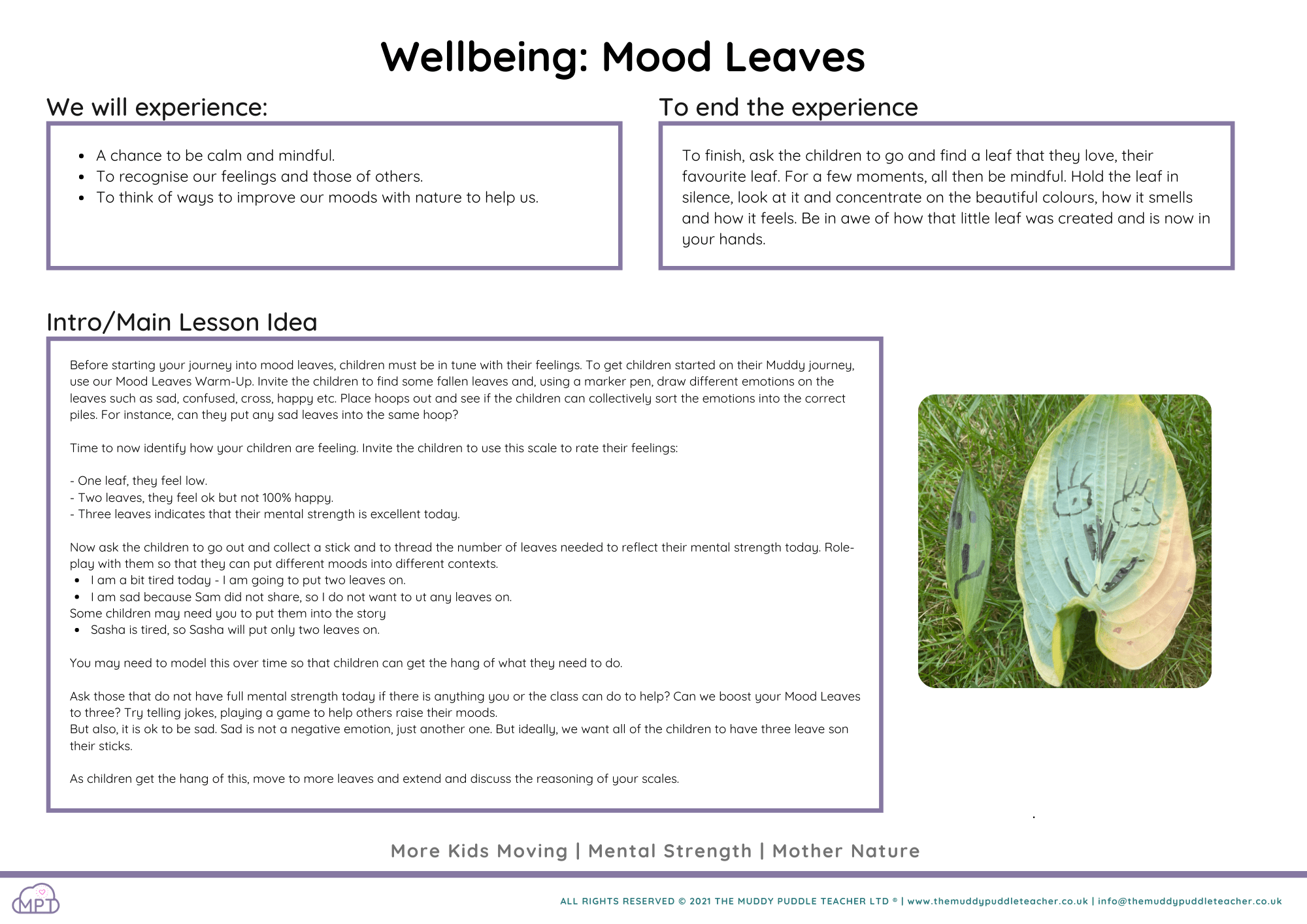
Mood Leaves is an outdoor wellbeing activity where children choose leaves to represent different feelings. They may choose a curled leaf for tired, a spiky leaf for angry, a smooth leaf for calm, a bright leaf for happy or a torn leaf for worried.

Mood Leaves can support:

  • emotional literacy
  • self-regulation
  • communication
  • nurture group work
  • SEND support
  • wellbeing
  • confidence
  • sensory exploration
  • emotional check-ins
  • calm transitions

It is a simple way to help children connect feelings to something they can see and hold.


New to Outdoor Wellbeing Activities for SEND? Start Here

If wellbeing activities feel hard to fit into the school day, start small.

You do not need a full outdoor lesson. You only need:

  • a few leaves
  • a calm outdoor space
  • a trusted adult
  • a short routine
  • a gentle question

Try starting with one child, a small nurture group or a class check-in.

Keep the language simple:

“Choose a leaf that matches how you feel.”

Some children may talk.
Some may point.
Some may choose silently.
Some may need time to watch first.

All of these are valid.

The aim is not to force emotional sharing. The aim is to give children a safe way to notice and express feelings.

If you are looking for complex needs ideas, explore Outdoor Ideas for Wheelchair Users and Non-Speaking Children. 


FREE Non-Verbal Wheelchair Friendly Nature Experience Cards


Try This Tomorrow: Mood Leaf Check-In

If you only try one Mood Leaves activity, start with this. Start your 60-day free trial today and begin with one simple Mood Leaves activity this week.

Mood Leaf Check-In

Time: 5–10 minutes
Prep: Low
Resources: Leaves, tray, hoop or basket
Learning links: PSHE, wellbeing, communication, emotional literacy
SEND focus: Regulation, nurture, self-awareness, non-verbal communication

Take children outside and invite them to find one leaf.

Ask:

“Can you choose a leaf that feels like your mood today?”

Give examples if needed:

  • “This leaf is curled. It might feel tired.”
  • “This leaf is spiky. It might feel cross.”
  • “This leaf is smooth. It might feel calm.”
  • “This leaf is bright. It might feel happy.”

Children place their leaf in a hoop, tray or basket.

They can say:

  • “I feel calm.”
  • “I feel worried.”
  • “I feel tired.”
  • “I don’t know.”
  • “I don’t want to say.”

Or they can simply place the leaf down.

Why this works

Mood Leaves works because it gives children an object to speak through. Some children find it easier to talk about a leaf than talk directly about themselves.

Instead of asking:

“How are you feeling?”

which can feel big and exposing, you are asking:

“What does your leaf show?”

That small shift can make emotional communication feel safer.


Why Mood Leaves Works Well for SEND

Mood Leaves works well for children with SEND because it is visual, sensory, practical and flexible.

It can support children who:

  • struggle to name emotions
  • find direct questions difficult
  • need non-verbal ways to communicate
  • become overwhelmed by big feelings
  • need nurture support
  • have speech and language needs
  • have autism
  • have ADHD
  • have SEMH needs
  • experience anxiety
  • need help with regulation
  • benefit from sensory outdoor learning

The activity is simple, but it opens up important emotional language.

Children can begin to understand:

  • feelings change
  • feelings can be shown in different ways
  • feelings can be talked about safely
  • other children have feelings too
  • adults are there to help, not judge

Mood Leaves Activity 1: The Feelings Leaf Tray

The Feelings Leaf Tray is a simple SEND wellbeing activity where children sort leaves into different feelings.

How It Works

Collect a range of leaves with different shapes, colours and textures.

Place them on a tray.

Add simple feeling labels or picture cards:

  • happy
  • sad
  • angry
  • worried
  • calm
  • tired
  • excited

Ask children to match leaves to feelings.

For example:

  • a bright leaf might be happy
  • a brown leaf might be tired
  • a torn leaf might be worried
  • a spiky leaf might be angry
  • a smooth leaf might be calm

There are no wrong answers. The child’s interpretation matters.

Adult Language

Use gentle prompts:

  • “Which leaf looks calm to you?”
  • “Which leaf feels worried?”
  • “Which one matches your mood today?”
  • “Can a leaf show more than one feeling?”
  • “What might help this leaf feel calmer?”

Why It Supports SEND

The Feelings Leaf Tray supports emotional literacy without relying heavily on writing or speaking.

Children can:

  • point
  • sort
  • match
  • choose
  • move leaves
  • use symbols
  • talk if ready

This makes the activity accessible for children with communication needs, autism, anxiety, SEMH needs or speech and language difficulties.

How to Extend Gently

Once children are comfortable, ask:

“What could help this mood?”

For example:

  • worried leaf → needs a safe adult
  • angry leaf → needs space
  • tired leaf → needs rest
  • sad leaf → needs kindness
  • excited leaf → needs movement
  • calm leaf → needs quiet

This helps children link feelings to regulation strategies. Gain more inspiration in our Outdoor Send Ideas and Activities Hub. 


Mood Leaves Activity 2: My Mood Leaf Journey

My Mood Leaf Journey helps children understand that feelings can change during the day.

This is especially useful for children who feel stuck in one emotion or struggle to recover after dysregulation.

How It Works

Ask the child to choose a leaf at the start of the session.

This is their starting mood leaf.

After a short outdoor activity, such as a walk, breathing activity or plant care job, ask them to choose another leaf.

This is their after mood leaf.

Place the two leaves side by side.

Ask:

  • “Are they the same or different?”
  • “Did your mood change?”
  • “What helped?”
  • “What does your body need next?”

The child can answer with words, pointing, gestures or symbols.

Example

A child chooses a torn leaf at the start.

They say, or show, that it feels worried.

After a short sensory walk, they choose a smoother leaf.

The adult might say:

“At the start, your leaf felt worried.
Now your leaf feels a little calmer.
The walk helped your body.”

Why It Supports SEND

This activity helps children notice that feelings move and change.

For children who struggle with emotional regulation, this is important.

It gently teaches:

  • feelings do not last forever
  • something can help
  • my body can feel different after regulation
  • adults can help me notice what works
  • I can learn what helps me

This is a simple way to build self-awareness and emotional resilience.


How to Use Mood Leaves as a SEND Intervention

Mood Leaves can be used as:

  • a nurture group activity
  • a morning check-in
  • a regulation activity
  • a PSHE lesson
  • a pastoral support tool
  • a transition activity
  • an SEMH intervention
  • a calm-down strategy
  • an outdoor wellbeing activity

For best results, keep it short and repeat it regularly.

A simple weekly structure could be:

  1. Go outside calmly.
  2. Choose a mood leaf.
  3. Place it in the tray.
  4. Name or show the feeling.
  5. Try one regulation activity.
  6. Choose a second leaf.
  7. Notice any change.

This routine helps children feel safe because they know what to expect.


Making Mood Leaves Inclusive

Do Not Force Talking

Some children may not want to explain their leaf. That is okay.

You can say:

“You don’t have to tell me. You can just show me.”

Accept All Interpretations

A green leaf might feel happy to one child and worried to another. Let the child lead.

Offer Visual Supports

Use feeling cards, symbols or colour prompts if needed.

Keep Groups Small

For children with SEND, small groups or one-to-one sessions may feel safer.

Use the Same Routine

Repetition helps children build confidence.

Avoid Correcting Feelings

Do not say:

“No, that leaf looks happy, not angry.”

Instead say:

“You think this leaf feels angry. Tell me more, or show me.”

Gain more inspiration in our Outdoor Send Ideas and Activities Hub. 


What Resources Do You Need?

You only need simple resources:

  • leaves
  • tray or basket
  • hoops
  • feelings cards
  • visual symbols
  • clipboard
  • camera or tablet
  • outdoor space
  • calm adult support

You can also use petals, sticks, stones or seed pods if leaves are not available.


Want Ready-to-Teach Outdoor Learning and SEND Resources?

The Muddy Puddle Teacher Club helps busy teachers save planning time with ready-to-use outdoor learning resources, SEND ideas and wellbeing activities.

Inside the club, you can find support for:

  • outdoor learning for SEND
  • outdoor wellbeing activities
  • regulation routines
  • nurture group ideas
  • sensory outdoor learning
  • EYFS outdoor provision
  • KS1 and KS2 outdoor learning
  • practical curriculum-linked activities
  • simple ideas you can use straight away

You can take a 60-day free trial and start today.

This is ideal if you want outdoor learning to feel simple, purposeful and inclusive without spending hours planning from scratch.

Looking for specific packs for specific needs?  Try this Outdoor Speech and Language Ideas pack. 

Outdoor Speech & Language Handbook


FAQs About Mood Leaves Wellbeing Activity for SEND

What is Mood Leaves?

Mood Leaves is an outdoor wellbeing activity where children choose leaves to represent feelings or moods. It helps children explore emotions in a visual, sensory and gentle way. Start your 60-day free trial today and begin with one simple Mood Leaves activity this week.

How does Mood Leaves support SEND?

Mood Leaves supports SEND by giving children a non-verbal and practical way to communicate feelings. It can help with emotional literacy, regulation, confidence, communication and nurture.

What age is Mood Leaves suitable for?

Mood Leaves can be adapted for EYFS, KS1, KS2 and SEND settings. Younger children may simply choose and name a feeling, while older children can reflect on how feelings change.

Can Mood Leaves help with emotional regulation?

Yes, Mood Leaves can support emotional regulation by helping children notice how they feel, connect emotions to objects and reflect on what helps their mood change.

Do children have to speak during Mood Leaves?

No. Children can point, choose, place, sort or show their mood leaf without speaking. This makes the activity useful for children with speech and language needs, anxiety or autism.

What resources do I need for Mood Leaves?

You need leaves, a tray or basket, and optional feelings cards or symbols. You can also use hoops, clipboards, photos or natural objects.

Can Mood Leaves be used in nurture groups?

Yes, Mood Leaves works very well in nurture groups because it supports emotional check-ins, communication, regulation and safe connection with adults and peers.

How often should I use Mood Leaves?

Little and often works best. You could use Mood Leaves as a weekly wellbeing activity, a morning check-in or a short regulation routine after playtime or transition.


Ready for More Outdoor Wellbeing and SEND Ideas?

If you want SEND wellbeing activities to feel calmer, more practical and more inclusive, join The Muddy Puddle Teacher Club.

You will find ready-to-use outdoor learning ideas, wellbeing resources, SEND-friendly activities and curriculum-linked planning to help children learn through movement, nature, talk and play.

Start your 60-day free trial today and begin with one simple Mood Leaves activity this week. Gain more inspiration in our Outdoor Send Ideas and Activities Hub. 

You need a subscription to download this file. Log in/Upgrade or Take a 60 Day Free Trial. Feel free to Send us a message if you need help.

New in