
Looking for simple Rainforests KS2 activities that help children explore rainforest layers, habitats, animals, plants, climate, geography, deforestation and sustainability? A rainforest topic is a brilliant way to bring outdoor learning into KS2 because children can use their own school grounds to investigate biodiversity, shelter, temperature, plant growth, mapping, classification, food chains and environmental responsibility. New to outdoor learning? Explore the Begginers Guide to Outdoor Learning.
You do not need a rainforest in your playground to teach rainforests outdoors. Children can compare their local outdoor space with a rainforest, look closely at plants and habitats, create rainforest layers using natural materials, build shelter structures, investigate shade and temperature, map an imaginary rainforest trail and think about how humans impact the natural world. Download this outdoor maths resource and thousands more – take a 60-day free trial.
At The Muddy Puddle Teacher®, we believe outdoor learning should make big topics feel real. Rainforests can feel far away for children, but by stepping outside, they can begin to understand living things, ecosystems, climate and conservation in a practical, meaningful way.
New to Teaching Rainforests Outdoors? Start Here
If teaching Rainforests KS2 feels like a big topic, start with comparison.
Take children outside and ask them to observe your school grounds. What plants can they see, what animals might live there, where is it shady, where is it damp, where is it warm, where are the tallest plants, where are the smallest living things?
Then compare this with a rainforest. Rainforests are warm, wet, full of plant life and home to a huge number of animals and insects. They have layers, including the forest floor, understory, canopy and emergent layer.
Children can begin by asking, how is our outdoor space like a rainforest, how is it different, what would need to change for rainforest plants and animals to live here?
This makes the topic more concrete and gives children a real place to begin. For more outdor georgraphy ideas try our Outdoor Ideas for Ocean and Seas.
Seas & Oceans Outdoor Learning Pack
Try This Tomorrow
Rainforest Layers Outdoors
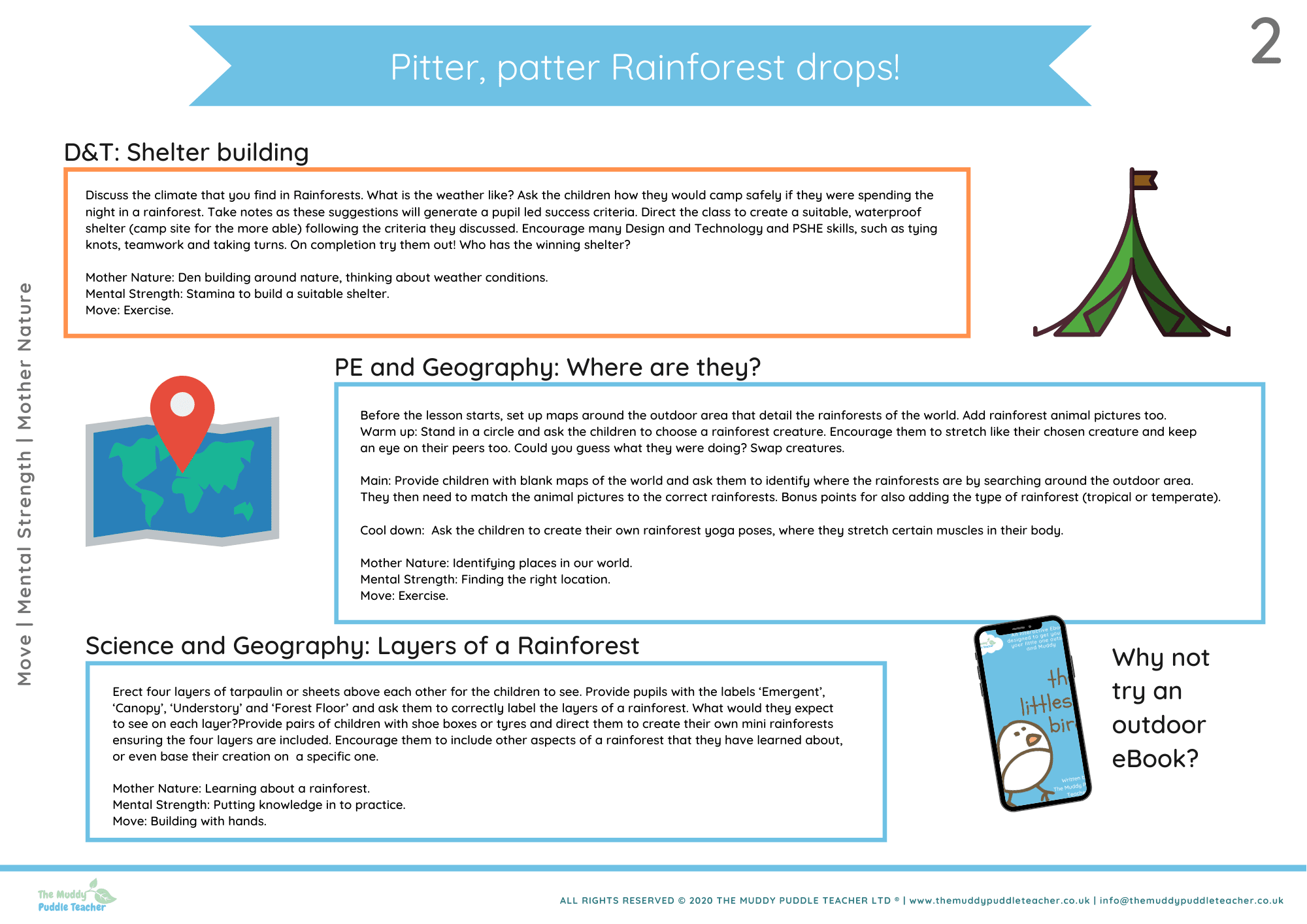
Take children outside and ask them to create the layers of the rainforest using natural objects, chalk, ropes, cones, sticks, leaves, crates or labels.
They can mark out four areas or build upwards using different heights to represent the forest floor, understory, canopy and emergent layer. Children can then place animal or plant cards in the layer where they might live.
Time: 25–35 minutes
Prep: Low
Resources: Chalk, labels, cones, sticks, leaves, rope, animal cards or clipboards
Learning: Rainforest layers, habitats, classification, geography vocabulary, teamwork and explanation
As children work, ask, which layer gets the most light, which layer might be darkest, where would a jaguar live, where might a monkey move, why do some plants grow tall, what might live on the forest floor?
This gives children a practical way to understand a topic that can otherwise feel abstract.
Why Rainforests Work Well Outdoors
Rainforests work well outdoors because the topic is about living things, habitats, climate, plants, animals and the relationship between people and nature. These ideas become easier for children to understand when they can observe nature directly.
Outdoor learning allows children to investigate shade, temperature, damp areas, plant growth, minibeast habitats, food chains, classification, shelter and biodiversity. These are not exactly the same as rainforest conditions, but they help children build the concepts they need.
A rainforest topic can link to geography, science, English, maths, art, DT, PSHE, computing and climate education. Children can map rainforest routes, classify animals, write persuasive speeches, create rainforest soundscapes, investigate microhabitats and debate deforestation.
The outdoors helps children move from “learning about rainforests” to thinking like geographers, scientists and environmental problem-solvers. Download this outdoor maths resource and thousands more – take a 60-day free trial.
KS2 Rainforest Layers Activities
The layers of the rainforest are a key part of this topic.
Children can create outdoor rainforest layer diagrams using chalk, ropes, hoops, sticks, cones or natural materials. They can label each layer and add key features, such as low light on the forest floor, small trees in the understory, dense branches in the canopy and the tallest trees in the emergent layer.
They can also use their bodies to show the layers. Some children crouch as the forest floor, some stand as the understory, some stretch arms wide as the canopy and some reach high as emergent trees.
Ask children to explain which animals might live in each layer and why. This helps them connect structure, habitat and adaptation.
KS2 Rainforest Animals and Habitats
Rainforests are full of fascinating animals, which makes the topic highly engaging.
Children can learn about animals such as jaguars, sloths, toucans, macaws, poison dart frogs, monkeys, tree frogs, snakes, butterflies, ants and beetles.
Outdoors, children can create habitat zones and decide where each animal might live. They can think about shelter, food, camouflage, movement and safety.
You might ask, why might a sloth live in the canopy, why might a frog need damp places, how does camouflage help an animal, what would a predator need, what would happen if part of the habitat disappeared?
This supports science, geography and environmental understanding.
Rainforest Food Chains Outdoors
Food chains can be taught very effectively outdoors.
Children can use natural objects, chalk arrows or labels to create rainforest food chains. For example, they might show leaves being eaten by insects, insects being eaten by frogs, frogs being eaten by snakes, and snakes being eaten by larger predators.
You can also compare rainforest food chains with local outdoor food chains. Children might look at grass, insects, birds and foxes, then compare these with rainforest examples.
This helps children understand producers, consumers, predators, prey and interdependence.
Ask, what happens if one part of the food chain disappears, why do plants matter, how are animals connected, how might deforestation affect the food chain?
Rainforest Climate and Weather Activities
Rainforests are known for being warm and wet, so children can investigate climate by comparing outdoor conditions.
Children can measure temperature in different parts of the school grounds, compare shady and sunny areas, observe damp and dry surfaces, collect rainfall data or investigate evaporation.
They might ask, where is the warmest part of our outdoor area, where is the coolest, where does water stay longest, how does shade change temperature, why do rainforest plants need so much water?
This helps children understand that climate affects plants, animals and habitats.
You can then compare your local climate with a tropical rainforest climate and discuss how this shapes life in each place.
Rainforest Plants and Adaptations
Rainforest plants are a fascinating way to explore adaptation.
Children can learn about tall trees, large leaves, climbing plants, vines, drip-tip leaves and plants that compete for light. Outdoors, they can observe local plants and compare leaf size, shape, texture and position.
They might investigate which leaves shed water quickly, which plants grow in shade, which leaves are largest or how plants reach towards light.
Ask children, why might rainforest leaves need to let water run off, why do plants grow tall, how do plants compete for sunlight, what would happen if the forest became too dry?
This makes adaptation more practical and easier to understand.
Rainforest Mapping and Geography
Rainforests offer brilliant opportunities for KS2 geography.
Children can locate tropical rainforests on a world map, explore the equator, compare continents and discuss countries where rainforests are found. Outdoors, they can create large-scale maps using chalk, ropes, cones and natural materials.
They might create a rainforest trail with rivers, forest layers, animal habitats, villages, logging areas and protected zones.
Children can use geographical vocabulary such as equator, tropical, climate, continent, country, habitat, river, forest, canopy, vegetation, biodiversity and conservation.
Outdoor mapping helps children physically move through the geography rather than only seeing it on a page.
Deforestation and Sustainability Outdoors
A rainforest topic often leads into deforestation and sustainability.
This can be explored carefully and age-appropriately in KS2. Children can use part of the outdoor area to model what happens when trees are removed. They might discuss how animals lose habitats, soil becomes exposed, food chains are disrupted and local communities are affected.
You could ask children to create two outdoor scenes, one healthy rainforest and one damaged rainforest. Then they can compare what has changed.
Questions might include, who depends on the rainforest, what happens when trees are cut down, why do people use rainforest land, how can we make better choices, what does sustainable mean?
This supports environmental awareness and thoughtful discussion.
Rainforest Writing Outdoors
Rainforests are a rich stimulus for writing.
Children can write setting descriptions, animal fact files, persuasive speeches, diary entries, adventure stories, poems, explanation texts, balanced arguments or campaign posters.
Outdoor learning gives them sensory vocabulary before they write. Even though they are not in a rainforest, children can use the outdoors to gather words linked to leaves, shadows, damp ground, tangled branches, sounds, movement and atmosphere.
They might write a rainforest opening using words such as humid, tangled, dripping, shadowy, bright, rustling, towering, hidden, alive and echoing.
This helps writing feel more vivid and less worksheet-based.
Rainforest Art and DT Outdoors
Rainforests can inspire wonderful art and design work.
Children can create rainforest murals using chalk, natural dyes, leaves and textured materials. They can make leaf prints, animal masks, canopy collages, clay rainforest animals, natural mandalas or 3D rainforest models.
For DT, children might build rainforest shelters, design animal habitats, create a water-carrying system, make a canopy bridge or build a model of a sustainable rainforest village.
Using outdoor materials helps children think creatively and sustainably.
Rainforest Soundscapes and Music
Rainforests are full of sound, which makes them perfect for music and performance.
Children can listen to outdoor sounds first, such as birds, wind, leaves, footsteps, rain or distant voices. Then they can create a rainforest soundscape using body percussion, voices, instruments or natural sounds.
They might create sounds for rain, insects, birds, monkeys, frogs, wind, rivers and leaves.
This can link to poetry, drama, music and speaking and listening.
Children can perform their soundscape before writing a rainforest poem or setting description.
Rainforests KS2 and SEND Outdoor Learning
Rainforest activities can support children with SEND because they are practical, sensory and visual.
Children can access the topic through building, sorting, matching, mapping, moving, listening, drawing, touching natural materials and working with a partner.
Some children may find rainforest vocabulary challenging, so use visuals, repeated words and real objects where possible. Words such as canopy, habitat, climate, tropical, damp, shade, layer and forest floor can be introduced through actions and outdoor examples.
Children can show understanding by placing animal cards, building layers, pointing to habitats, creating sound effects, sorting leaves or explaining verbally.
Outdoor learning helps make the topic more concrete and inclusive.
Rainforests KS2 for Greater Challenge
For children who are ready for greater challenge, encourage deeper thinking and debate.
They might compare two rainforest regions, investigate the impact of deforestation, debate land use, explore indigenous communities respectfully, research conservation projects or design a sustainable solution to a rainforest problem.
They could create a persuasive speech, a balanced argument or a campaign explaining why rainforests matter.
Ask questions such as, why are rainforests important globally, who benefits from deforestation, who is harmed, how can people use resources responsibly, what choices can consumers make, how can we protect biodiversity?
This helps children think critically about environmental issues.
Want Ready-to-Use Rainforests KS2 Resources?
The Muddy Puddle Teacher® helps busy teachers save planning time with simple, curriculum-linked outdoor learning resources.
Inside The Muddy Puddle Teacher® membership, you will find ready-to-use KS2 outdoor learning activities, rainforest topic ideas, geography resources, science investigations, writing prompts, SEND support, forest school links, climate education ideas and simple planning to help you take learning outside.
Our resources are designed to help you use your school grounds, reduce planning stress and make big topics like rainforests feel practical, meaningful and manageable.
Ready for More KS2 Outdoor Learning Ideas?
If you enjoyed these Rainforests KS2 outdoor learning activities, you can access hundreds more outdoor learning resources inside The Muddy Puddle Teacher®.
Start today with a 60-day free trial and explore outdoor learning resources for KS2, KS1, EYFS, SEND, forest school, outdoor play, geography, science, literacy, climate education and curriculum-linked teaching.
Download this outdoor maths resource and thousands more – take a 60-day free trial.
Start with one rainforest layer activity, one outdoor habitat comparison or one deforestation discussion, then build from there.
Outdoor learning does not have to be complicated. Sometimes, it just needs children to step outside, notice nature and begin asking bigger questions about the world.
Rainforests KS2 FAQs
How can I teach Rainforests KS2 outdoors?
You can teach Rainforests KS2 outdoors by creating rainforest layers, mapping habitats, comparing local plants with rainforest plants, investigating shade and temperature, building food chains and exploring deforestation through practical activities.
What are good Rainforests KS2 activities?
Good Rainforests KS2 activities include rainforest layer models, animal habitat sorting, food chain trails, climate investigations, plant adaptation studies, rainforest mapping, soundscapes, persuasive writing and sustainability debates.
How do rainforests link to KS2 geography?
Rainforests link to KS2 geography through continents, countries, the equator, climate zones, biomes, vegetation, rivers, land use, sustainability, biodiversity and human impact.
How do rainforests link to KS2 science?
Rainforests link to KS2 science through habitats, classification, food chains, adaptation, plant growth, biodiversity, climate, living things and environmental change.
Can rainforest activities support outdoor writing?
Yes. Rainforest outdoor learning can support writing by giving children sensory vocabulary, setting ideas, animal details, environmental issues and real outdoor experiences to inspire descriptions, poems, reports and persuasive texts.
Can Rainforests KS2 support SEND learners?
Yes. Rainforest activities can support SEND learners because they are practical, visual and sensory. Children can learn through sorting, building, mapping, listening, moving, matching and using natural materials.
Do I need a woodland area to teach rainforests outdoors?
No. You can teach rainforest ideas using a playground, field, garden, trees, shrubs, potted plants, chalk, cones, natural objects, labels, cards and your school grounds.