
a

Training & Resources

muddy puddle teacher logo

The Muddy Puddle Teacher ®

Leading with Outdoor Learning and Outdoor Play

Home 9 Outdoor Learning Resources 9 KS1 Outdoor Learning 9 Adding Money 20p, 50p and £1 Outdoor Maths Activities
making money

Adding Money 20p, 50p and £1 Outdoor Maths Activities

Download

Looking for adding money 20p, 50p and £1 activities for KS1 or lower KS2? Money can be a tricky maths concept for children because coins do not behave like ordinary counting objects. A 50p coin is one coin, but it is worth much more than a 20p coin, and a £1 coin is one coin but worth 100 pennies. Taking money learning outdoors and using a playful pizza shop theme helps children practise adding coins in a practical, meaningful and memorable way. New to taking the curriculum outdoors? Discover The Beginner’s Guide to Outdoor Learning.

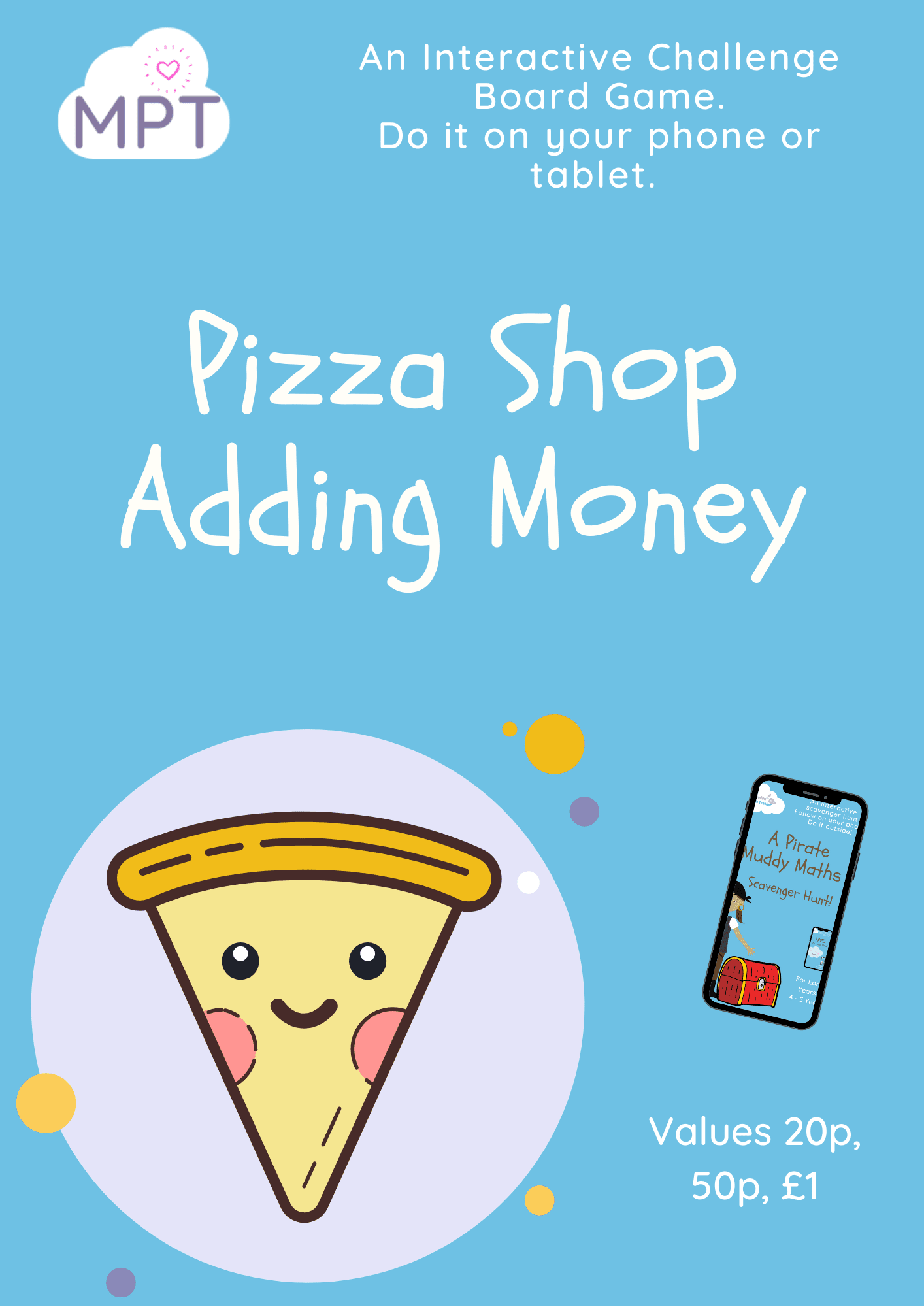
Our Pizza Shop Adding Money 20p, 50p and £1 eBook is designed to help children explore money through outdoor role play, pretend shopping, ordering, pricing, adding totals and solving real-life maths problems. It is ideal for KS1, lower KS2, intervention groups and children who need more hands-on practice with coin values. Take a 60-day free trial and download now. 

New to outdoor maths? Start here

If teaching money feels difficult, start with real or pretend coins and a clear purpose. Children often understand money better when they can see why they are adding it. A pizza shop gives them a familiar reason to read prices, choose items, add coins and pay for an order.

You do not need a full outdoor role-play area. A mud kitchen, bench, tray, crate, tuff tray, playground table or small outdoor corner can become a pizza shop. Add simple pizza bases, natural loose parts for toppings, chalk price labels and coins or coin cards showing 20p, 50p and £1.

Keep the first session simple. Let children handle the coins, compare their values and practise making totals before moving into more challenging addition. Some children will need lots of time to understand that 20p, 50p and £1 have different values even though each is still one coin.

Try this tomorrow, Outdoor Pizza Shop Orders

Set up a simple outdoor pizza shop using paper plates, cardboard circles, chalk circles, stones, bark slices or leaves as pizza bases. Children can decorate the pizzas with natural toppings such as petals, small stones, leaves, sticks, grass, cones or seed pods.

Give each pizza a price using 20p, 50p and £1 amounts. A small pizza might cost 20p, a special topping might cost 50p and a large pizza might cost £1. Children take turns being the customer and the shopkeeper. The customer chooses a pizza, adds any toppings, works out the total and pays using coin cards or pretend money.

This activity supports adding money, coin recognition, counting in 20s and 50s, understanding £1, role play, speaking and listening, turn-taking and practical problem-solving. It is a lovely way to make money feel purposeful rather than abstract.

Free idea, Topping Total Challenge

Give children a pizza base and tell them that each topping has a different price. Leaves might cost 20p, stones might cost 50p and a special flower topping might cost £1. Children build their pizza, then add the total cost.

A child might choose two leaves and one stone, then work out 20p plus 20p plus 50p. Another child might choose one £1 topping and one 20p topping, then work out £1.20.

Encourage children to place a coin card beside each topping before adding. This helps them see the value of each item and supports children who need a visual step before calculating mentally.

This outdoor maths activity supports money addition, counting on, number sense, place value, problem-solving and mathematical talk. It can be made easier by using only 20p and 50p, or made harder by adding several toppings and asking children to compare totals.

Free idea, Pizza Delivery Money Trail

Create a short pizza delivery trail around the outdoor space. Place order cards in different areas, such as on the fence, near a tree, beside the mud kitchen, under a cone or on a bench. Each order should show a pizza price using 20p, 50p and £1.

Children move around the trail in pairs, find an order and work out the total amount needed. They can collect the correct coins, write the total in chalk, say the amount to a partner or bring the correct payment back to the pizza shop.

For example, an order might say one cheese pizza for £1 and one topping for 50p, so children need to make £1.50. Another order might say two toppings at 20p each and one drink at 50p, so children need to calculate 90p.

This activity adds movement, retrieval practice and teamwork to money learning. It is especially useful for children who need repeated practice but find worksheets tiring or confusing.

Why teach adding money outdoors?

Teaching adding money outdoors helps children see that maths is useful in real life. Money is not just a set of coin pictures on a worksheet. It is something we use to buy, sell, compare, choose and solve problems.

Outdoor money activities give children a chance to physically handle coins, move between roles, talk through totals and repeat the skill in a playful way. This is particularly helpful when children are learning coins such as 20p, 50p and £1 because the values can be confusing at first.

The pizza shop theme gives the maths a purpose. Children are not just adding random amounts, they are working out the cost of an order, checking payment and solving a problem within play.

Adding 20p, 50p and £1 in KS1

In KS1, children need lots of practical experience with coin values. They need to understand that different coins have different values, that coins can be combined to make totals and that there are different ways to make the same amount.

Adding 20p, 50p and £1 helps children practise counting in 20s, counting in 50s, bridging to £1, comparing amounts and beginning to understand pounds and pence together.

Outdoor role play supports this because children can keep returning to the same concept in different ways. They might buy one pizza, add toppings, compare prices, check change informally or decide which order costs more.

Adding money for lower KS2

For lower KS2 children, this resource can support money consolidation, especially for children who still need practical experience. Children can work with totals over £1, compare orders, solve multi-step problems and explain how they worked out the answer.

They might calculate the cost of three pizzas, work out whether £2 is enough, compare two orders, find the difference between prices or design their own menu using 20p, 50p and £1 amounts.

Outdoor learning can be particularly helpful for children who feel embarrassed about needing more support with money. The role-play context makes the practice feel purposeful and less like a catch-up worksheet.

Take a 60-day free trial and download now. 

Pizza shop role play and mathematical language

A pizza shop is a brilliant way to build mathematical language. Children can use words and phrases such as price, cost, total, altogether, more, less, cheaper, more expensive, pounds, pence, pay, order, change, enough, not enough and how much.

This language matters because children need to understand the words around money as well as the calculations. When they act as shopkeeper and customer, they have a real reason to say, “That costs £1.50,” “I need 20p more,” “This one is cheaper,” or “You have enough money.”

For children with speech and language needs, repeated role-play phrases can make money vocabulary much easier to use.

Adding money and SEND support

Outdoor money activities can be very supportive for children with SEND because they are practical, visual and flexible. Children can take part by choosing toppings, matching coins, counting amounts, moving around the trail, pointing to prices, role-playing, using coin cards or working with a trusted adult.

For children with dyscalculia, coin values often need to be taught through repeated concrete experiences. Placing a 20p, 50p or £1 coin beside an item can help children link the coin to its value. For children with ADHD, movement and role play can support attention and motivation. For children with anxiety, working in pairs or having a clear shopkeeper role can make the activity feel safer.

The key is to keep the first prices simple, use clear visuals and allow children to count with support before expecting mental fluency.

Want ready-to-use adding money resources?

Inside The Muddy Puddle Teacher Club, we help busy teachers save planning time with ready-to-use outdoor maths activities, KS1 resources, lower KS2 support, SEND-friendly ideas and practical learning resources.

The Pizza Shop Adding Money 20p, 50p and £1 eBook is designed to help children practise money skills through playful outdoor learning, without adding extra workload for teachers.

Take a 60-day free trial and download now. 

FAQs

How do you teach adding money with 20p, 50p and £1?

You can teach adding money with 20p, 50p and £1 by using practical role play, coin cards, real coins, simple prices and buying activities. Children need time to compare coin values, count totals and understand that one coin can have a different value from another coin.

Why is money difficult for children?

Money can be difficult because coins do not match simple counting. One coin can be worth 1p, 20p, 50p or £1, so children need to understand value rather than just count the number of coins.

How can I teach money outdoors?

You can teach money outdoors through role-play shops, pizza menus, delivery trails, chalk prices, coin hunts, outdoor cafes, mud kitchen shops and practical buying and selling games.

What age is adding 20p, 50p and £1 suitable for?

Adding 20p, 50p and £1 is most suitable for KS1 children who are learning money and lower KS2 children who need consolidation. It can also be used for intervention groups and children who benefit from practical maths.

Why use a pizza shop theme for adding money?

A pizza shop theme gives children a clear and familiar reason to use money. They can choose pizzas, add toppings, read prices, pay for orders, compare totals and practise social language while learning maths.

Can adding money activities support SEND?

Yes, adding money activities can support SEND when they are practical, visual and flexible. Children can match coins to toppings, use coin cards, count with adult support, move around a trail, role-play or work with a partner.

What resources do I need for Pizza Shop Adding Money 20p, 50p and £1?

You can use simple resources such as 20p, 50p and £1 coins or coin cards, chalk, paper plates, cardboard circles, leaves, stones, sticks, petals, trays, baskets, price labels, clipboards or a mud kitchen area.

Ready for more adding money activities?

Get the Pizza Shop Adding Money 20p, 50p and £1 eBook, outdoor maths ideas, KS1 money activities, lower KS2 support and SEND-friendly resources inside The Muddy Puddle Teacher Club. Start your 60-day free trial today and make money learning practical, playful and memorable.

You need a subscription to download this file. Log in/Upgrade or Take a 60 Day Free Trial. Feel free to Send us a message if you need help.

New in