Pizza Shop Adding Money 1p, 2p, 5p and 10p EBook Outdoor Maths Activities
Looking for a simple Pizza Shop Adding Money 1p, 2p, 5p and 10p activity to help children practise early money skills? A pizza shop theme is a fun and practical way to help children recognise coins, count small amounts, add prices together and understand that money has real value. New to this area of teaching? Explore – What is outdoor learning?
Money can feel tricky when it is only taught on a worksheet. A pizza shop makes the learning playful because children can choose toppings, build pizzas, read prices, pay with coins, add totals and take turns being the customer or shopkeeper. Like this resource? Download this resource and more take a 60-day free trial.
At The Muddy Puddle Teacher®, we believe maths should be practical, active and meaningful. You do not need lots of expensive resources. Pretend coins, chalk, cardboard pizza bases, paper plates, leaves, stones, petals, sticks, bottle tops, trays and a simple outdoor counter are enough to create a brilliant pizza shop money activity. For more outdoor learning ideas head to the Outdoor Leaning Hub.
New to Teaching Money Outdoors? Start Here
If children are new to money, begin with coin recognition.
Let children handle 1p, 2p, 5p and 10p coins first. Talk about their colour, size, shape and value. Children need time to notice that coins can look different and be worth different amounts.
Then give the coins a purpose. Set up a small pizza shop outside and add simple prices. A pizza base might cost 5p, cheese might cost 2p, tomato might cost 1p and a special topping might cost 10p.
Children can begin by matching the correct coin to one item, then move on to adding two items together.
Outdoor role play helps children learn money because they are using coins for a reason. They are buying pizza, choosing toppings and solving real little maths problems as they play.
Try This Tomorrow
Outdoor Pizza Shop
Set up a pretend pizza shop outside using trays, crates, chalk menus, paper plates and natural loose parts. Children can make pizzas using leaves for basil, stones for olives, petals for peppers, sticks for crusts, mud kitchen ingredients or recycled craft materials.
Add simple prices using 1p, 2p, 5p and 10p coins.
Time: 20–30 minutes
Prep: Low
Resources: Pretend or real coins, paper plates, trays, chalk, natural loose parts, menu cards and a simple counter
Learning: Coin recognition, adding money, counting, making totals, role play, communication and problem-solving
As children play, adults can ask, how much does the pizza cost, which coin do you need, how much are the pizza and topping altogether, can you make 10p another way, which pizza is cheaper, which pizza costs more?
This gives children a quick, purposeful money activity and helps maths feel fun, practical and memorable.
Find more outdoor ideas:
Why Pizza Shop Money Activities Work Well
Pizza shop money activities work well because children understand the idea of ordering food. The context feels familiar, playful and easy to join in with.
Children can be the chef, customer, cashier, waiter or delivery driver. Each role gives them a reason to use mathematical language. They might ask for a price, count coins, add toppings, compare totals or check if the customer has paid enough.
Using 1p, 2p, 5p and 10p keeps the learning focused. Children can practise recognising coins, counting in ones, twos, fives and tens, making small totals and beginning to add prices together.
The pizza shop also gives lots of opportunities for speaking, listening, turn-taking and imaginative play.
Coin Recognition with 1p, 2p, 5p and 10p
Before children start adding money, they need to feel confident with the coins.
Children can sort coins into bowls, match coins to price labels, make coin rubbings, place coins on a chalk money line or compare which coin is worth more.
They might notice that 1p and 2p coins are copper coloured, 5p and 10p coins are silver coloured, 2p is worth more than 1p and 10p is worth more than 5p.
Adults can model useful vocabulary such as coin, pence, price, cost, pay, total, altogether, more, less, cheaper, dearer, value and change.
The more children handle the coins, the more confident they become.
Adding Pizza Prices
Once children can recognise the coins, they can begin adding prices together.
A pizza base might cost 5p and cheese might cost 2p, so altogether that pizza costs 7p. Tomato might cost 1p and olives might cost 5p, so together they cost 6p. A drink might cost 10p and a topping might cost 2p, so altogether that is 12p.
Children can build the total using real or pretend coins before saying or recording the answer.
You might ask, how much is it altogether, can you count on from 5p, what is 2p more, which coins will you use, can you make the same amount in another way?
This helps children see money as addition in a real context.
Making Amounts in Different Ways
A pizza shop is also a brilliant way to show that the same amount can be made in different ways.
Children can make 5p using one 5p coin, five 1p coins, a 2p, a 2p and a 1p, or a 2p coin with three 1p coins.
They can make 10p using one 10p coin, two 5p coins, five 2p coins, ten 1p coins or a mixture of coins.
This is powerful because children begin to understand value. They see that more coins does not always mean more money.
You might ask, which uses fewer coins, which uses more coins, are they the same amount, can you make 10p using only 2p coins, can you make 8p using 5p, 2p and 1p?
Pizza Shop Menus for Outdoor Maths
A simple menu helps children use money with purpose.
Your pizza shop menu might include pizza base 5p, cheese 2p, tomato 1p, olives 5p, peppers 2p, mushroom 1p, drink 10p, delivery 5p and special pizza 10p.
Children can read the menu, choose what they want and add the prices together.
They can also create their own menus on cardboard, chalkboards or paper. This supports number writing, mark-making, spelling, communication and ownership of the role play.
Keep prices small at first, then increase the challenge when children are ready.
Outdoor Pizza Shop for EYFS
For EYFS and Reception children, keep the learning playful and concrete.
Children can match one coin to one price, count out pennies, sort 1p, 2p, 5p and 10p coins, make pizzas with natural materials and practise simple buying and selling language.
They might start with items that cost exactly one coin, such as tomato 1p, cheese 2p, chips 5p or pizza 10p.
The focus should be on handling coins, matching, counting, talking and role play. Children do not need lots of written recording. The maths is happening through the play.
For more outdoor learning ideas head to the Outdoor Leaning Hub.
Outdoor Pizza Shop for KS1
For KS1 children, you can add more challenge by asking them to add two or three prices together.
They might work out the cost of a pizza base with two toppings, a pizza and a drink, or two pizzas for a friend. They can compare which pizza is cheaper, which customer spent the most or how to make a total in different ways.
You might ask, how much is a 5p base and 2p cheese, how much are two 10p pizzas, can you make 12p using 10p and 2p, can you make 9p using 5p, 2p and 1p coins?
This supports addition, counting on, reasoning and early problem-solving. Like this resource? Download this resource and more take a 60-day free trial.
Pizza Shop Role Play and Language
The pizza shop gives children a lovely reason to speak, listen and take turns.
Children can use phrases such as, what would you like, that costs 5p, can I have cheese please, here is 10p, your total is 7p, I need 2p more, this pizza is cheaper, this one costs more.
This role play supports communication and language alongside maths.
For children who need more support, adults can model short phrases and use visual menus or coin cards. Children can participate by pointing, choosing, handing over coins or matching coins to prices.
Pizza Shop Maths and SEND
Pizza shop money activities can support children with SEND because the learning is visual, practical and repetitive.
Children can touch the coins, see the prices, choose toppings, match amounts and repeat the same buying routine. This makes abstract money concepts easier to understand.
Some children may focus on just 1p and 2p first. Others may work on matching one coin to one price before adding totals.
The activity can be adapted easily so that every child can join in through choosing, counting, matching, paying, serving, making pizzas or taking photographs of the shop.
Pizza Shop Continuous Provision
A pizza shop can become part of outdoor continuous provision.
You can leave out a simple pizza counter, menu cards, pretend coins, trays, paper plates and natural loose parts. Children can return to it during free flow or outdoor play.
Over time, adults can add small challenges. One day children might match coins to prices, another day they might make 5p in different ways, then add two toppings, then create their own menu.
This repeated practice helps money learning stick.
Want Ready-to-Use Pizza Shop Money Resources?
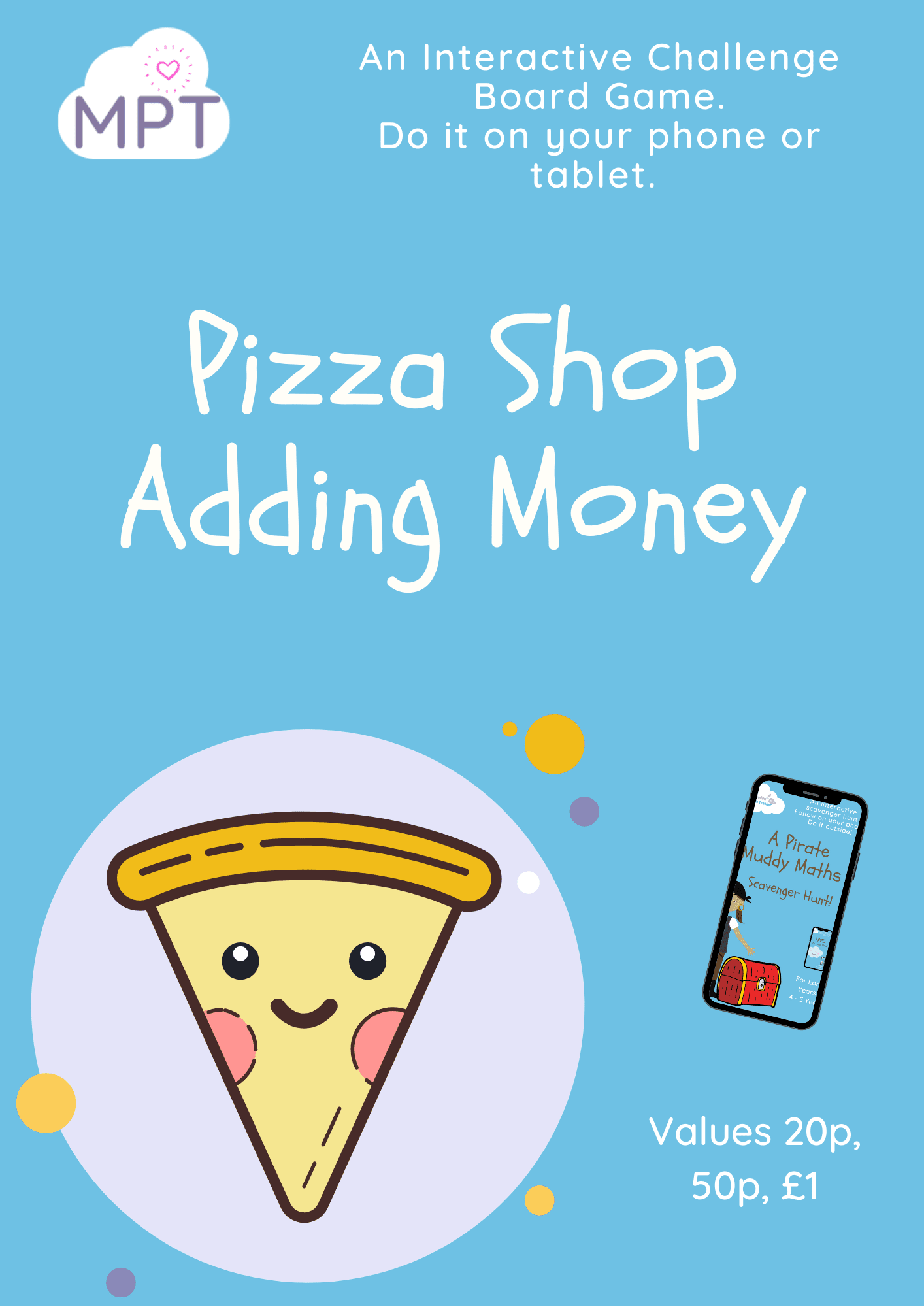
The Pizza Shop Adding Money 1p, 2p, 5p and 10p EBook is designed to help children practise early money skills through playful, practical learning.
Inside The Muddy Puddle Teacher® membership, you will find ready-to-use outdoor maths activities, money role play resources, EYFS and KS1 maths ideas, SEND support, outdoor play prompts, continuous provision activities and simple planning to help you take learning outside.
Our resources are created to save teachers time, reduce planning stress and make maths feel active, purposeful and fun.
Ready for More Outdoor Maths Ideas?
If you enjoyed this Pizza Shop Adding Money 1p, 2p, 5p and 10p EBook activity, you can access hundreds more outdoor learning resources inside The Muddy Puddle Teacher®.
Like this resource? Download this resource and more take a 60-day free trial and explore outdoor learning resources for EYFS, KS1, SEND, forest school, outdoor play, maths, role play and continuous provision.
Start with one pizza shop, one menu and four coins, then build from there.
Outdoor maths does not have to be complicated. Sometimes, it just needs a playful shop, simple prices and children ready to count, add and talk.
Pizza Shop Adding Money FAQs
What is Pizza Shop Adding Money 1p, 2p, 5p and 10p?
Pizza Shop Adding Money 1p, 2p, 5p and 10p is a practical money activity that helps children recognise coins, count small amounts, add prices and use money through pizza shop role play.
What age is this pizza shop money activity for?
This activity is suitable for EYFS, Reception and KS1. Younger children can focus on coin recognition and matching, while older children can add prices and make totals in different ways.
How can I teach adding money with a pizza shop?
You can teach adding money by giving pizza bases and toppings simple prices, then asking children to add two or more items together using 1p, 2p, 5p and 10p coins.
What coins does this activity use?
This activity focuses on 1p, 2p, 5p and 10p coins. These are useful early coins for helping children count in ones, twos, fives and tens.
Can children make the same amount in different ways?
Yes. Children can explore how to make amounts such as 5p and 10p in different ways using 1p, 2p, 5p and 10p coins.
Can this support SEND learners?
Yes. Pizza shop money activities can support SEND learners because they are practical, visual, repetitive and meaningful. Children can join in through matching, choosing, counting, paying and role play.
Do I need special resources for this activity?
No. You can use pretend coins, real coins with supervision, paper plates, chalk, cardboard menus, trays, natural loose parts, recycled materials and an outdoor space.
For more outdoor learning ideas head to the Outdoor Leaning Hub.