
a

Training & Resources

muddy puddle teacher logo

The Muddy Puddle Teacher ®

Leading with Outdoor Learning and Outdoor Play

Home 9 Outdoor Learning Resources 9 Let’s go Abroad with Jess Gosling Outdoor International School Teacher
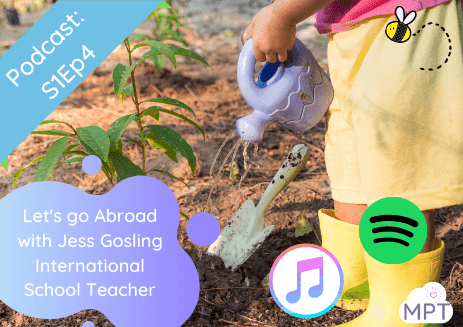
Let's go Abroad with Jess Gosling Outdoor International School Teacher

Let’s go Abroad with Jess Gosling Outdoor International School Teacher

Download

Let’s Go Abroad with Jess Gosling

What is it really like to teach abroad, and how does outdoor learning change when you work in a different country, climate and culture?

In this episode of the Let’s Talk All Things Muddy Outdoor Learning Podcast, Sarah Seaman chats with experienced international early years teacher Jess Gosling.

Jess has worked internationally for more than ten years across a range of educational settings. Her career has included teaching in countries such as Egypt, Japan, Vietnam, Taiwan and Poland, giving her a valuable perspective on how childhood, education and outdoor provision can look across different cultures. (jessgoslingearlyyearsteacher.com)

Sarah and Jess discuss outdoor learning from an international-school perspective, including how schools use their outdoor environments, how climate affects provision and what teachers should consider before moving abroad. Jess describes this particular podcast conversation as an exploration of how outdoor learning looks and is managed within an international school. (jessgoslingearlyyearsteacher.com)

This episode is ideal for teachers considering an international career, educators already working overseas and anyone curious about how learning outside differs around the world.

Explore our Outdoor Learning Hub visit our Outdoor Play Hub and discover practical support in our SEND Outdoor Learning Hub.

Listen to Let’s Go Abroad with Jess Gosling today.

Who Is Jess Gosling?

Jess Gosling is a British-trained early years teacher, author and international education specialist.

She has spent more than a decade teaching internationally and has worked in a variety of schools and cultural contexts. Her experience includes working in Egypt, Japan, Vietnam, Taiwan and Poland. (jessgoslingearlyyearsteacher.com)

Jess has also been awarded Fellowship of the Chartered College of Teaching in recognition of her work in education. Alongside classroom teaching, she writes, conducts research, contributes to professional publications and supports teachers who are considering moving into international education. (jessgoslingearlyyearsteacher.com)

Her work is particularly relevant to teachers interested in early years education, English as an additional language, international-school life and the practical realities of moving overseas.

Jess is also the author of Becoming a Successful International Teacher, drawing on her experience to help educators understand the opportunities and challenges involved in teaching abroad. (School Management Plus)

What Is It Like to Teach Abroad?

Teaching abroad can offer teachers opportunities to experience a different culture, explore new educational approaches and become part of an international community.

However, it is not simply an extended holiday.

International teachers still plan, assess, attend meetings, communicate with families and manage the everyday responsibilities of school life.

They may also need to adjust to a new language, unfamiliar customs, different working expectations and being a long way from their established support networks.

The experience can vary enormously between countries and schools. Some international schools follow the English National Curriculum, while others use the International Baccalaureate, American curricula, bilingual models or locally developed approaches.

Salary, accommodation, healthcare, class sizes, resources and professional expectations can also differ significantly.

Jess’s experience gives listeners a realistic insight into both the excitement and practical considerations involved in building an international teaching career.

How Does Outdoor Learning Differ Around the World?

Outdoor learning is shaped by much more than the physical space available.

Climate, culture, air quality, school expectations, local wildlife, resources and attitudes towards play can all influence how children learn outside.

A school in a hot climate may avoid the middle of the day and use shaded areas early in the morning. A school experiencing heavy rain, extreme heat, snow or high pollution may need to adapt outdoor routines throughout the year.

In some countries, children may have access to large landscaped campuses. In others, outdoor provision may take place on rooftops, balconies, courtyards or compact urban playgrounds.

Cultural attitudes are important too.

What one community considers an appropriate level of physical challenge or messy play may feel very different in another location.

Effective international outdoor learning therefore cannot simply copy a model from the UK and place it into another country.

Teachers need to understand their local environment, listen to families and create an approach that is safe, respectful and meaningful for the children they teach.

Outdoor Learning Does Not Need a Forest

International schools can be located in busy cities, dry landscapes, tropical climates or densely populated areas.

Not every school has access to woodland.

The Muddy Puddle Teacher® approach helps teachers see the potential in the outdoor space they already have.

A playground can be used for active maths. A courtyard can become a storytelling space. A wall can support chalk writing, art or large-scale mark-making. Containers can provide opportunities for water, sand and sensory investigation.

Outdoor learning is not defined by trees.

It is about giving children opportunities to learn through movement, play, investigation and real experiences outside the traditional classroom.

This makes it particularly useful within international schools, where the landscape may look very different from the British woodland settings sometimes associated with outdoor education.

You can listen while driving to work, planning lessons, walking the dog or enjoying a quiet cup of tea. Listen to more episodes; head to the Outdoor Learning Podcast Hub. 

Early Years Teaching in an International School

Early years classrooms in international schools can be wonderfully diverse.

Children may speak several languages, come from different cultural backgrounds and have very different previous experiences of education.

Some children may be new to both the school and the country.

This makes relationships, routines and communication especially important.

Outdoor play can offer children ways to connect before they have developed confidence in the school’s main language.

Children can build, move, explore, copy, gesture and cooperate without relying solely on spoken English.

A shared game or practical activity can create opportunities for friendship and communication.

Outdoor learning may also give teachers a clearer view of children’s strengths. A child who is quiet during whole-class discussion may become a confident leader during construction, movement or imaginative play.

Jess has particular experience of working with young children and supporting pupils who use English as an additional language. (Nexus Education)

New to learning outside? Begin with our Beginner’s Guide to Outdoor Learning and explore our Free Level 1 Outdoor Learning Course.

Supporting Children with English as an Additional Language Outdoors

The outdoors creates meaningful reasons for children to communicate.

Instead of learning vocabulary only through flashcards or worksheets, children can connect words to actions, objects and experiences.

They can carry something heavy, find something smooth, build something tall or move underneath, between and around objects.

This helps language become physical and memorable.

Teachers can support children by modelling short phrases, repeating useful vocabulary, using gestures and allowing time for observation.

Visual prompts, photographs and real objects can make instructions more accessible.

Children should also be encouraged to use their home language.

Maintaining and valuing the language a child speaks at home supports identity, family relationships and wider communication. Jess has previously emphasised the importance of supporting children in their home language within bilingual and international settings. (Podbay)

Outdoor learning can then become a shared space where different languages, cultures and experiences are recognised rather than treated as barriers. Make a start: Outdoor Learning Maths HubOutdoor SEND HubForest School Hub. 

Climate and Weather in International Schools

Weather is one of the most significant differences teachers may encounter when moving abroad.

Outdoor learning in a tropical climate requires different planning from outdoor learning in Poland or the UK.

Schools may need to consider heat, humidity, ultraviolet exposure, heavy rainfall, snow, frozen surfaces, insects or poor air quality.

Children may need shaded areas, water breaks, suitable clothing and shorter outdoor sessions.

In some locations, outdoor play may happen earlier in the day before temperatures rise. In others, winter clothing and safe movement on cold surfaces become priorities.

Teachers should follow their school’s local procedures and understand regional guidance rather than relying entirely on habits developed in the UK.

The aim is not to prove that children can go outside in every condition.

It is to create safe, appropriate and regular opportunities that respond to the local environment.

Free Level 1 Outdoor Learning Course.

Adapting Outdoor Provision to the Local Culture

Working internationally requires curiosity and respect.

Teachers bring valuable professional experience with them, but they must also be willing to listen.

Families may have different expectations around clothing, independence, physical risk, dirt, weather and adult supervision.

A teacher who immediately labels these differences as wrong may damage trust.

Instead, schools can explain the purpose of outdoor learning, share photographs and examples, invite questions and create gradual opportunities for families to understand the approach.

Parents may feel more confident when they can see that outdoor learning is planned, purposeful and connected to children’s development.

International schools should also use local knowledge.

Families, support staff and community members may understand seasonal changes, plants, wildlife and environmental risks far better than a newly arrived teacher.

Good outdoor provision grows through partnership rather than assuming one educational culture has all the answers.

Outdoor Learning and International School Communities

International schools often bring together children, staff and families from many countries.

This creates exciting opportunities for outdoor projects that celebrate different cultures and experiences.

Children might explore traditional games from around the world, compare plants and weather, share family stories or create an international growing area.

Families could contribute songs, outdoor childhood games, recipes, gardening knowledge or stories connected to their home countries.

These experiences can help children feel represented.

They also show that international education is not simply about teaching a British curriculum in another location.

It can create a genuine exchange of ideas and traditions.

Outdoor spaces offer a relaxed environment for community events, family activities and collaborative projects.

They can become places where people connect beyond the formal structures of the school day.

What Should Teachers Consider Before Moving Abroad?

Teaching overseas can be rewarding, but careful research is essential.

Teachers should consider the school’s curriculum, ethos, salary package, accommodation, healthcare, visa arrangements, safeguarding procedures and expectations around workload.

It is also important to understand what is included in the employment package.

Flights, health insurance, housing, school fees for dependants and relocation support may be included in some contracts but not others.

Teachers moving with partners or children will have additional considerations, including employment rights, childcare, education and access to medical support.

The location itself matters too.

Living in a capital city may feel very different from working in a smaller or more remote community.

Jess’s wider work supports teachers with the realities of international applications, cultural adjustment and finding suitable roles abroad. (Apple Podcasts)

Questions to Ask an International School

Before accepting a role, teachers should find out how the school operates in practice rather than relying only on its website or recruitment presentation.

Ask about planning expectations, contact time, class sizes, additional adults, professional development, staff turnover and leadership structures.

For outdoor learning, ask how often children go outside, what spaces are available, whether weather or air-quality restrictions apply and how the school approaches risk.

It is also useful to ask whether staff are encouraged to adapt provision or expected to follow a fixed programme.

Teachers with children should clarify whether school places are guaranteed and whether all fees are covered.

A good interview should allow both the school and teacher to decide whether the partnership is right.

Try This Tomorrow

Use a map or globe to begin a conversation about how schools and outdoor environments might differ around the world.

Choose two contrasting countries and look at their climate, landscape and wildlife.

Ask children how these differences might affect outdoor play and learning.

Would children need more shade, different clothing or alternative resources?

Encourage them to recognise that children around the world may play differently but share many of the same needs for movement, friendship, imagination and belonging.

Time: fifteen to twenty minutes.

Preparation: low.

Best for: understanding the world, geography, communication, cultural awareness and outdoor-learning discussions.

Extend the activity by taking children outside and asking how your own environment affects the way they play and learn.

Free Level 1 Outdoor Learning Course.

Use This Podcast for Staff Development

This episode can provide a useful starting point for staff discussions about culture, inclusion and outdoor provision.

Ask staff to listen to the episode and identify one idea that challenged their assumptions.

Teams could consider how cultural expectations influence their own approach to weather, risk, play and learning environments.

Discuss how the school welcomes families who have different experiences of education.

Staff might also reflect on whether outdoor provision is designed around the children and local environment or copied from a model developed elsewhere.

International and UK-based schools can both benefit from this reflection.

Every setting has its own community, context and physical environment.

Free Level 1 Outdoor Learning Course.

Listen to Let’s Go Abroad with Jess Gosling

This episode offers an honest and fascinating look at teaching, early years education and outdoor learning beyond the UK.

Jess’s international experience reminds us that there is no single way to create meaningful outdoor provision.

Effective practice responds to children, families, culture, climate and the environment available.

Listen as Sarah and Jess discuss the reality of international-school life and the opportunities that can come from teaching in another part of the world.

Listen to Let’s Go Abroad with Jess Gosling now.

Free Level 1 Outdoor Learning Course.

Frequently Asked Questions

Who is Jess Gosling?

Jess Gosling is a British-trained early years teacher, author and international education specialist. She has taught internationally for more than ten years in countries including Egypt, Japan, Vietnam, Taiwan and Poland. (jessgoslingearlyyearsteacher.com)

What is this podcast episode about?

The episode explores teaching abroad and how outdoor learning is organised within international schools. It considers differences in culture, climate, environments and educational expectations. (jessgoslingearlyyearsteacher.com)

Is the episode useful for teachers thinking of moving abroad?

Yes. It provides insight into international-school life and encourages teachers to think carefully about school culture, employment packages, living overseas and adapting to a different educational context.

Can outdoor learning work in a hot country?

Yes, but provision must be adapted. Schools may need to use shade, schedule sessions during cooler parts of the day, provide regular water breaks and follow local guidance relating to heat and air quality.

Do international schools follow the English curriculum?

Some international schools follow the English National Curriculum, but others use the International Baccalaureate, American programmes, bilingual curricula or their own frameworks. Teachers should research each school carefully.

Free Level 1 Outdoor Learning Course.

Author Box

Written by Sarah Seaman PGCE MA

Founder of The Muddy Puddle Teacher®

Teacher for over 19 years

Bloomsbury author

Trainer of thousands of teachers across the UK


You need a subscription to download this file. Log in/Upgrade or Take a 60 Day Free Trial. Feel free to Send us a message if you need help.

New in