
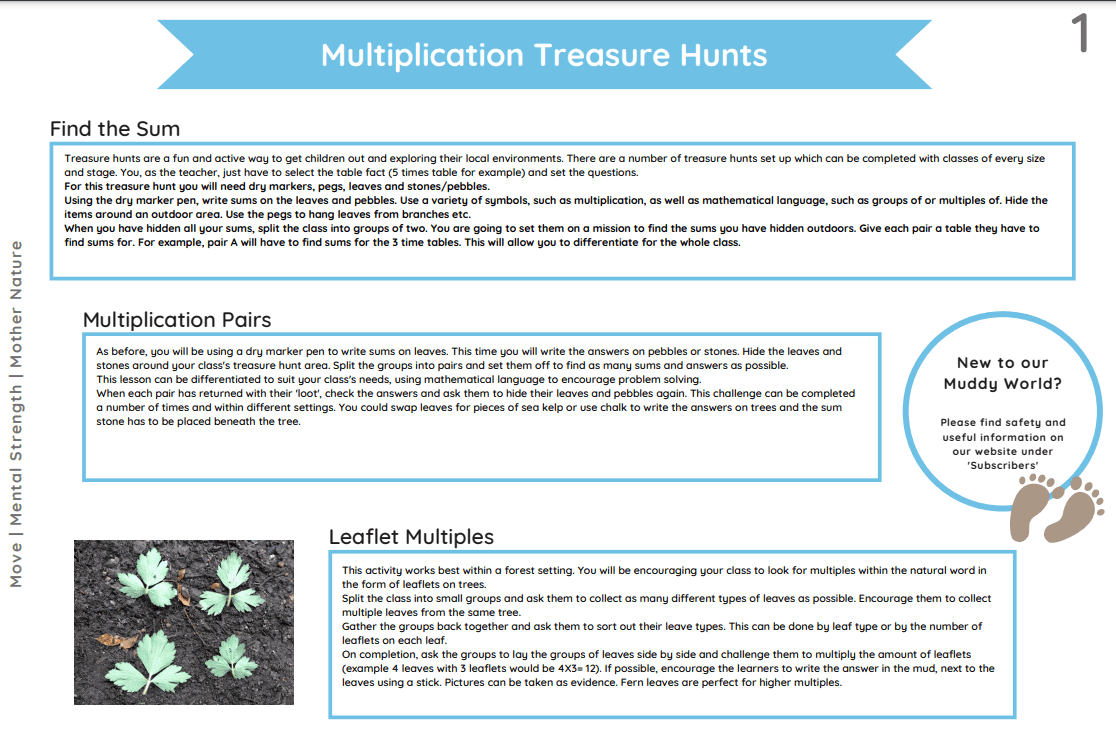
Counting in Multiples Outdoor Activities
Take It Outside!
Looking for simple ways to teach counting in multiples outside? These two outdoor maths activities help children practise skip counting, times tables, number patterns and counting aloud in a much more active way.
Counting in multiples is one of those maths skills children need again and again. It supports times tables, division, fractions, number patterns, money, measures and problem-solving. But for some children, chanting multiples indoors can feel repetitive, passive or hard to remember. Use this FREE Beginner Guide to Outdoor Learning to make a start.
Taking it outside makes it more physical.
Children can step, jump, throw, collect, chant, move and see number patterns in a bigger space. This helps them remember the rhythm of counting in 2s, 5s, 10s, 3s, 4s and beyond.
These ideas are perfect for:
KS1 maths
KS2 maths
outdoor maths activities
times table practice
active learning
SEND maths support
children who need movement
quick lesson starters
intervention groups
playground maths
If you are new to outdoor learning, start with our Beginners Guide to Outdoor Learning.
Download all of our resources today with a 60-day free trial.
Learn more about how we teach lesson in KS2 outside.
What Does Counting in Multiples Mean?
Counting in multiples means counting on in equal steps.
For example:
Counting in 2s:
2, 4, 6, 8, 10, 12
Counting in 5s:
5, 10, 15, 20, 25, 30
Counting in 10s:
10, 20, 30, 40, 50
Children need to notice the pattern, hear the rhythm and understand that each number increases by the same amount.
Outdoor learning helps because children can practise this through movement and play, rather than only chanting from the board.
For more support, link to Outdoor Maths Activities and KS1 Outdoor Learning or KS2 Outdoor Learning.
New to Counting in Multiples Outside? Start Here
Keep it simple.
You do not need lots of equipment or a complicated lesson plan. Choose one multiple, give children a clear movement pattern and let them practise saying the numbers aloud.
You can use:
chalk
cones
hoops
sticks
stones
leaves
beanbags
number cards
playground markings
Start with counting in 2s, 5s or 10s. Then move on to 3s, 4s, 6s or 8s when children are ready.
The aim is not to make maths harder. The aim is to make the counting pattern easier to feel, hear and remember.
Idea 1: Jump the Multiples
This is a simple outdoor activity for helping children practise counting in multiples using movement.
You Will Need
Chalk or cones
Outdoor space
Number cards, optional
Hoops, optional
How to Set It Up
Draw a line of numbers on the playground. You can write every number, or just the multiples you want children to practise.
For younger children, start with:
2, 4, 6, 8, 10, 12, 14, 16, 18, 20
For counting in 5s, use:
5, 10, 15, 20, 25, 30, 35, 40, 45, 50
For counting in 10s, use:
10, 20, 30, 40, 50, 60, 70, 80, 90, 100
Ask children to jump from number to number while saying the multiples aloud.
For example:
“Jump and count in 2s.”
Children jump:
2, 4, 6, 8, 10
Then ask:
“What do you notice?”
They might notice that the numbers are all even, they all go up by 2, or they follow a pattern.
Make It Easier
Use fewer numbers.
Start with 2, 4, 6, 8, 10.
Let children watch first, then join in.
Say the numbers together as a class.
Make It Harder
Ask children to:
count backwards in multiples
start from a different number
hide one number and find the missing multiple
create their own multiples path
count in 3s, 4s, 6s or 8s
explain the pattern
Example challenge:
“Jump in 5s from 10 to 50.”
Or:
“Start at 24 and count backwards in 4s.”
This is a brilliant way to support times tables without making children sit still and chant.
Download all of our resources today with a 60-day free trial.
Idea 2: Collect and Count in Groups
This activity helps children understand that multiples are groups of equal amounts.
Instead of only saying the numbers, children build the multiples using outdoor objects.
You Will Need
Leaves, stones, sticks or cones
Hoops or chalk circles
Number cards
Outdoor space
How to Set It Up
Choose a multiple.
For example, counting in 5s.
Place hoops on the ground, or draw chalk circles.
Ask children to collect 5 objects for each hoop.
They place 5 leaves in the first hoop, 5 leaves in the second hoop, 5 leaves in the third hoop and so on.
Then count together:
5, 10, 15, 20, 25
This helps children see that each multiple is another equal group.
You can repeat this with:
groups of 2
groups of 3
groups of 4
groups of 5
groups of 10
Example
If children are counting in 3s, they put 3 stones in each hoop.
Then they count:
3, 6, 9, 12, 15
Ask:
How many groups do we have?
How many are in each group?
How many altogether?
What multiple did we land on?
What pattern do you notice?
This links counting in multiples to early multiplication.
Make It Easier
Use groups of 2, 5 or 10.
Keep the number of groups small.
Count each group together.
Make It Harder
Ask children to:
write the multiplication fact
predict the total before counting
create 6 groups of 4
count backwards by removing one group at a time
compare two different multiples
create a word problem
Example:
“We have 4 hoops. Each hoop has 5 leaves. How many leaves altogether?”
Children count:
5, 10, 15, 20
Then write:
4 × 5 = 20
For more practical ideas, explore our Outdoor Maths Lesson Plans.
Try This Tomorrow
Take children outside and draw five circles on the playground.
Choose counting in 5s.
Ask children to place 5 natural objects in each circle.
Then count together:
5, 10, 15, 20, 25
Time: 10 minutes
Prep: Very low
Best for: counting in multiples, times tables, early multiplication and active maths
This simple activity helps children see that counting in multiples is really counting equal groups.
Get more insight and listen to our Muddy Teacher Podcast: Let’s learn about KS2 Outdoors with Jacki.
Why Outdoor Learning Helps Children Count in Multiples
Counting in multiples is about pattern, rhythm and repeated steps.
The outdoors naturally supports this because children can:
move as they count
jump along number patterns
build equal groups
use real objects
chant aloud without feeling too exposed
practise with a partner
see maths on a bigger scale
repeat without it feeling like a worksheet
Some children remember number patterns better when they attach them to movement. Jumping, stepping, clapping, collecting and grouping can all help children build confidence.
Outdoor maths is especially useful for children who find times tables stressful. It gives them a playful way to practise before moving into written calculations.
For SEND support, head to the SEND Outdoor Learning Hub . For more specific needs, use the Outdoor Learning Handbook for Dyscalculia.
Supporting SEND Learners
These counting in multiples activities are helpful for children who need a practical route into maths.
They can support children who:
struggle to remember times tables
find abstract numbers difficult
need movement to learn
benefit from visual patterns
need repeated practice
find worksheets overwhelming
need confidence with number
learn best through hands-on tasks
You can adapt the activities by:
using fewer numbers
using larger objects
repeating the same multiple several times
working in pairs
counting aloud together
using visual number cards
giving children time to watch before joining in
focusing on one multiple at a time
The key is to keep it calm, simple and successful.
Explore our SEND videos designed to calm children coming from outside inside:
Common Misconceptions
Children may count every object instead of counting in groups
Let them count each group first, then practise saying only the multiples.
For example:
“There are 5 in this hoop. Now another 5 makes 10.”
Children may lose the pattern
Keep the multiple visible using number cards, chalk or a chant.
Children may rush and miss numbers
Slow the activity down. Ask children to step or jump only when they say the next multiple correctly.
Children may not connect multiples to times tables
Use language such as:
“Five groups of two is ten.”
Then write:
5 × 2 = 10
Bringing the Learning Back Inside
After the outdoor activity, children can record their learning in books.
They could:
write the multiples they practised
draw the groups they made
write multiplication facts
create their own multiples challenge
complete missing number sequences
explain the pattern they noticed
Useful sentence stems:
I counted in multiples of…
I noticed the pattern…
Each group had…
There were ___ groups of ___
The total was…
This links to times tables because…
This helps children connect the outdoor experience with written maths.
Want Ready-to-Use Outdoor Maths Resources?
The Muddy Puddle Teacher® Club helps busy teachers save planning time with:
ready-to-use outdoor learning resources
outdoor maths activities
times table activities
KS1 and KS2 lesson ideas
SEND-friendly maths support
practical number activities
outdoor learning planning
low-prep teaching ideas
You can start a 60-day free trial and download resources today.
Try our Outdoor Maths Activities, Outdoor Number Activities and KS2 Outdoor Learning Resources.
Download Counting in Multiples Outdoor Activity
If you want a simple, low-prep way to help children practise counting in multiples, these two outdoor ideas are a brilliant place to start.
Use them as:
a maths starter
a full outdoor lesson
a times table warm-up
a SEND intervention
a group activity
a playground maths challenge
a revision activity
Download all of our resources today with a 60-day free trial.
FAQs
What are counting in multiples activities?
Counting in multiples activities help children count in equal steps, such as 2s, 5s, 10s, 3s or 4s. They support times tables, multiplication, division and number patterns.
How can I teach counting in multiples outside?
You can teach counting in multiples outside by using chalk number paths, jumping games, cones, hoops and natural objects. Children can move, count aloud and build equal groups.
What age is this activity suitable for?
These activities are suitable for KS1 and KS2. Younger children can count in 2s, 5s and 10s, while older children can practise 3s, 4s, 6s, 7s, 8s, 9s and 12s.
Can this support SEND learners?
Yes. Outdoor counting in multiples activities can support SEND learners because they are visual, practical and movement-based. They help children practise number patterns without relying only on worksheets.
Do I need special equipment?
No. You can use chalk, cones, hoops, sticks, stones, leaves, beanbags or number cards. The activities are designed to be simple and low-prep.
Can this help with times tables?
Yes. Counting in multiples is a key step towards understanding times tables. Building equal groups outside helps children see how repeated counting links to multiplication.
For bespoke ideas, head to our teacher-created Outdoor Learning Knowledge Hub.
Download all of our resources today with a 60-day free trial.
Author Box
Written by Sarah Seaman PGCE MA
Founder of The Muddy Puddle Teacher®
Teacher for over 19 years
Bloomsbury author
Trainer of thousands of teachers across the UK