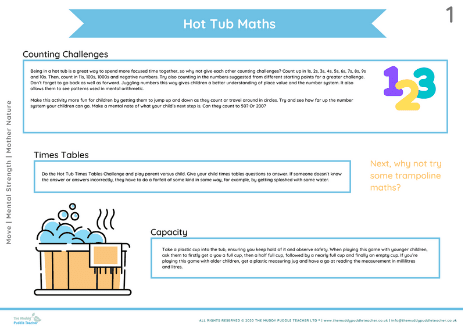
Looking for fun hot tub maths activities for kids? The Maths Hot Tub Learning, Parents Ideas Pack is designed to help families turn everyday outdoor moments into playful learning. A hot tub, paddling pool, garden tub or water play area can become a brilliant space for counting, measuring, estimating, sorting, comparing, floating, sinking and simple problem-solving. New to taking the curriculum outdoors? Discover The Beginner’s Guide to Outdoor Learning.
Maths does not always need to happen at a table. Children often learn best when they are relaxed, moving, talking and playing. Water play gives parents a simple way to practise maths naturally, without pressure, worksheets or formal lessons. Take a 60-day free trial and download now.
New to outdoor maths at home? Start here
If home learning feels overwhelming, keep it playful. You do not need to “teach a lesson” in the hot tub. You can simply add small maths moments into what children are already doing.
Start with counting toys, comparing sizes, pouring water, spotting shapes, timing turns, estimating how many cups will fill a bucket or talking about more, less, full, empty, heavy, light, warm and cool.
The best maths at home often happens through conversation. A simple question such as “How many ducks are floating now?” or “Which cup holds more water?” can build mathematical thinking without children even realising they are learning.
Try this tomorrow, floating number fun
Add a few bath toys, foam numbers, plastic cups or floating objects to the water. Ask children to count how many are floating, then hide one behind your hand, under a cup or at the side of the tub and ask how many are left.
You can keep it very simple for younger children, or make it trickier by asking them to add two more, take one away, make a group of five or find two numbers that make ten.
This activity supports counting, addition, subtraction, number bonds, problem-solving and mathematical language. It works because children are already engaged in play, so the maths feels natural and fun.
Free idea, cup filling challenge
Give children different-sized cups, jugs, bowls or containers and ask them to investigate how many small cups of water it takes to fill a larger container. They can estimate first, then test their idea by pouring and counting.
You can use language such as full, empty, half full, nearly full, holds more, holds less, overflow, measure and estimate. Older children can compare two containers and decide which one has the greater capacity.
This is a brilliant outdoor maths activity because it builds early measuring skills in a real, hands-on way. It also supports fine motor control, vocabulary and scientific thinking. Take a 60-day free trial and download now.
Free idea, hot tub shape hunt
Ask children to look around the hot tub, garden or water play area and spot shapes. They might notice circles in bubbles, rectangles on towels, squares on tiles, cylinders in cups, triangles on bunting or curves in water ripples.
Children can call out the shapes they see, make shapes with their fingers, create shapes using floating toys or draw shapes with water on the patio. Older children can talk about sides, corners, edges, symmetry and 3D shapes.
This is a simple way to bring geometry into everyday outdoor play. It helps children realise that maths is all around them, not just in books.
Why use water play for maths?
Water play is brilliant for maths because it is naturally practical. Children can pour, count, compare, estimate, sort, measure, time, share and solve problems without needing a formal activity.
A hot tub, paddling pool or garden water tray gives children a calm and enjoyable space to explore number and measurement. Because the experience feels playful, children are often more willing to have a go, make predictions and test ideas.
This is especially helpful for children who say they do not like maths. When maths is hidden inside play, confidence can grow.
Hot tub maths for early years
For early years children, hot tub maths can focus on counting, matching, sorting, comparing, shapes, capacity and simple language. Parents can ask questions such as, “How many toys are in the water?” “Which cup is full?” “Can you find something round?” “Who has more?” or “Can you pour to the line?”
The aim is not to rush children into formal sums. The aim is to help them notice number, shape, space and measure through playful experiences.
Early maths should feel active, sensory and joyful.
Hot tub maths for primary children
For primary children, hot tub maths can become more challenging. Children can estimate capacity, time how long objects float, compare containers, practise number bonds, count in 2s, 5s or 10s, create multiplication groups, measure water levels or solve simple word problems.
For example, “If three ducks are floating and we add four more, how many are there altogether?” or “If each cup holds 100ml, how much water will three cups hold?”
The key is to keep it light. A few minutes of playful maths is better than turning relaxing family time into a formal lesson.
Maths hot tub learning for parents
Parents often worry that supporting maths at home means worksheets, apps or sitting at the table. But everyday family routines can be full of maths. Bath time, cooking, walking, shopping, gardening and water play all offer real opportunities to count, compare, measure and talk.
The Maths Hot Tub Learning, Parents Ideas Pack helps parents see how simple maths can be. It gives families easy ways to build confidence through playful outdoor learning at home.
This is especially useful during weekends, holidays, sunny days or family time when children need active, low-pressure learning.
Hot tub maths and SEND support
Hot tub maths can be supportive for children with SEND because it is sensory, playful and flexible. Children can take part by pointing, pouring, choosing, counting, matching, sorting, moving objects or simply watching first.
For children with dyscalculia, practical objects can make number and measure easier to understand. For children with ADHD, water play can provide movement and engagement. For children with anxiety, relaxed family play can reduce pressure. For children with speech and language needs, repeated phrases such as more, less, full, empty and how many can build confidence.
As always, keep activities short, calm and child-led. The learning should feel positive, not forced.
Safety and supervision
Hot tub and water play activities must always be closely supervised by an adult. Children should never be left alone near water, even for a moment. Keep water depth appropriate, use safe objects, avoid slipping hazards and make sure children are comfortable, warm and able to get out when needed.
Maths should be added gently into safe play. The priority is always supervision, comfort and wellbeing.
Want ready-to-use maths ideas for parents?
Inside The Muddy Puddle Teacher Club, we help parents, teachers and educators make outdoor learning simple, playful and easy to use. You will find ready-to-use outdoor maths ideas, home learning activities, parents packs, SEND-friendly support and nature-based resources for children of different ages.
The Maths Hot Tub Learning, Parents Ideas Pack is designed to help families turn everyday outdoor play into meaningful maths, without pressure or planning overwhelm.
Take a 60-day free trial and download now.
FAQs
What are hot tub maths activities for kids?
Hot tub maths activities are playful water-based learning ideas that help children practise counting, measuring, estimating, comparing, sorting, shapes and simple problem-solving while playing in a hot tub, paddling pool or garden water area.
How can parents teach maths through water play?
Parents can teach maths through water play by counting toys, comparing containers, pouring water, spotting shapes, estimating capacity, timing turns, sorting objects and asking simple questions during play.
Is water play good for maths learning?
Yes, water play is excellent for maths learning because it is practical, sensory and meaningful. Children can explore number, measure, shape and comparison through real objects and hands-on experiences.
Can hot tub maths support early years children?
Yes, hot tub maths can support early years children by helping them practise counting, comparing, full and empty, more and less, shapes, sorting and early problem-solving through play.
Can hot tub maths work for older children?
Yes, older children can use hot tub maths for estimating, measuring capacity, timing, multiplication, number bonds, addition, subtraction and problem-solving. The challenge can be adapted to suit the child’s age and confidence.
Can water-based maths support SEND?
Yes, water-based maths can support SEND because children can learn through movement, sensory play, real objects, repetition and low-pressure interaction. Activities can be adapted using visuals, simple language and short tasks.
Ready for more hot tub maths ideas?
Get the Maths Hot Tub Learning, Parents Ideas Pack, outdoor maths resources, home learning activities and SEND-friendly ideas inside The Muddy Puddle Teacher Club. Start your 60-day free trial today and make maths part of everyday outdoor play.