
KS1 The Three Little Pigs Outdoor Learning Activities
Looking for simple KS1 The Three Little Pigs activities you can take outside? This traditional tale is perfect for outdoor learning because children can build, test, retell, problem-solve, act, measure, compare materials and explore story language in a practical way.
The Three Little Pigs is a brilliant KS1 story for linking literacy, science, design technology, maths, drama, speaking and listening and outdoor play. Children already know the structure of the story, which makes it easier for them to retell, sequence, innovate and explore the characters in more depth. Raed the beginners guide to outdoor play.
At The Muddy Puddle Teacher®, we believe outdoor learning should feel simple, purposeful and easy to set up. You do not need expensive resources. Sticks, straw, leaves, stones, cardboard, crates, fabric, chalk, clipboards, natural loose parts and your school grounds are enough to create meaningful outdoor Three Little Pigs learning.
New to Outdoor Literacy? Start Here
If outdoor literacy feels overwhelming, start with one part of the story and one outdoor activity.
The Three Little Pigs works beautifully outside because it is full of action. Children can build houses, test materials, create story paths, act out the wolf, design warning signs, make maps, write speech bubbles or retell the story using natural objects.
Start small. You might ask children to build one pig’s house using outdoor materials, then talk about whether it is strong, weak, safe, tall, low, wide or narrow.
The key is to let the story become active. Children do not need to sit at a table to understand characters, settings, problems and solutions. They can move through the story, build it, test it and talk about it. Download this resource and thousands more, take a 60-day free trial.
Try This Tomorrow
If you only do one thing, try this quick outdoor Three Little Pigs activity.
Build a Pig House Challenge
Take children outside and ask them to build a house for one of the little pigs using natural or loose part materials.
They might use sticks, straw, leaves, stones, cardboard, crates, fabric or blocks. Once built, children can test whether their house is strong enough to stand in the wind, survive a gentle fan, hold a toy pig or stay upright when lightly shaken.
Time: 20–30 minutes
Prep: Low
Resources: Sticks, straw, leaves, stones, crates, cardboard, fabric, toy pigs or picture cards
Learning: Story retelling, materials, problem-solving, teamwork, speaking and listening, design technology and vocabulary
As children work, ask them to explain their choices. Why did you choose sticks, how could you make it stronger, what would the wolf notice, is your house safe, what could you change?
This gives children a quick outdoor literacy success while also linking beautifully to science and design technology.
Why The Three Little Pigs Works Well Outdoors
The Three Little Pigs works well outdoors because the story is practical. It includes homes, materials, weather, danger, safety, choices, repeated language and problem-solving.
Children can physically explore the difference between straw, sticks and bricks or similar outdoor materials. They can test strength, stability and structure. They can act out the wolf’s movements, follow a story trail, create a map of the pigs’ journey or build a village for the characters.
Outdoor learning helps children understand the story more deeply because they are not just reading it. They are experiencing it.
This is especially helpful for KS1 children who still need movement, play, talk and practical exploration to support literacy. When children build, act and retell outdoors, they gain confidence with vocabulary, sequencing, sentence structure and story language.
KS1 Three Little Pigs Story Retelling Outdoors
Outdoor spaces are ideal for retelling traditional tales.
You can create a simple story trail around the playground or field. One area becomes the straw house, another becomes the stick house, another becomes the brick house and another becomes the wolf’s path.
Children can move from place to place, retelling the story using actions, voices and repeated phrases. They might say, little pig, little pig, let me come in, not by the hair on my chinny chin chin, then I’ll huff and I’ll puff and I’ll blow your house down.
You can add chalk arrows, story stones, picture cards or natural objects to help children remember the sequence.
This supports oral storytelling, memory, vocabulary and confidence before children write.
Three Little Pigs Outdoor Writing Ideas
Once children have explored the story outside, writing becomes much easier.
Children could write warning signs for the pigs, labels for the houses, instructions for building a strong house, speech bubbles for the wolf, wanted posters, letters from one pig to another, alternative endings or a new version of the story set in your school grounds.
The outdoor experience gives children something real to write about. Instead of asking them to imagine a house, they have built one. Instead of asking them to describe materials, they have touched and tested them. Instead of asking them to write dialogue, they have acted it out.
This makes writing feel more purposeful.
You might begin with simple sentence stems such as, my house is made from, the wolf said, the pig ran to, the strongest material was, I chose this because, next time I would.
Three Little Pigs Outdoor Science Links
The Three Little Pigs is a brilliant story for exploring materials in KS1 science.
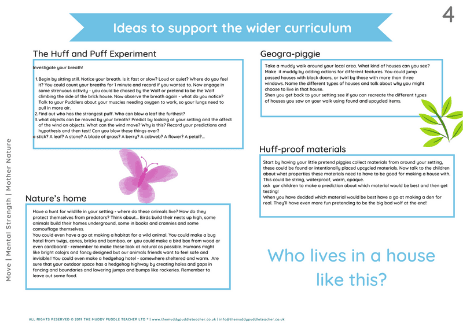
Children can investigate which materials are strong, flexible, waterproof, heavy, light, rough, smooth, natural or man-made.
Outside, they might compare straw, sticks, stones, bricks, leaves, cardboard, fabric and plastic. They can test which materials are best for building a house and explain why.
You might ask, which material is strongest, which one is weakest, which one would keep the rain out, which one blows away easily, which one is heavy, which one is easy to build with?
This helps children link story learning with real scientific enquiry. Download this resource and thousands more, take a 60-day free trial.
Three Little Pigs Outdoor Maths Links
The story can also support outdoor maths.
Children can count how many sticks they use, compare the height of each house, measure the length of walls, sort materials by size, create patterns with bricks or stones, count footsteps between the three houses or make a simple map of the pigs’ journey.
They might compare which house is tallest, widest, strongest or uses the most materials.
You can ask questions such as, how many sticks did you use, which wall is longer, how many stones are in your house, can you make the house taller, how many steps from the straw house to the brick house?
This keeps maths practical and connected to the story.
Three Little Pigs Outdoor Role Play
Role play is a powerful way for KS1 children to understand character and story structure.
Children can become the pigs, the wolf, builders, neighbours, architects, safety inspectors or reporters. They can visit each house, ask questions, describe what happened and give advice.
A child acting as a reporter might say, I am here at the scene of the blown-down straw house. The first little pig says he should have used stronger materials.
A child acting as a builder might explain how to improve the house.
This supports speaking and listening, vocabulary, drama, confidence and comprehension.
Three Little Pigs Design and Build Challenge
A simple design challenge can help children think more deeply about the story.
Ask children to design a house that the wolf cannot blow down. They must choose materials, build a structure and explain how they made it strong.
They might use wide bases, heavier materials, extra supports, walls, roofs, corners or layers.
Children can test their designs using a gentle breeze, fan, hand fan or by blowing carefully from a distance.
The aim is not to create a perfect house. The aim is to test, improve and explain.
This links beautifully to design technology and science.
Three Little Pigs and SEND Outdoor Learning
The Three Little Pigs can work well for children with SEND because the story is repetitive, familiar and practical.
Children can access the learning through building, moving, acting, sorting, touching materials, using picture cards, joining in repeated phrases or working with a partner.
Some children may enjoy the sensory element of straw, sticks, stones, fabric or mud. Others may enjoy the structure of the repeated story language.
Outdoor learning can reduce pressure because children are not expected to sit still for long periods. They can move, build, talk and take part in a way that feels more natural.
Keep instructions clear, use visuals and allow children to show understanding through actions, objects or short spoken phrases.
Want Ready-to-Use KS1 Three Little Pigs Resources?
The Muddy Puddle Teacher® helps busy teachers save planning time with simple, curriculum-linked outdoor learning resources.
Inside the Muddy Puddle Teacher® membership, you will find ready-to-use KS1 outdoor literacy activities, traditional tale resources, story-linked lessons, outdoor phonics ideas, maths and science links, SEND support, forest school ideas and simple planning to help you take learning outside.
Our resources are designed to help you use your school grounds, reduce planning stress and make outdoor learning feel manageable, purposeful and fun.
Ready for More KS1 Outdoor Literacy Ideas?
If you enjoyed these KS1 The Three Little Pigs outdoor learning activities, you can access hundreds more outdoor learning resources inside The Muddy Puddle Teacher®.
Start today with a 60-day free trial and explore outdoor learning resources for KS1, EYFS, KS2, SEND, forest school, outdoor play, literacy, maths, science and story-linked teaching.
Start with one story trail, one pig house challenge or one outdoor retelling activity, then build from there.
Outdoor literacy does not have to be complicated. It just needs a story, a space and a simple reason for children to talk, move and create. Download this resource and thousands more, take a 60-day free trial.
KS1 The Three Little Pigs FAQs
How can I teach The Three Little Pigs outdoors?
You can teach The Three Little Pigs outdoors by creating story trails, building pig houses, testing materials, acting out the story, writing signs, making maps and using natural loose parts to retell the tale.
What outdoor activities work well for The Three Little Pigs?
Good outdoor activities include building houses from sticks, straw and stones, creating a story path, testing materials, acting as the wolf, designing a stronger house, writing warning signs and making a map of the pigs’ journey.
Is The Three Little Pigs good for KS1 outdoor learning?
Yes. The Three Little Pigs is ideal for KS1 outdoor learning because it links to literacy, science, design technology, maths, speaking and listening, role play and problem-solving.
How does The Three Little Pigs link to science?
The story links to science through materials. Children can compare straw, sticks, stones, bricks, cardboard, fabric and other materials, then test which are strong, weak, waterproof, flexible or suitable for building.
How does The Three Little Pigs support writing?
Outdoor Three Little Pigs activities give children real experiences to write about. They can write labels, signs, instructions, speech bubbles, letters, reports, descriptions, story maps and alternative endings.
Can The Three Little Pigs support SEND learners?
Yes. The story is repetitive, familiar and practical, which can support SEND learners. Children can join in through actions, building, sensory play, repeated phrases, visuals, role play and partner work.
Do I need special resources for outdoor Three Little Pigs activities?
No. You can use simple outdoor materials such as sticks, straw, leaves, stones, crates, cardboard, fabric, chalk, cones, hoops and picture cards.