
KS1 Robin Hood Outdoor Learning Activities
Looking for simple KS1 Robin Hood activities you can take outside? Robin Hood is a brilliant theme for outdoor learning because it naturally links to forests, maps, journeys, teamwork, problem-solving, traditional tales, history, drama, storytelling, maths, literacy and nature. Are you new to outdoor learning explore this article to learn more : What is Outdoor Learning?
A Robin Hood topic works beautifully in KS1 because children can step into the story. They can explore woodland settings, build hideouts, follow trails, create maps, act in role, write messages, solve clues, compare characters and use outdoor spaces to bring the legend to life.
At The Muddy Puddle Teacher®, we believe outdoor learning should feel simple, purposeful and exciting. You do not need a forest or lots of expensive resources. Sticks, leaves, chalk, crates, fabric, cones, rope, clipboards, natural loose parts, story cards and your school grounds are enough to create meaningful Robin Hood outdoor learning. Download this resource and 1000’s more – take a 60-day free trial.
New to Outdoor Learning? Start Here
If outdoor learning feels overwhelming, start with one story idea and one outdoor space.
Robin Hood is a great theme to begin with because it gives children a clear setting and a strong sense of adventure. You might create a Sherwood Forest trail, build an outlaw hideout, make a map to Nottingham, write secret messages, act out a scene between Robin Hood and the Sheriff or collect natural objects for a woodland camp.
The key is to keep the learning age-appropriate. You do not need to focus heavily on weapons or fighting. Instead, focus on forests, bravery, fairness, teamwork, choices, helping others, solving problems and storytelling.
Outdoor Robin Hood learning works best when children can move, imagine, talk and create.
Try This Tomorrow
If you only do one thing, try this simple Robin Hood outdoor activity.
Sherwood Forest Hideout
Take children outside and ask them to create a safe woodland hideout for Robin Hood and his friends using natural loose parts, crates, fabric, sticks, leaves, cones, logs or chalk.
Children can decide where the hideout should go, how it will be hidden, who will use it and what signs or clues might lead people there.
Time: 20–30 minutes
Prep: Low
Resources: Sticks, leaves, fabric, crates, cones, chalk, rope, natural loose parts or cardboard signs
Learning: Story setting, teamwork, speaking and listening, design, problem-solving, positional language and imaginative play
As children build, adults can ask, where should the entrance go, how will Robin Hood find it, how can we make it hidden, what would the Sheriff notice, what could we add to make it safer, how will the team work together?
This gives children an immediate outdoor learning success and helps the Robin Hood story come alive.
Why Robin Hood Works Well Outdoors
Robin Hood works well outdoors because the story belongs in a forest setting. Children can understand the world of the tale more deeply when they are surrounded by trees, sticks, leaves, paths, dens, shadows and natural materials.
Outdoor learning helps children imagine Sherwood Forest, think about journeys, create hideouts, follow clues and act out scenes in a way that feels real and memorable.
The Robin Hood theme can support literacy, history, geography, maths, PSHE, drama, art, design technology and forest school-style learning. Children can explore big ideas such as fairness, kindness, courage, rules, leadership and helping others.
For KS1 children, this kind of active, story-linked learning can make writing, speaking and comprehension much easier because they have experienced the story physically.
KS1 Robin Hood Storytelling Outdoors
Outdoor spaces are perfect for Robin Hood storytelling.
You can create a simple story trail where one area becomes Sherwood Forest, one becomes Robin Hood’s hideout, one becomes Nottingham Castle and one becomes the path where a message is hidden.
Children can move from place to place and retell the story using actions, voices and role play.
They might become Robin Hood, Little John, Maid Marian, the Sheriff of Nottingham, villagers, forest animals, messengers or travellers.
This helps children understand setting, character, sequence and story language. It also gives them ideas before writing.
Robin Hood Outdoor Writing Ideas
Once children have explored the Robin Hood theme outside, writing becomes more purposeful.
Children could write a wanted poster for Robin Hood, a secret message to the Merry Men, a map label for Sherwood Forest, a diary entry from Robin Hood, a letter from the Sheriff, a set of forest rules, a description of the hideout or a new adventure set in the school grounds.
You might use sentence stems such as, Robin Hood crept through the forest, the hideout was hidden behind, the Sheriff shouted, the secret message said, we followed the path to, the forest was dark and.
Outdoor experiences help children write with more detail because they have built, walked, acted and imagined the story in a real space.
Robin Hood Outdoor Maths Links
Robin Hood can link naturally to outdoor maths.
Children can count steps along a forest trail, measure the distance between clues, create number-coded messages, compare stick lengths, sort natural materials, make patterns for a forest path, count coins in a treasure challenge or follow a map using positional language.
You might ask, how many steps to the hideout, which route is shorter, how many clues did we find, can you sort the sticks by length, which pile has more leaves, can you make a repeating pattern for the path?
This keeps maths practical and linked to the story.
Robin Hood Outdoor Geography Links
The Robin Hood theme is ideal for early map work and geography.
Children can draw maps of Sherwood Forest, create routes to the hideout, mark landmarks, use simple symbols, follow directions or compare natural and human features.
They might use chalk, sticks, cones, leaves and stones to create a large outdoor map. A stick might show a path, a hoop might show a camp, stones might show a river and leaves might show woodland.
Adults can introduce words such as map, route, path, direction, near, far, behind, beside, between, forest, village, castle and landmark.
This helps children understand place and movement through story.
Robin Hood and Outdoor History
Robin Hood is a legend rather than a straightforward historical account, but it can still help KS1 children begin to explore the past.
Children can talk about how life long ago might have been different from life today. They might think about forests, castles, villages, travelling on foot, messages, clothing, homes and communities.
Keep this simple and age-appropriate. You might ask, did people have cars, how did they travel, what might a forest have been used for, who might live near a castle, how are stories from the past passed on?
This helps children begin to understand that stories can come from long ago and that people lived differently in the past.
Robin Hood and Fairness
Robin Hood is a useful theme for exploring fairness, kindness and choices.
Children can discuss whether Robin Hood was helpful, brave, fair, kind or wrong. They can think about rules, helping people, sharing and standing up for others.
You might ask, is it always right to help someone, should everyone share, what makes a fair leader, was Robin Hood making good choices, how can we help people in our class?
This links the story to PSHE and Philosophy for Children in a gentle, KS1-friendly way.
Outdoor discussion can feel less formal, especially if children are sitting in a circle under a tree or around their Robin Hood hideout.
Robin Hood Forest School-Style Ideas
Robin Hood works beautifully with forest school-style outdoor learning.
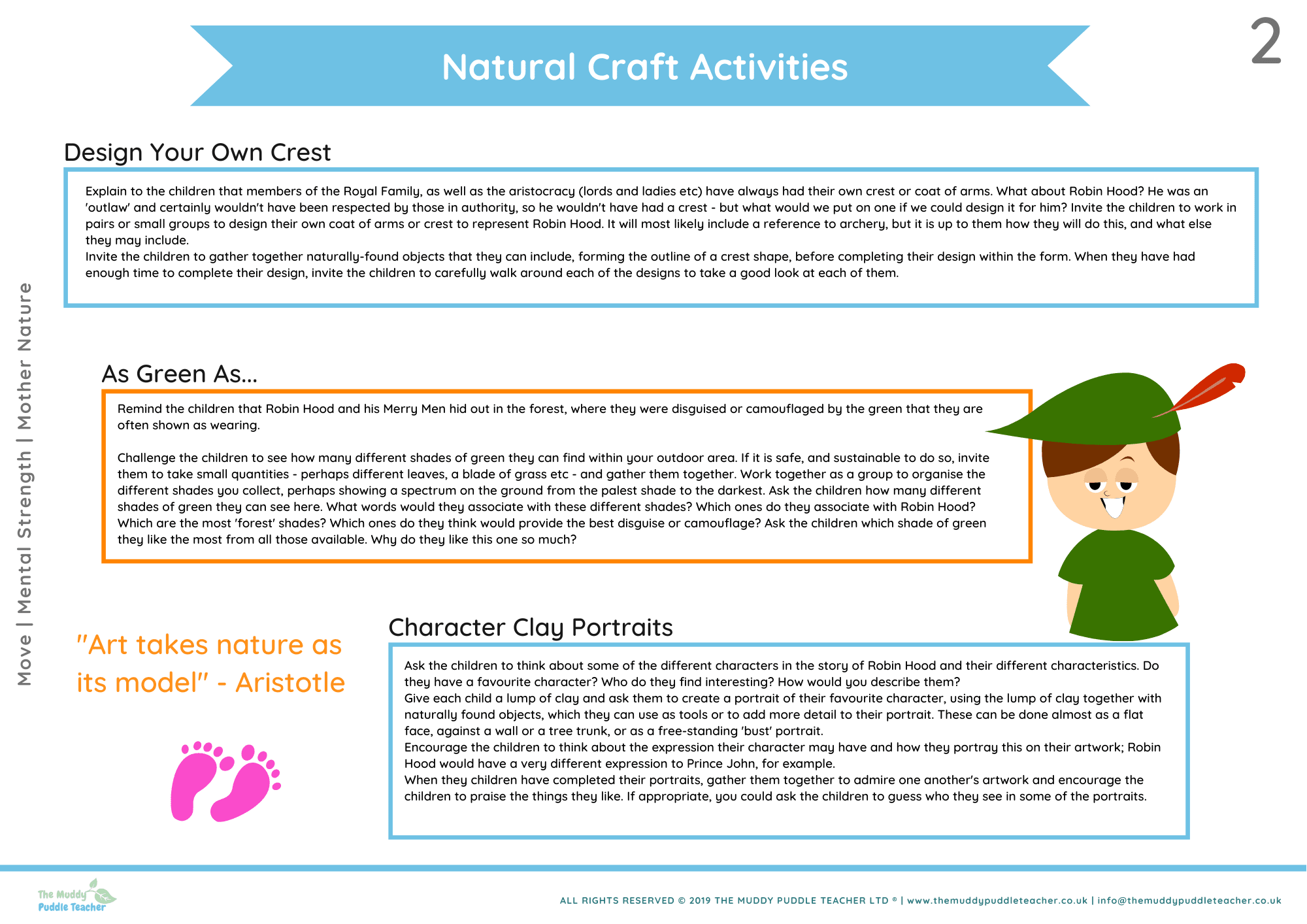
Children can build hideouts, make journey sticks, create natural maps, design woodland signs, make leaf crowns, build mini shelters for forest animals, create forest sound maps or make natural art inspired by Sherwood Forest.
They can also explore how people might have used natural materials long ago, such as sticks, leaves, bark, stones and plants.
Keep the focus on creativity, teamwork and respect for nature. The Robin Hood theme should encourage children to care for the forest, not damage it.
Robin Hood Outdoor Role Play
Role play helps children understand character, motivation and story structure.
Children can act as Robin Hood’s team, forest guards, messengers, villagers, castle workers or reporters. They can create a scene where Robin Hood receives a secret message, helps someone lost in the forest or plans a safe journey through Sherwood.
Adults can support vocabulary by modelling phrases such as, we must follow the path, the message is hidden, the Sheriff is near, the forest is quiet, the team must work together, the hideout is safe.
Role play supports speaking, listening, confidence and comprehension.
Robin Hood Activities for Children Who Need More Support
Robin Hood outdoor learning can support children who need movement, visuals, repetition or practical experiences.
Some children may find it easier to join in by building a hideout, carrying materials, following a picture clue, matching objects, acting out a role, drawing a map or choosing natural objects.
Use clear instructions, simple story cards and repeated language. Children do not need to write straight away. They can show understanding through actions, building, pointing, talking, sorting and role play.
For children who enjoy strong interests such as maps, forests, castles, animals or adventure, this topic can be very motivating.
Robin Hood Activities for Greater Challenge
For children who are ready for more challenge, ask them to create their own Robin Hood adventure.
They could design a map with symbols, write clues for another group, compare two routes, write a persuasive letter from Robin Hood, debate whether Robin Hood was right or wrong, or create a new character who joins the Merry Men.
You might ask them to explain their choices using because. For example, we put the hideout behind the tree because it was hidden, or Robin Hood should help the villagers because they were hungry.
This deepens language, reasoning and storytelling.
Want Ready-to-Use KS1 Robin Hood Resources?
The Muddy Puddle Teacher® helps busy teachers save planning time with simple, curriculum-linked outdoor learning resources.
Inside the Muddy Puddle Teacher® membership, you will find ready-to-use KS1 outdoor learning activities, story-linked lessons, Robin Hood-style outdoor ideas, literacy prompts, maths links, geography activities, SEND support, forest school activities and simple planning to help you take learning outside.
Our resources are designed to help you use your school grounds, reduce planning stress and make outdoor learning feel manageable, purposeful and fun.
Ready for More KS1 Outdoor Learning Ideas?
If you enjoyed these KS1 Robin Hood outdoor learning activities, you can access hundreds more outdoor learning resources inside The Muddy Puddle Teacher®.Download this resource and 1000’s more – take a 60-day free trial. outdoor learning resources for KS1, EYFS, KS2, SEND, forest school, outdoor play, literacy, maths, history, geography and story-linked teaching.
Start with one Sherwood Forest hideout, one outdoor map or one secret message trail, then build from there.
Outdoor learning does not have to be complicated. It just needs a story, a space and a simple adventure.
KS1 Robin Hood FAQs
How can I teach Robin Hood outdoors?
You can teach Robin Hood outdoors by creating a Sherwood Forest trail, building a hideout, making maps, writing secret messages, acting in role, following clues and using natural materials for storytelling.
Is Robin Hood suitable for KS1?
Yes. Robin Hood can be suitable for KS1 when taught in an age-appropriate way. Focus on forests, adventure, teamwork, fairness, maps, storytelling and helping others.
What outdoor activities work well for Robin Hood?
Good Robin Hood outdoor activities include building hideouts, creating forest maps, writing secret messages, following clue trails, making woodland signs, acting in role, designing routes and exploring fairness through discussion.
How does Robin Hood link to outdoor literacy?
Robin Hood links to outdoor literacy through storytelling, character work, wanted posters, secret messages, diary writing, map labels, forest descriptions, role play and new adventure writing.
How does Robin Hood link to geography?
Robin Hood links to geography through maps, routes, landmarks, directions, forest settings, paths, castles, villages and positional language.
Can Robin Hood support SEND learners?
Yes. Robin Hood activities can support SEND learners because they are practical, visual and active. Children can join in through building, role play, maps, clues, movement, natural objects and repeated story language.
Do I need a forest to teach Robin Hood outdoors?
No. You can create a Robin Hood outdoor learning experience using a playground, field, school grounds, garden, local park, trees, bushes, crates, chalk, sticks and natural loose parts.