
Goldilocks and the Three Bears Outdoor Learning Activities
Looking for simple Goldilocks and the Three Bears activities you can take outside? This traditional tale is perfect for outdoor learning because children can explore size, measure, temperature, materials, homes, feelings, choices, story sequencing, role play and descriptive language in a practical way. Learn more about Early Years Outdoors, explore the Beginners Guide to EYFS Outdoor Learning.
Goldilocks and the Three Bears works beautifully for EYFS, Reception and KS1 because the story is familiar, repetitive and full of clear contrasts. Children can compare big, medium and small, hot, warm and cold, hard and soft, full and empty, broken and fixed, safe and unsafe.
At The Muddy Puddle Teacher®, we believe outdoor literacy should feel simple, playful and meaningful. You do not need expensive resources or a complicated setup. Bowls, spoons, chairs, crates, sticks, leaves, stones, chalk, clipboards, blankets, story cards and your outdoor space are enough to create rich outdoor learning through a well-loved story. Like this resource? Download this and 100’s others now.
New to Outdoor Literacy? Start Here
If outdoor literacy feels overwhelming, start with one part of the story and one clear outdoor activity.
Goldilocks and the Three Bears is a great story to begin with because children already understand the pattern. They know there are three bowls, three chairs, three beds and three bears. This makes it easy to link the story to outdoor maths, language, role play and problem-solving.
Start small. You might create a bear cottage outdoors using crates and fabric, set up three bowls in the mud kitchen, draw a story path with chalk or ask children to sort natural objects into big, medium and small.
The key is to make the story active. Children do not need to sit still to understand characters, setting and events. They can move through the story, build it, compare it, act it out and talk about it.
Try This Tomorrow
If you only do one thing, try this quick outdoor Goldilocks activity.
Big, Medium and Small Bear Trail
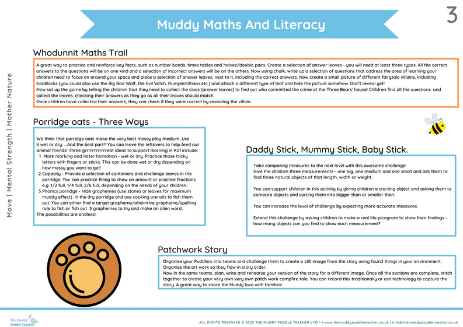
Take children outside and create three bear spaces, one for Daddy Bear, one for Mummy Bear and one for Baby Bear. Ask children to collect natural objects and sort them into big, medium and small.
They might sort sticks, stones, leaves, pine cones, bowls, spoons, cups, chairs, crates or blocks.
Time: 15–20 minutes
Prep: Low
Resources: Three hoops, chalk circles, trays or labelled spaces, natural objects, bowls or loose parts
Learning: Size language, sorting, comparing, early maths, story links, speaking and listening
As children sort, adults can add language such as this stick is too big for Baby Bear, this stone is smaller than that one, which bowl is medium-sized, can you find something bigger, can you put them in order?
This gives children a quick outdoor literacy and maths success without needing lots of preparation.
Why Goldilocks and the Three Bears Works Well Outdoors
Goldilocks and the Three Bears works well outdoors because the story is full of things children can explore practically.
Children can compare sizes using natural objects, test textures using outdoor materials, create bear homes, make porridge in the mud kitchen, act out the story, build beds from leaves and sticks or draw a map of Goldilocks’ journey through the woods.
The outdoor environment gives children real materials to touch, move, sort and describe. This helps them understand vocabulary such as enormous, tiny, medium, hard, soft, smooth, rough, warm, cold, full, empty, broken, comfortable and uncomfortable.
Outdoor learning also helps children explore the feelings and choices in the story. Was Goldilocks curious, rude, frightened, brave or sorry? How did the bears feel when they came home? What should Goldilocks have done differently?
This turns a familiar traditional tale into a rich outdoor learning experience. Head to the Outdoor Early Years Hub for more ideas.
Goldilocks Story Retelling Outdoors
Outdoor spaces are ideal for retelling Goldilocks and the Three Bears.
You can create a simple story trail with different areas for the woods, the bears’ cottage, the porridge table, the chairs and the beds. Children can move from place to place, retelling the story with actions, voices and repeated phrases.
They might pretend to knock on the door, taste the porridge, sit on the chairs, test the beds and run away through the woods.
Use chalk arrows, natural objects, picture cards, bowls, spoons, crates or fabric to help children remember the sequence.
This supports oral storytelling, memory, sequencing, vocabulary and confidence before children write.
Goldilocks Outdoor Writing Ideas
Once children have explored the story outside, writing becomes easier and more purposeful.
Children could write labels for the bears’ cottage, signs saying do not enter, sorry letters from Goldilocks, speech bubbles for the bears, instructions for making porridge, wanted posters, story maps, character descriptions or a new ending where Goldilocks makes better choices.
The outdoor experience gives children something real to write about. They have sorted the bowls, built the beds, walked through the woods and acted as the characters.
You might use sentence stems such as, Goldilocks felt, Baby Bear said, the porridge was, the chair was too, the bed was too, next time Goldilocks should.
This helps children move from talk and play into meaningful writing.
Goldilocks Outdoor Maths Links
Goldilocks and the Three Bears is brilliant for outdoor maths because it naturally includes three, size, order, comparison and measure.
Children can sort natural objects into big, medium and small, order sticks by length, compare the size of bowls, count three spoons, make three beds, create patterns for the bears, measure footprints, count steps through the woods or compare full and empty bowls in the mud kitchen.
You might ask questions such as, which bowl is biggest, which stick is shortest, can you find three leaves for Baby Bear, how many chairs do the bears need, which bed is longest, can you put the objects in order?
This makes maths practical, playful and linked to the story.
Goldilocks Outdoor Science Links
The story also links well to simple science and materials.
Children can explore hard and soft materials by making beds for the bears. They might test leaves, grass, sticks, fabric, stones, bark or cardboard and decide which would make the most comfortable bed.
They can explore hot, warm and cold through pretend porridge play, using safe sensory materials such as oats, water, mud, leaves or petals. They can talk about temperature and how things change.
They can also investigate which materials are best for a bear cottage, a chair or a bed.
Ask questions such as, which material feels soft, which material is hard, which one would make a good bed, which one would be uncomfortable, which bowl is full, which bowl is empty?
This helps children use scientific vocabulary in a story context. Head to the Outdoor Early Years Hub for more ideas.
Goldilocks Outdoor Role Play
Role play is a powerful way for children to understand the characters and events.
Children can become Goldilocks, Daddy Bear, Mummy Bear, Baby Bear, forest animals, neighbours, police officers, reporters or cottage builders. They can act out what happened, interview the bears or help Goldilocks make things right.
A child acting as a reporter might say, I am here outside the bears’ cottage where someone has eaten the porridge and broken Baby Bear’s chair.
A child acting as Goldilocks might explain why she went inside and what she should do next.
This supports speaking and listening, confidence, empathy and comprehension.
Goldilocks and Feelings Outdoors
Goldilocks and the Three Bears is a useful story for exploring feelings and choices.
Outside, children can choose natural objects to represent how each character feels. A rough stone might show anger, a soft leaf might show kindness, a curled leaf might show worry and a bright flower might show happiness.
You can ask, how did Baby Bear feel when his chair was broken, how did Goldilocks feel when she woke up, was Goldilocks wrong to go inside, what could she do to say sorry, how can we look after other people’s things?
This helps children develop emotional literacy, empathy and PSHE skills through story and nature. Lookimng for more EYFS traditional story ideas? Explore The Three LIttle Pigs Outdoor Ideas.
Goldilocks Design and Build Challenge
Ask children to build a new chair or bed for Baby Bear using outdoor loose parts.
They might use sticks, crates, leaves, fabric, stones, cardboard or blocks. The challenge is to make it strong, comfortable and the right size for Baby Bear.
Children can test their design using a toy bear or small object. They can then improve it if it falls, wobbles or feels uncomfortable.
This links beautifully to design technology, problem-solving, maths and language.
Ask questions such as, is it strong enough, is it too big, is it too small, how could you make it softer, what could you add, what would Baby Bear think?
Goldilocks and SEND Outdoor Learning
Goldilocks and the Three Bears can work well for children with SEND because the story is repetitive, familiar and practical.
Children can access the learning through sorting, building, touching materials, acting, repeating phrases, using picture cards, moving around a story trail or working with a partner.
Some children may enjoy the sensory element of oats, water, bowls, fabric, sticks and leaves. Others may enjoy the predictable pattern of three.
Outdoor learning can reduce pressure because children can show understanding through movement, objects and play rather than only through writing.
Keep instructions clear, use visuals and allow children to join in through actions, short phrases, sorting, building or choosing objects.
Want Ready-to-Use Goldilocks Outdoor Learning Resources?
The Muddy Puddle Teacher® helps busy teachers, nursery practitioners, childminders, home educators and parents save planning time with simple, curriculum-linked outdoor learning resources.
Inside the Muddy Puddle Teacher® membership, you will find ready-to-use outdoor literacy activities, traditional tale resources, EYFS and KS1 story-linked lessons, maths and science links, SEND support, forest school ideas, outdoor play resources and simple planning to help you take learning outside.
Our resources are designed to help you use your school grounds, reduce planning stress and make outdoor learning feel manageable, purposeful and fun.
Ready for More Outdoor Traditional Tale Ideas?
If you enjoyed these Goldilocks and the Three Bears outdoor learning activities, you can access hundreds more outdoor learning resources inside The Muddy Puddle Teacher®.
Like this resource? Download this and 100’s others now. Explore outdoor learning resources for EYFS, KS1, KS2, SEND, forest school, outdoor play, literacy, maths, science and story-linked teaching.
Start with one story trail, one big, medium and small sorting activity or one Baby Bear design challenge, then build from there.
Outdoor literacy does not have to be complicated. It just needs a story, a space and a simple reason for children to talk, move, compare and create.
Goldilocks and the Three Bears FAQs
How can I teach Goldilocks and the Three Bears outdoors?
You can teach Goldilocks and the Three Bears outdoors by creating a story trail, sorting objects into big, medium and small, making porridge in the mud kitchen, building beds and chairs, acting out the story and using natural loose parts to retell it. Head to the Outdoor Early Years Hub for more ideas.
What outdoor activities work well for Goldilocks and the Three Bears?
Good outdoor activities include big, medium and small sorting, outdoor story trails, bear cottage role play, porridge mixing, bed building, chair design challenges, character interviews, story mapping and feelings activities using natural objects.
Is Goldilocks and the Three Bears good for KS1 outdoor learning?
Yes. Goldilocks and the Three Bears is ideal for KS1 outdoor learning because it links to literacy, maths, science, design technology, PSHE, speaking and listening and imaginative play.
How does Goldilocks link to outdoor maths?
Goldilocks links to outdoor maths through counting, sorting, comparing, ordering, measuring, size language, capacity, full and empty, big, medium and small, and the number three.
How does Goldilocks support outdoor writing?
Outdoor Goldilocks activities give children practical experiences to write about. They can write labels, signs, sorry letters, speech bubbles, instructions, story maps, character descriptions and alternative endings.
Can Goldilocks activities support SEND learners?
Yes. Goldilocks activities can support SEND learners because the story is repetitive, familiar and practical. Children can join in through movement, sorting, building, sensory play, repeated phrases, visuals and role play.
Do I need special resources for Goldilocks outdoor learning?
No. You can use simple resources such as bowls, spoons, crates, sticks, leaves, stones, fabric, chalk, clipboards, blankets, toy bears, picture cards and natural loose parts.