
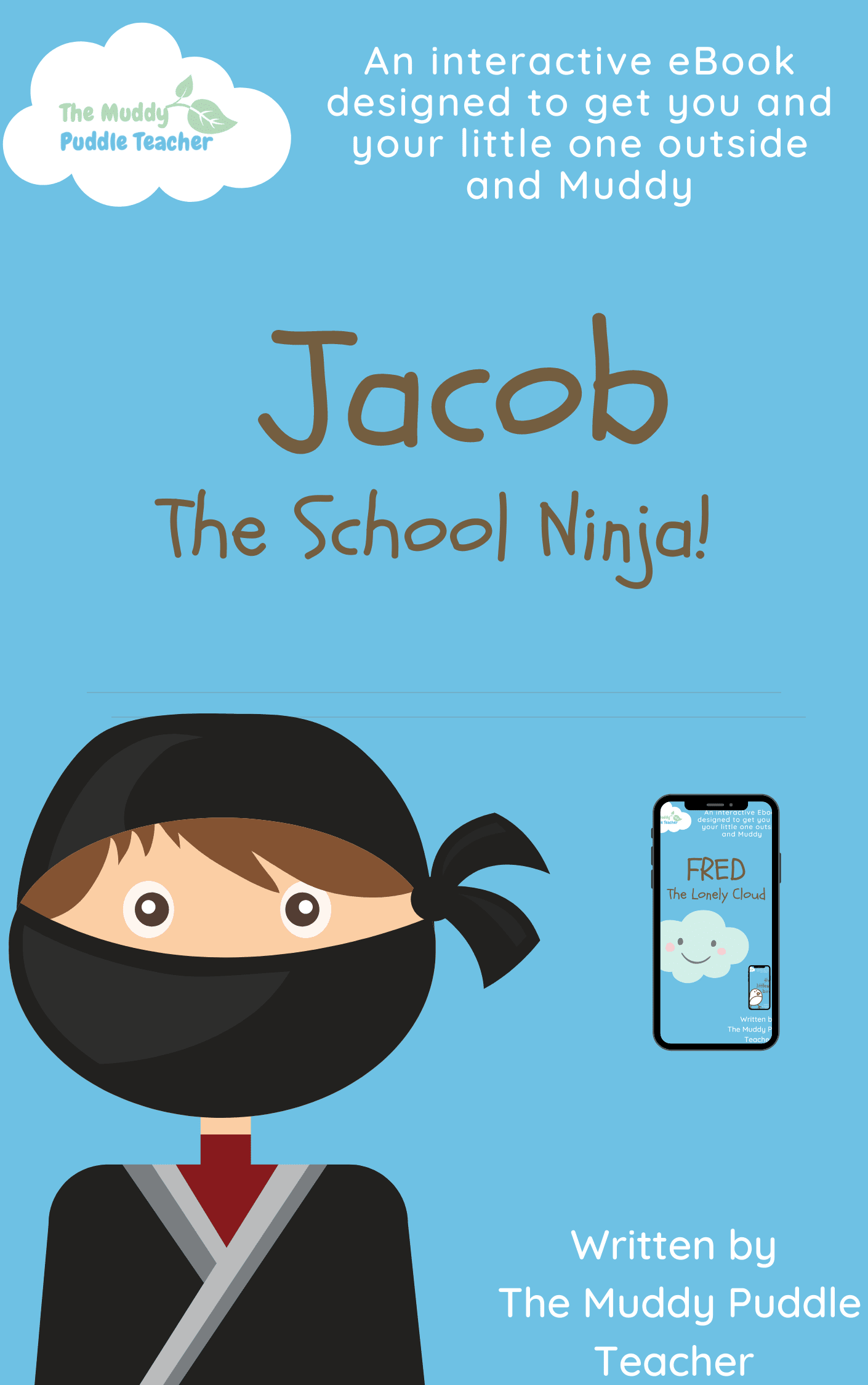
Looking for a simple outdoor comprehension lesson linked to the Jacob the Ninja EBook? Taking comprehension outdoors is a brilliant way to help children understand characters, settings, vocabulary, sequencing, inference and prediction through movement, talk and active learning. New to outdoor learning? Explore the Begginers Guide to Outdoor Learning.
Comprehension does not always have to happen at a desk. Some children understand a story more deeply when they can step into it, act it out, follow a trail, collect clues, discuss character choices and respond practically before writing answers down.
At The Muddy Puddle Teacher®, we believe reading should feel active, inclusive and meaningful. An outdoor comprehension lesson gives children a chance to move, think, talk and respond to the text in a way that supports confidence, especially for children who find written comprehension tricky. Download this outdoor maths resource and thousands more – take a 60-day free trial.
New to Outdoor Comprehension? Start Here
If outdoor comprehension feels new, begin with one part of the story and one clear reading skill.
You might focus on predicting what Jacob will do next, ordering key events, finding clues about how Jacob feels, exploring new vocabulary, discussing character choices or answering questions about the setting.
The key is to make the comprehension physical before making it written. Children can move between question stations, act out scenes, match clues to answers, place events in order, create freeze frames or choose natural objects to represent feelings.
This helps children understand that comprehension is not just answering questions. It is about thinking carefully about the text.
Try This Tomorrow
Jacob the Ninja Story Trail
Take children outside and create a simple Jacob the Ninja comprehension trail. Place question cards, picture prompts or key vocabulary around the outdoor area. Children move from station to station, reading each prompt and discussing their answer with a partner before recording or sharing.
Time: 25–35 minutes
Prep: Low
Resources: Jacob the Ninja EBook, question cards, clipboards, pencils, chalk, cones or natural markers
Learning: Reading comprehension, retrieval, inference, prediction, vocabulary, sequencing and speaking and listening
You might include prompts such as, what do we know about Jacob so far, how do you think Jacob feels here, what clue tells you that, what might happen next, which word shows movement, what would you do if you were Jacob?
This gives children a practical way to engage with the story and makes comprehension feel more active.
Why Take Comprehension Outdoors?
Outdoor comprehension works well because it gives children space to think, talk and respond in different ways.
Some children find comprehension difficult because they are expected to read, process, infer and write at the same time. Taking the lesson outdoors breaks this down. Children can talk first, move between ideas, use drama, discuss vocabulary and rehearse answers before recording them.
Outdoor comprehension can support reading, writing, speaking and listening, drama, PSHE, SEND and wellbeing. It can also help children who need movement, sensory input or practical experiences to stay engaged.
The aim is still strong reading comprehension. The outdoors simply gives children another route into the text.
Jacob the Ninja Retrieval Questions Outdoors
Retrieval questions help children find information from the text.
Outside, you can turn retrieval into a hunt. Place answers or clues around the outdoor space and ask children to match them to questions about the story.
Children might look for key facts about Jacob, the setting, what happened first, what Jacob did, who he met or what problem appeared in the story.
You could ask, where was Jacob, what did Jacob do first, who was involved, what object was important, what happened after that?
This helps children practise looking back at the text and finding evidence. Download this outdoor maths resource and thousands more – take a 60-day free trial.
Jacob the Ninja Inference Activities
Inference can feel tricky, but outdoor learning makes it more practical.
Ask children to choose natural objects to represent how Jacob might feel at different points in the story. A smooth stone might show calm, a sharp stick might show danger, a curled leaf might show worry, a bright flower might show bravery or excitement.
Then ask children to explain their choice using evidence from the text.
You might ask, how do we know Jacob is nervous, what clue tells us he is brave, why might Jacob behave in that way, what is he thinking but not saying, what would his face look like at this point?
This helps children connect feelings, evidence and explanation.
Jacob the Ninja Prediction Activities
Prediction works beautifully outdoors because children can physically step into the next part of the story.
Pause the EBook at an exciting moment and ask children to move to one of three prediction zones. Each zone represents a possible next event.
Children choose a zone, then explain why they think that might happen using clues from the story.
You might ask, what do you think Jacob will do next, what clue helped you decide, what might go wrong, how could Jacob solve the problem, what would be a surprising ending?
This helps children understand that predictions should be based on evidence, not random guesses.
Jacob the Ninja Vocabulary Activities
A ninja story is a great opportunity to explore action vocabulary.
Take key words from the Jacob the Ninja EBook and place them around the outdoor area. Children can read each word, act it out, match it to a meaning, use it in a sentence or find a natural object that represents the word.
Words might link to movement, stealth, bravery, speed, danger, problem-solving or feelings.
Children could act out words such as creep, leap, hide, dash, sneak, pounce, freeze, tumble, whisper or rescue, depending on the vocabulary in the EBook.
This helps children understand vocabulary physically and verbally before using it in writing.
Jacob the Ninja Sequencing Outdoors
Sequencing helps children understand the structure of the story.
Write key events from Jacob the Ninja onto cards and place them out of order around the outdoor area. Children collect the cards, discuss them and place them in the correct order on the ground.
They can use first, next, then, after that, finally to retell the story.
For more challenge, remove one event and ask children to identify what is missing. You could also ask children to create freeze frames for each key event.
This supports comprehension, oral retelling and story structure.
Jacob the Ninja Character Work
Outdoor drama is a strong way to explore Jacob as a character.
Children can create freeze frames showing Jacob at different moments in the story. They might show Jacob being brave, worried, determined, surprised, careful or proud.
After each freeze frame, ask children to explain what Jacob might be thinking and feeling.
You might ask, what kind of character is Jacob, how does he change, what does he want, what problem does he face, what choices does he make, what can we learn from him?
This helps children move beyond basic answers and think more deeply about character.
Jacob the Ninja Setting Activities
If the story has an exciting setting, take children outside and ask them to create a ninja-style setting using natural materials.
They might build a secret path, hideout, obstacle route, quiet corner, training area or mission trail. Then ask children to describe the setting using vocabulary from the story.
This supports comprehension because children are thinking about where the story happens and how the setting affects the character.
Children can then write setting descriptions, map labels or short story openings linked to Jacob’s world.
Outdoor Comprehension and Writing
Outdoor comprehension can lead naturally into writing.
After exploring Jacob the Ninja outside, children might write answers to comprehension questions, a character description, a diary entry, a prediction paragraph, a retelling, a new mission for Jacob or a book review.
Because children have moved, talked, acted and gathered ideas first, their written responses are usually stronger.
You might use sentence stems such as, I think Jacob feels, I know this because, the clue in the text is, I predict, the most important event was, Jacob is a good character because.
This helps children structure their answers clearly. Find more comprehsnion activities for KS1 Outdoor activities – The Lonely Cloud.
Outdoor Learning Comprehension: Fred the Lonely Cloud (eBook)
Supporting Children Who Find Comprehension Difficult
Some children find comprehension hard because they struggle with decoding, language, memory, attention or written responses.
Outdoor comprehension can help because it breaks the task into smaller, more active steps. Children can listen, move, point, choose, act, talk and match before writing.
Use short questions, visual prompts, partner talk and repeated sentence stems. Allow children to show understanding in different ways, such as choosing an object, standing in a prediction zone, ordering picture cards or acting out a scene.
The aim is to help children access the meaning of the text, not to make the task harder.
Greater Challenge for Confident Readers
For children who are ready for more challenge, ask them to justify their answers using evidence.
They can compare Jacob with another character, explain how his feelings change, identify the most important turning point, discuss the author’s word choices or create their own comprehension questions for another group.
You might ask, what evidence supports your answer, which word is most effective, how does the author build tension, what would change if Jacob made a different choice, what question would test someone’s understanding of the story?
This helps children think more deeply about the text.
Want Ready-to-Use Outdoor Comprehension Resources?
The Jacob the Ninja EBook can be used as part of an active outdoor comprehension lesson where children explore retrieval, inference, prediction, vocabulary and sequencing through movement and discussion.
Inside The Muddy Puddle Teacher® membership, you will find ready-to-use outdoor literacy resources, comprehension lessons, story-linked activities, phonics and reading ideas, SEND support, forest school links and simple planning to help you take learning outside.
Our resources are created to save teachers time, reduce planning stress and make reading feel purposeful, active and inclusive.
Ready for More Outdoor Literacy Ideas?
If you enjoyed this Outdoor Comprehension Lesson: Jacob the Ninja EBook, you can access hundreds more outdoor learning resources inside The Muddy Puddle Teacher®.
Download this outdoor maths resource and thousands more – take a 60-day free trial. explore outdoor learning resources for EYFS, KS1, KS2, SEND, forest school, outdoor play, English, reading, comprehension and story-linked teaching.
Start with one story trail, one prediction zone or one character freeze frame, then build from there.
Outdoor comprehension does not have to be complicated. Sometimes, it just needs a good story, a few questions and space for children to move, talk and think.
Outdoor Comprehension Lesson FAQs
What is an outdoor comprehension lesson?
An outdoor comprehension lesson takes reading skills outside. Children explore retrieval, inference, prediction, vocabulary, sequencing and character understanding through movement, talk, drama, trails and practical tasks.
How can I use Jacob the Ninja EBook outdoors?
You can use Jacob the Ninja EBook outdoors by creating a story trail, question hunt, prediction zone, vocabulary action game, sequencing task, character freeze frame or ninja mission linked to the text.
Why teach comprehension outdoors?
Teaching comprehension outdoors helps children engage with the text through movement, discussion and practical response. It can support children who find written comprehension difficult.
What comprehension skills can children practise outdoors?
Children can practise retrieval, inference, prediction, sequencing, vocabulary, summarising, character analysis and using evidence from the text.
Can outdoor comprehension support SEND learners?
Yes. Outdoor comprehension can support SEND learners because children can respond through movement, choosing, pointing, matching, acting, partner talk and visual prompts before writing.
Do children still write answers in outdoor comprehension?
They can. Outdoor comprehension can include written answers, but children often benefit from talking, acting and exploring first, then writing afterwards.
Do I need lots of resources?
No. You can use the EBook, question cards, chalk, clipboards, pencils, cones, natural markers and your outdoor space.