a

Training & Resources

muddy puddle teacher logo

The Muddy Puddle Teacher ®

Leading with Outdoor Learning and Outdoor Play

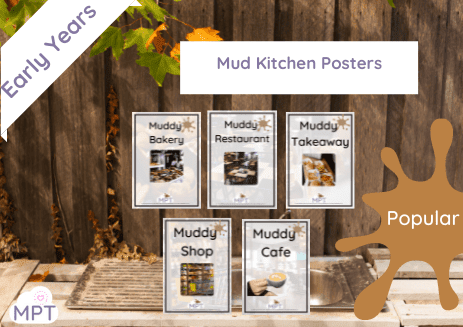
Free Muddy Kitchen (Themed Posters)

Muddy Kitchen (Themed Posters)

Download

Mud kitchens are one of the most powerful outdoor play spaces in early years. They are simple, low-cost and full of learning, but sometimes children need a little help to know how to use the space with purpose, imagination and language. New to outdoor play?  Let us help you explore the Beginners Guide to Outdoor Play.

Our free mud kitchen posters are designed to support EYFS outdoor play by giving children visual prompts, vocabulary, ideas and inspiration while they mix, stir, pour, scoop, create and imagine outside.

They can be used in nurseries, reception classes, childminding settings, preschool gardens, school playgrounds or home outdoor areas. You do not need a perfect mud kitchen. A few bowls, spoons, pans, old trays, water, soil, leaves, petals, sticks and stones can be enough to create rich learning.

These free mud kitchen posters help children see the mud kitchen as more than just messy play. They support communication and language, early writing, maths, role play, sensory exploration, fine motor skills, social skills and creativity.

You may also want to explore our Early Years Outdoors, Outdoor Play Resources and Free Outdoor Learning Resources pages.  To download this resource, take a 60-day free trial now.


What Are Free Mud Kitchen Posters?

Free mud kitchen posters are printable display resources that can be added to your outdoor mud kitchen area to support children’s play and learning.

They might include recipe ideas, vocabulary prompts, mud kitchen rules, imaginative play words, ingredient labels, number prompts, safety reminders or open-ended questions.

The aim is not to control children’s play.

The aim is to gently extend it.

A poster might encourage a child to say, “I am making soup,” instead of just tipping water. It might help another child count spoonfuls, write a menu, collect natural ingredients, describe textures or invite a friend to play.

In early years, these little prompts matter. They help children build language, confidence and independence without needing an adult to direct every moment.

A mud kitchen poster can turn a corner of the playground into a café, potion lab, bakery, soup station, woodland restaurant or nature kitchen.

For more support, link this page to Mud Kitchen Ideas EYFS, Outdoor Play Ideas for Early Years and Outdoor Learning Activities for EYFS.


Why Mud Kitchens Are So Good for EYFS Outdoor Learning

Mud kitchens are brilliant because they bring together so many areas of learning naturally.

Children are not just “playing in mud”. They are experimenting, talking, negotiating, measuring, imagining, problem-solving and developing physical skills.

When a child fills a pot with water, adds leaves, stirs with a stick and tells you they are making dinosaur soup, they are using language, storytelling, motor skills, sensory exploration and early science.

When another child says, “I need three stones and two flowers,” they are using early maths.

When a group of children decide who is the chef, who is the customer and who is writing the menu, they are practising social skills, communication and early literacy.

This is why mud kitchens are so valuable in EYFS outdoor learning. They allow children to learn through real materials, real movement and real imagination.

Our free mud kitchen posters give you an easy way to make this learning more visible.


How Can Mud Kitchen Posters Support Communication and Language?

Many children talk more freely when they are busy with their hands.

The mud kitchen gives children something to do, something to share and something to talk about.

Posters can support this by giving children words they may not use yet, such as mix, stir, scoop, sprinkle, pour, mash, collect, serve, bake, chop, recipe, ingredients, customer, chef, menu, potion, soup, café and special.

You can use the posters to model language without interrupting play too much.

You might say, “I can see you are stirring your mixture,” or, “What ingredients are you adding today?” or, “Who are you serving that soup to?”

The visual prompts help children return to these words again and again.

For children with speech and language needs, EAL learners or quieter children, mud kitchen posters can provide a gentle way into communication.

They can point, copy, repeat, choose, name and join in without pressure.

You may also want to link to Outdoor Speech and Language Ideas, SEND Outdoor Learning


How Can Mud Kitchen Posters Support Early Writing?

Mud kitchens are a wonderful place for meaningful mark making.

Children often write more willingly when the writing has a purpose.

They can write recipes, labels, menus, order forms, opening times, ingredient lists, potion names, café signs or price tags.

The free mud kitchen posters can encourage children to see writing as part of play, not as a separate adult-led task.

You could add chalkboards, clipboards, pencils, waterproof labels, old notebooks, laminated menu sheets or large pieces of cardboard.

A child who is reluctant to write indoors may happily make a sign that says “Mud Cakes 5p” because it belongs to their play.

That is the magic of outdoor learning.

It gives children a reason to write.

For more ideas, connect this page to Outdoor Mark Making, EYFS Writing Outdoors and Outdoor Literacy Activities.


How Can Mud Kitchen Posters Support Early Maths?

Mud kitchens are full of maths.

Children naturally count, compare, sort, fill, empty, measure, share and estimate while they play.

They might count spoonfuls of mud, compare full and empty containers, make two cakes for two friends, sort leaves by size, or decide which pot holds the most water.

Posters can support this by adding simple prompts such as, “Can you add three spoonfuls?”, “How many petals are in your potion?”, “Which bowl is the fullest?”, “Can you make a recipe for two people?” or “How much does your mud cake cost?”

You do not need to turn the mud kitchen into a formal maths lesson.

The best maths in the mud kitchen feels natural.

It happens through play, talk and real problem-solving.

To download this resource, take a 60-day free trial now.


What Should You Put in a Mud Kitchen?

A mud kitchen does not need to be expensive.

You can begin with old pans, spoons, bowls, baking trays, jugs, cups, sieves, muffin tins, ladles, buckets, baskets and recycled containers.

Natural ingredients make the play richer. Children can use mud, water, leaves, petals, grass, stones, sticks, herbs, pine cones, bark and seeds.

You can also add chalkboards, clipboards, recipe cards, menus, labels and posters to support literacy and language.

The best mud kitchens are open-ended.

They do not tell children exactly what to make.

They give children materials and prompts so they can create their own ideas.

That is why free mud kitchen posters are helpful. They add structure without taking away imagination.


How to Use Free Mud Kitchen Posters Outside

Print the posters, laminate them if possible, and place them near the mud kitchen at child height.

You could attach them to a fence, shed, outdoor board, mud kitchen wall or storage area.

Try not to overcrowd the space. A few clear posters are often better than too many.

You might choose one poster for vocabulary, one for recipe ideas and one for simple mud kitchen expectations.

Change them across the year to keep interest high.

In spring, children might make flower soup or garden café recipes.

In summer, they might make petal potions, ice cream shops or seaside cafés.

In autumn, they might use leaves, conkers and seed pods.

In winter, they might make warming soups, muddy pies or hot chocolate role play.

The posters are there to support the play, not dominate it.


Free Mud Kitchen Posters Are Great for Child-Led Play

Mud kitchens work best when children feel ownership.

They need time to explore, repeat, copy others, invent recipes, make a mess and return to the same ideas again and again.

Posters can help adults step back.

Instead of constantly giving instructions, adults can point children towards the visual prompts and ask simple questions.

“What could you make today?”

“What ingredients will you need?”

“How will you serve it?”

“What could you write on your menu?”

This keeps the play child-led but still rich in learning.

It also helps staff see the value of mud kitchen play, especially when they need to explain to parents or leaders why messy outdoor play matters.

For more support, head to the Early Years Outdoors Hub. 


Download the Free Mud Kitchen Posters

Download our free mud kitchen posters and add them to your EYFS outdoor area, nursery garden, reception playground or home learning space.

They are designed to help children talk, imagine, create, count, write and play with purpose outside.

You can also sign up for our Free Outdoor Learning Magazine for weekly outdoor ideas. To download this resource, take a 60-day free trial now. to access thousands of outdoor learning resources for EYFS, KS1, KS2, SEND, outdoor play and wellbeing.

Suggested Podcast Embed

Embed a relevant Muddy Puddle Teacher podcast episode about early years outdoor play, child-led learning, outdoor provision, sensory play or outdoor learning in EYFS.


FAQ Section

What age are the free mud kitchen posters suitable for?

The posters are ideal for nursery, preschool, reception and early years outdoor play. They can also be used with KS1 children who enjoy role play, messy play and outdoor learning.

Do I need a proper mud kitchen to use these posters?

No. You can use the posters with a simple outdoor table, tray, crate, bench, tuff tray or corner of the playground. Add bowls, spoons, water, mud and natural objects and children can begin playing.

Can mud kitchen posters support learning?

Yes. Mud kitchen posters can support communication, vocabulary, early writing, maths, imagination, social skills, sensory play and fine motor development.

Are mud kitchens good for children with SEND?

Yes. Mud kitchens can be very helpful for children who need sensory input, movement, repetition, practical learning and open-ended play. Visual posters can also support children who benefit from prompts and structure.

How should I display mud kitchen posters outside?

Print and laminate them if possible, then attach them at child height near the mud kitchen. Keep the display simple so children can easily see and use the prompts during play.


Author Box

Written by Sarah Seaman PGCE MA
Founder of The Muddy Puddle Teacher®
Teacher for over 19 years
Bloomsbury author
Trainer of thousands of teachers across the UK

The Muddy Puddle Teacher® helps educators use outdoor learning, outdoor play and nature-based resources to make teaching more active, inclusive and joyful.

You need a subscription to download this file. Log in/Upgrade or Sign up. Feel free to Send us a message if you need help.

New in