
a

Training & Resources

muddy puddle teacher logo

The Muddy Puddle Teacher ®

Leading with Outdoor Learning and Outdoor Play

Home 9 Outdoor Learning Resources 9 Focused Feet Barefoot Therapy
Focused Feet Barefoot Therapy

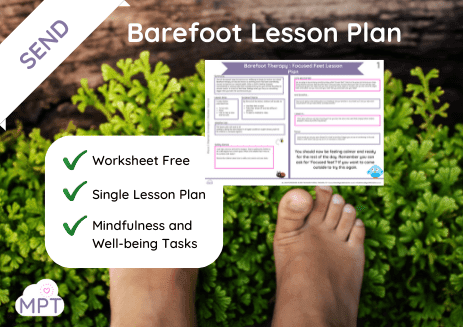
Focused Feet Barefoot Therapy

Download

Outdoor Learning Ideas to Support Regulation, Balance and Sensory Development

Looking for simple barefoot therapy ideas to support children’s regulation, balance, sensory development and body awareness? This guide gives teachers, SENDCos, teaching assistants, nurture staff, and early years practitioners practical ways to use safe, barefoot outdoor learning to help children feel grounded, focused, and connected to their bodies. For more inspiration, head to the Physical Development Outdoors Hub. 

Focused Feet barefoot therapy is about slowing children down and helping them notice what is under their feet. It can support sensory processing, coordination, balance, confidence and calm. For some children, especially those with SEND, anxiety, ADHD, autism, dyspraxia or sensory processing differences, barefoot outdoor experiences can offer helpful sensory input when planned carefully.

This does not mean children should be made to take their shoes off or walk barefoot in unsafe spaces. It means giving children safe, optional, carefully supervised opportunities to explore texture, pressure, balance and movement through their feet. Need a starting point?  Explore our Beginners Guide to Outdoor Learning for SEND. 

The aim is simple: calm bodies, focused minds and connected children. Download now and take a 60-day free trial.


Quick Answer: What Is Focused Feet Barefoot Therapy?

Focused Feet barefoot therapy is a gentle outdoor sensory activity where children safely explore different textures, movements and surfaces using their feet. It can help support regulation, balance, coordination, sensory awareness, grounding and focus.

Barefoot activities may help children:

  • notice their body

  • improve balance

  • develop foot strength

  • experience calming sensory input

  • practise coordination

  • slow down and focus

  • connect with nature

  • regulate through gentle movement

  • explore textures safely

  • build confidence outdoors

For children who are constantly rushing, dysregulated, anxious or disconnected from their body, barefoot therapy can become a simple outdoor regulation tool.

We do have specific packs on all areas. of SEND, explore our Dyscalculia Handbook. 

Outdoor Dyscalculia Handbook


New to Barefoot Therapy Outdoors? Start Here

If barefoot therapy feels unusual or risky, start very small.

You do not need children walking around the whole playground without shoes. You can begin with a small, safe, supervised space.

Start with:

  1. A clean mat or tray

  2. A few safe natural textures

  3. A clear choice to join in or watch

  4. A towel and water nearby

  5. A calm adult leading the activity

The most important rule is choice.

Some children will love barefoot sensory work. Others will dislike it or feel anxious. That is okay. Children should never be forced to take off shoes or socks.

They can take part by:

  • looking

  • touching with hands

  • wearing socks

  • standing on one texture only

  • using a brush or object

  • watching first

  • choosing a preferred surface

Barefoot therapy works best when it feels safe, calm and child-led. Download now and take a 60-day free trial.


Try This Tomorrow: The Barefoot Texture Tray

If you only try one Focused Feet activity, try this.

Barefoot Texture Tray

Time: 5–10 minutes
Prep: Low
Resources: Shallow trays, towel, warm water, safe textures
Learning links: PSHE, science, sensory language, physical development, communication
SEND focus: Sensory regulation, body awareness, balance, confidence

Create two or three shallow trays with safe textures.

Try:

  • smooth pebbles

  • grass

  • dry leaves

  • soft fabric

  • sand

  • bark chips suitable for children

  • warm water

  • foam matting

Invite children to step into one tray at a time.

Use calm language:

  • “What can your feet feel?”

  • “Is it soft or hard?”

  • “Is it warm or cold?”

  • “Do your feet want more or less?”

  • “Can you stand still and breathe?”

Children can describe, point, show thumbs up or down, or simply experience the texture quietly.

Why this works

This activity helps children slow down and notice their body. The feet have lots of sensory receptors, so exploring texture through the feet can support grounding and body awareness.

It also gives adults a gentle way to introduce sensory language such as rough, smooth, soft, cold, warm, bumpy and calm.


Why Barefoot Outdoor Learning Can Support Children

Children spend a lot of time in shoes, sitting down, moving quickly or being told to keep still. Barefoot outdoor learning gives them a chance to notice the ground, adjust their balance and feel different textures directly.

For some children, this can support:

  • proprioception

  • vestibular awareness

  • balance

  • sensory processing

  • coordination

  • emotional regulation

  • attention

  • confidence

  • physical development

It can be especially helpful when used as a calm routine rather than a chaotic sensory activity.

Barefoot therapy should not be about excitement and mess for the sake of it. It should be slow, purposeful and safe.


Safety First: Barefoot Therapy in Schools

Before using barefoot therapy outdoors, always check your setting’s health and safety procedures.

Consider:

  • Is the surface clean and safe?

  • Is there glass, litter, sharp stones or animal mess?

  • Do children have cuts, verrucas or foot conditions?

  • Is parental consent needed?

  • Are children comfortable taking part?

  • Is the activity supervised closely?

  • Is there a towel and water available?

  • Can children stop at any time?

  • Are allergies or skin sensitivities considered?

For schools, it may be better to start with barefoot trays, mats or a controlled sensory path rather than asking children to walk freely outdoors.

Always make the activity optional and inclusive.


Focused Feet Barefoot Therapy Idea 1: The Sensory Foot Path

A sensory foot path is a short barefoot route using safe textures. It can be used as a regulation activity, nurture group task, sensory circuit or calm outdoor intervention.

How to Set It Up

Create a short path using trays, mats or clearly marked sections.

You might include:

  1. Soft fabric

  2. Smooth pebbles

  3. Grass

  4. Sand

  5. Warm water

  6. Towel finish

Keep the path short at first.

Children walk slowly along the path and notice how each surface feels.

Use repeated language:

“Step. Feel. Breathe. Notice.”

What It Supports

The sensory foot path can support:

  • balance

  • coordination

  • sensory processing

  • emotional regulation

  • body awareness

  • vocabulary

  • confidence

  • calm transitions

It can be especially useful before a focused task, after playtime or during nurture group sessions.

How to Adapt It for SEND

For children with SEND, offer choices.

They could:

  • walk with shoes on first

  • wear socks

  • touch textures with hands

  • step on only one tray

  • hold an adult’s hand

  • use a visual first/then card

  • stop whenever needed

The child should feel in control. Sensory work should never become a battle.

Adult Language That Helps

Use calm, short phrases:

  • “Try one step.”

  • “You can stop.”

  • “Soft grass.”

  • “Bumpy stones.”

  • “Your body is noticing.”

  • “Stand still and breathe.”

  • “Shoes back on when you are ready.”

Avoid over-talking. Let the child experience the sensation.


Focused Feet Barefoot Therapy Idea 2: Grounding Feet Routine

A grounding feet routine is a simple, repeated barefoot activity that helps children settle their body and attention. Head to th SEND Hub for more resources. 

It works well as:

  • a morning regulation routine

  • a nurture group opener

  • a sensory break

  • a calm-down strategy

  • a transition support activity

  • a mindful outdoor learning moment

How to Do It

Ask children to stand barefoot on a safe mat, grass patch or tray.

Guide them through this simple routine:

  1. Stand still.

  2. Press toes into the ground.

  3. Lift toes up.

  4. Press heels down.

  5. Rock gently forwards and backwards.

  6. Take three slow breaths.

  7. Say or show how your feet feel.

Keep it short and calm.

What It Supports

This routine can support:

  • grounding

  • balance

  • focus

  • body awareness

  • emotional regulation

  • calm breathing

  • sensory feedback

  • readiness to learn

It gives children a physical way to pause.

Instead of saying, “Calm down,” we are helping the body find calm through movement, pressure and breath. Download now and take a 60-day free trial.

How to Use It in School

You could use this routine:

  • before phonics

  • before writing

  • after lunch

  • after a busy playtime

  • before a nurture group session

  • during an outdoor SEND intervention

  • before coming back inside

Use the same words each time so children learn the routine.

Example:

“Feet on the ground.
Toes press down.
Heels press down.
Breathe in.
Breathe out.
Ready.”


How Focused Feet Can Support SEND

Focused Feet barefoot therapy can be useful for children who need support with:

  • sensory regulation

  • balance

  • coordination

  • body awareness

  • anxiety

  • attention

  • transitions

  • emotional regulation

  • confidence outdoors

  • physical development

It may support children with:

  • autism

  • ADHD

  • dyspraxia

  • SEMH needs

  • sensory processing differences

  • anxiety

  • nurture needs

  • movement needs

But every child is different. For some children, barefoot work may be calming. For others, it may feel too much. The care plan should always follow the child. 

For more bespoke work for specific needs, try this Outdoor Ideas Pack for Dyslexia Students. 

Outdoor Handbook Dyslexia


How to Make Barefoot Therapy Inclusive

Make It Optional

Children should be able to choose how they take part.

Start Small

Begin with one safe texture and a short time.

Use Visuals

Use simple cards:

  • shoes off

  • step

  • feel

  • stop

  • shoes on

  • wash feet

Offer Alternatives

Children can touch with hands, wear socks or watch first.

Keep It Calm

Avoid turning the activity into a noisy race.

Use Sensory Language

Teach words such as:

  • soft

  • rough

  • smooth

  • bumpy

  • cold

  • warm

  • wet

  • dry

  • tickly

  • heavy

  • light

Link It to Regulation

Use barefoot therapy as part of a calm routine, not just a novelty activity.


Want Ready-to-Teach Outdoor Learning and SEND Resources?

The Muddy Puddle Teacher Club helps busy teachers save planning time with ready-to-use outdoor learning resources, SEND ideas and sensory-friendly activities.

Inside the club, you can find support for:

  • outdoor learning for SEND

  • sensory outdoor learning

  • regulation routines

  • nurture group ideas

  • outdoor wellbeing activities

  • EYFS outdoor provision

  • KS1 and KS2 outdoor learning

  • practical curriculum-linked activities

  • simple ideas you can use straight away

Head to th SEND Hub for more resources. 

This is ideal if you want outdoor learning to feel simple, safe and purposeful without spending hours planning from scratch.Download now and take a 60-day free trial.


FAQs About Focused Feet Barefoot Therapy

What is Focused Feet barefoot therapy?

Focused Feet barefoot therapy is a gentle sensory activity where children safely explore textures and grounding movements through their feet. It can support regulation, balance, coordination, sensory awareness and calm.

Is barefoot therapy safe in schools?

Barefoot therapy can be used safely in schools if it is carefully risk assessed, supervised and optional. Use clean trays, safe textures, mats or controlled areas rather than unsafe outdoor surfaces.

How can barefoot therapy support SEND?

Barefoot therapy may support SEND by helping children develop body awareness, balance, sensory regulation, confidence and calm. It can be especially useful when adapted to the child’s sensory needs.

Should children be forced to take their shoes off?

No. Children should never be forced to take off shoes or socks. Barefoot therapy should always be optional. Children can watch, touch textures with their hands, wear socks or choose one safe texture.

What textures can I use for barefoot sensory play?

You can use safe textures such as grass, soft fabric, smooth pebbles, sand, dry leaves, warm water, foam mats or child-safe bark. Always check for sharp objects, allergies and hygiene. Head to th SEND Hub for more resources. 

How long should a barefoot therapy session last?

Start with 5 to 10 minutes. Short, calm sessions are usually more effective than long or overstimulating activities.

Can barefoot therapy help with regulation?

Yes, for some children, barefoot sensory activities can help regulation by providing grounding sensory input, slow movement and body awareness. It should be used calmly and consistently.

What age is barefoot therapy suitable for?

Barefoot therapy can be adapted for early years, KS1, KS2 and SEND settings, as long as it is safe, supervised and appropriate for the child.


Ready for More Outdoor Sensory and SEND Ideas?

If you want outdoor learning to become calmer, safer and more inclusive, join The Muddy Puddle Teacher Club.

You will find ready-to-use outdoor learning ideas, sensory activities, SEND-friendly resources and curriculum-linked planning to help children learn through movement, nature, talk and play.

Start your 60-day free trial today and begin with one simple Focused Feet activity this week.


You need a subscription to download this file. Log in/Upgrade or Take a 60 Day Free Trial. Feel free to Send us a message if you need help.

New in