
a

Training & Resources

muddy puddle teacher logo

The Muddy Puddle Teacher ®

Leading with Outdoor Learning and Outdoor Play

Home 9 Outdoor Learning Resources 9 EYFS Minibeast Activities
minibeasts

EYFS Minibeast Activities

Download

EYFS Minibeast Activities for Outdoor Learning

Looking for simple EYFS minibeast activities you can take outdoors? Minibeasts are one of the best early years topics for outdoor learning because children can search, observe, talk, count, compare, draw, build and wonder in a real natural environment. Are you new to outdoor play in the Early Years? Explore our Beginners Guide to Outdoor Play. 

Minibeast activities are perfect for Nursery, Reception, childminders and early years settings because they support curiosity, communication, understanding the world, early science, maths, literacy and sensory play.

Whether you have a playground, nursery garden, field, woodland area, mud kitchen or small outdoor space, you can use minibeasts to make outdoor learning meaningful, hands-on and exciting. Make a start, download this resource and thousands more – take a 60-day free trial.


New to Outdoor Learning? Start Here

If outdoor learning feels overwhelming, start small.

You do not need a huge outdoor area or expensive equipment. Begin with one short minibeast hunt, one observation activity or one small group exploration using magnifiers, leaves, soil, logs or stones.

The key is to make it manageable. Choose one simple activity, try it with your children, then build from there.

Outdoor learning is not about changing everything overnight. It is about helping children notice the world around them and learn through real experiences.


Try This Tomorrow

If you only do one thing, try this:

Gentle Minibeast Hunt

Take a small group outside and look carefully under leaves, near logs, around planters, in grass or close to damp soil. Encourage children to look gently, observe closely and talk about what they notice.

Time: 10–15 minutes
Prep: Low
Learning: Understanding the world, observation, communication, vocabulary, care for living things

Bring the children back together and ask, What did you find? Where was it living? How did it move? What colours could you see? How can we look after tiny creatures?

This simple activity gives children a real experience to talk about and can lead naturally into drawing, counting, storytelling, sorting or mark-making. For more Early Years Outdoor Play Ideas, head to the EYFS Outdoors Hub


Why Minibeasts Work So Well Outdoors

Minibeasts are naturally exciting for young children. They are small, surprising, easy to find and full of opportunities for questions.

Children might notice a worm moving through soil, a woodlouse hiding under a log, a snail leaving a trail, a spider web sparkling in the sun or a ladybird resting on a leaf.

These moments help children build curiosity and develop early scientific thinking.

EYFS minibeast activities can support communication, vocabulary, observation, comparison, fine motor skills, early maths, mark-making, storytelling, care for living things and confidence outdoors.

Instead of only learning about minibeasts from a picture or worksheet, children can experience them in real life. Looking for play resources? Try our Superhero Activities below. 

Outdoor Play: Superhero Activities EYFS


EYFS Minibeast Activities and Understanding the World

Minibeasts are a brilliant way to support Understanding the World in EYFS.

Children can explore where minibeasts live, what they need, how they move, what they look like and why we need to care for them.

You can use the outdoor space to talk about habitats, soil, leaves, plants, weather, seasons, life cycles and living things.

Keep the learning gentle and respectful. Children should be encouraged to observe carefully, return minibeasts to where they were found and understand that even tiny creatures have an important role in nature.

This helps children build early environmental awareness and a sense of care for the world around them.


EYFS Minibeast Activities for Communication and Language

Minibeast outdoor learning gives children lots to talk about.

They can describe what they see, ask questions, explain where they found something, compare different creatures and share their ideas with friends.

Useful vocabulary might include tiny, wriggly, smooth, slimy, shiny, fast, slow, legs, wings, shell, antennae, habitat, under, behind, beside, hiding and crawling.

Children often talk more when they are excited by something real. A minibeast hunt gives them a purpose for speaking, listening and learning new words.

For children who are quieter indoors, the outdoors can sometimes provide a more natural reason to communicate.


EYFS Minibeast Activities for Maths

Minibeasts can support early maths in a very practical way.

Children can count how many minibeasts they find, compare sizes, sort picture cards or natural objects, make simple tally marks, explore patterns on wings or shells and use positional language during a hunt.

You do not need to turn every minibeast activity into a maths lesson. One small focus is enough.

For example, after a minibeast hunt, children could count how many different creatures they found or compare which minibeast was the smallest, longest or fastest.

This helps maths feel meaningful because it is linked to something children have actually experienced.


EYFS Minibeast Activities for Literacy

Minibeasts can also inspire early literacy.

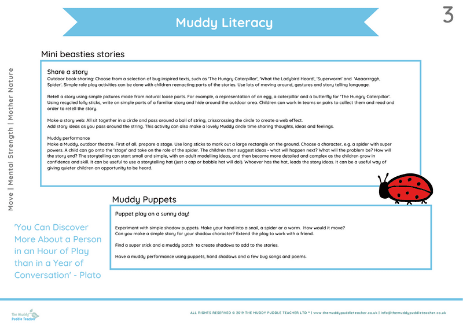
Children can draw what they found, make simple labels, create a minibeast story, act out the journey of a worm, describe a snail trail, make marks in mud or chalk, or use natural materials to create a story setting.

The outdoor experience gives children something real to write and talk about.

A child who may not feel ready to write a sentence can still make marks, tell an adult their idea, copy a word, draw a minibeast or act out a story.

This makes literacy feel more playful, purposeful and accessible. For more Early Years Outdoor Play Ideas, head to the EYFS Outdoors Hub


Minibeast Play and Continuous Provision

Minibeasts are a lovely theme for outdoor continuous provision.

You can create a small investigation area with magnifiers, clipboards, picture cards, natural materials, bug viewers, logs, bark, leaves, soil and simple mark-making tools.

Children can return to the area independently, revisit their ideas and deepen their learning over time.

You might also link minibeasts to mud kitchen play, small world play, construction, loose parts, water play, art or storytelling.

Keep the provision simple. A few thoughtful resources and a real outdoor space are often more powerful than a table full of activities.


Want Ready-Made EYFS Minibeast Resources?

If you like the idea of taking minibeast learning outdoors but want ready-to-use resources, The Muddy Puddle Teacher® membership can help.

Inside the membership, you’ll find over 1,000 resources, including EYFS minibeast activities, outdoor learning ideas, outdoor play resources, outdoor phonics, outdoor maths, SEND interventions, Forest School-style planning, seasonal resources and continuous provision ideas.

Everything is designed to save you time and help you make learning active, inclusive and curriculum-linked.

Make a start, download this resource and thousands more – take a 60-day free trial and try one outdoor minibeast activity this week.

For more Early Years Outdoor Play Ideas, head to the EYFS Outdoors Hub


FAQs About EYFS Minibeast Activities

What are EYFS minibeast activities?

EYFS minibeast activities are early years learning experiences based around small creatures such as worms, snails, spiders, woodlice, ants, bees, butterflies and ladybirds. They can support outdoor learning, early science, communication, maths, literacy and play.

Why are minibeasts good for EYFS outdoor learning?

Minibeasts are good for EYFS outdoor learning because children can observe them in real life. This supports curiosity, vocabulary, questioning, care for living things, sensory exploration and understanding the world.

How can I teach minibeasts outdoors?

You can teach minibeasts outdoors through gentle bug hunts, habitat investigations, nature observation, minibeast storytelling, outdoor mark-making, counting activities and continuous provision.

Do I need a forest for minibeast activities?

No. You can explore minibeasts in a playground, nursery garden, field, local park, mud kitchen area, planters or any small outdoor space with leaves, soil, logs, grass or plants.

Can minibeast activities support SEND children?

Yes. Minibeast activities can support SEND children because they are practical, sensory, visual and hands-on. They can encourage communication, regulation, curiosity, movement and focused attention.


Final Thoughts

EYFS minibeast activities are a simple and powerful way to take outdoor learning into your early years setting.

Start with one gentle minibeast hunt. Let children look closely, talk about what they notice and care for the tiny creatures they find.

Outdoor learning helps children understand that nature is full of questions, stories, patterns and learning opportunities.

Muddy best wishes,
Sarah
Founder of The Muddy Puddle Teacher® Make a start, download this resource and thousands more – take a 60-day free trial.

You need a subscription to download this file. Log in/Upgrade or Take a 60 Day Free Trial. Feel free to Send us a message if you need help.

New in