
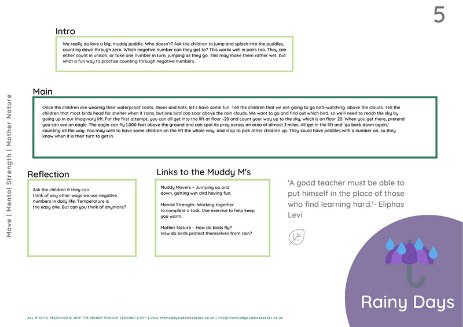
Counting through negative numbers can feel tricky for children because it is often taught using flat worksheets, number lines and abstract symbols. But when children can move forwards, step backwards, jump, count aloud and physically travel across zero, negative numbers begin to make much more sense. New to outdoor learning? Explore our Beginners Guide to Outdoor Learning.
This outdoor maths activity helps children understand what happens when numbers go below zero. Instead of just looking at a number line on paper, children become the number line. They step, jump, count, predict and explain their thinking using their bodies and the outdoor space.
This page is for KS2 teachers looking for a simple, practical way to teach negative numbers outside. It is especially useful for children who need movement, visual support or a more memorable way to understand maths.
You do not need expensive equipment. A playground, chalk, cones, number cards or even sticks and stones can help children explore counting through zero in a much more active and meaningful way.
Want more simple ways to take maths outside?
Explore our Outdoor Learning Knowledge Hub, download our Free Outdoor Learning Magazine, or start your 60 Day Free Trial to access thousands of outdoor learning resources, lesson ideas, interventions and activity packs.
The Muddy Puddle Teacher® helps teachers take learning outside in simple, practical and curriculum-linked ways.
Why Teach Negative Numbers Outside?
Negative numbers can feel confusing because children are being asked to understand something they cannot easily see. They may know that 5 is bigger than 2, but when we introduce -1, -2 and -3, the direction of the number line suddenly matters much more.
Taking the lesson outside helps children:
physically move along a number line
see zero as a central point
understand “less than zero” through movement
count forwards and backwards with confidence
compare positive and negative numbers
explain their reasoning aloud
work collaboratively with others
Outdoor maths gives children the chance to feel the maths as well as see it. This is especially powerful for children who find abstract maths difficult indoors.
Activity: Human Negative Number Line
You Will Need
Playground chalk
Cones or sticks
Number cards from -10 to +10
Space to move
Optional: hoops, rope, beanbags or natural objects
Set Up
Draw a large number line on the playground or outdoor surface. Place zero in the middle, positive numbers to the right and negative numbers to the left.
Make the number line big enough for children to stand on each number. If you do not have chalk, use cones, rope, sticks, stones or printed number cards.
You could start with:
-5, -4, -3, -2, -1, 0, 1, 2, 3, 4, 5
Then extend to:
-10 to 10
-20 to 20
temperature examples
money examples
real-life word problems
Step 1: Start at Zero
Ask one child to stand on zero.
Say:
“Zero is our starting point. Numbers to this side are positive. Numbers to this side are negative.”
Ask children to walk slowly along the number line and say each number aloud.
Then ask:
What happens when we move forwards from zero?
What happens when we move backwards from zero?
Which number is smaller, -2 or 3?
Which number is closer to zero, -1 or -5?
This helps children see that negative numbers are not just random numbers with a minus sign. They have a place and position.

Step 2: Count Back Through Zero
Give children a starting number, such as 4.
Ask them to stand on 4 and count backwards one step at a time:
4, 3, 2, 1, 0, -1, -2, -3
Repeat with different starting points.
Try:
Start at 6 and count back 9
Start at 3 and count back 7
Start at 1 and count back 5
Start at -2 and count back 4
Each time, children physically move one step at a time. This makes the idea of “crossing zero” much clearer.
Step 3: Count Forwards From Negative Numbers
Now ask children to start on a negative number.
For example:
“Start on -4 and count forwards 6.”
Children step:
-4, -3, -2, -1, 0, 1, 2
Ask:
“Where did you finish?”
This helps children understand that counting forwards from a negative number moves towards zero first, then into positive numbers.
Try:
Start on -5 and count forwards 3
Start on -6 and count forwards 8
Start on -10 and count forwards 12
Start on -2 and count forwards 7
Encourage children to say the numbers aloud as they move.
Step 4: Add Real-Life Context
Negative numbers make more sense when children can connect them to everyday situations.
Use examples such as:
Temperature
“The temperature was 3°C. Overnight it dropped by 5 degrees. What temperature is it now?”
Children start on 3 and move back 5 spaces.
Answer: -2°C
Lift or Stairs
“You are on floor 2. You go down 4 floors. Where are you now?”
Children start on 2 and move back 4 spaces.
Answer: -2
Money
“You have £2. You spend £5. How much do you owe?”
Children start on 2 and move back 5 spaces.
Answer: -3
This helps children understand why negative numbers matter in real life.
Link here to Outdoor Maths Resources, KS2 Number Activities, and Maths Outdoor Lesson Plans.
Step 5: Partner Challenges
Children work in pairs. One child gives the instruction and the other child moves along the number line.
Examples:
Start on 5. Count back 8.
Start on -3. Count forwards 6.
Start on 0. Count back 4.
Start on -7. Count forwards 10.
Start on 2. Count back 6.
The partner checks the answer and asks:
“How do you know?”
This is where the learning becomes deeper. Children are not just moving; they are explaining.
Step 6: Muddy Puddle Teacher® Challenge
Give children a “Take It Out of the Class” challenge:
“Can you create your own outdoor negative number line and write five challenges for another group to solve?”
Children can create number lines using:
chalk
sticks
stones
cones
rope
leaves
number cards
hoops
They then write or say instructions for another group.
For example:
“Start on -2. Move forwards 9. Where do you land?”
This encourages children to apply their learning and create their own maths problems.
How This Supports Different Learners
This outdoor negative numbers activity is particularly helpful for children who:
need visual support
learn better through movement
find abstract maths difficult
need repeated practice
benefit from talking through their thinking
struggle to understand number lines on paper
need confidence before recording in books
It can also support SEND learners because the activity is practical, active and low-pressure. Children can move, copy, listen, repeat and practise before they are expected to write anything down. Use thiss support guidance for children with Dyscalculia.
Thsi video can help more practical outdoor maths ideas in KS2:
Classroom Follow-Up
After the outdoor lesson, bring children back inside and ask them to record what they did.
They could:
draw the number line
write three examples
explain how they counted through zero
create their own negative number word problem
compare two negative numbers
write a reflection sentence
Example sentence stems:
I know -4 is less than -1 because…
When I count backwards through zero…
Negative numbers are useful when…
I found it easier outside because…
This helps connect the outdoor experience with written mathematical understanding.
Common Misconceptions to Address
Children may think -5 is bigger than -2 because 5 is bigger than 2
Use the number line to show that -5 is further away from zero on the negative side.
Children may stop at zero
Practise counting through zero repeatedly so they see that the number line continues.
Children may confuse direction
Use physical movement: forwards towards positive numbers, backwards towards negative numbers.
Children may not understand why negative numbers are useful
Use temperature, money, lifts, basements and real-life examples.
FAQ
What age is this negative numbers activity suitable for?
This activity is most suitable for KS2 children, especially Year 4, Year 5 and Year 6. It can also be adapted for confident Year 3 children or used as an intervention for older children who need extra support.
Do I need special equipment?
No. You can use chalk, cones, sticks, stones, rope or printed number cards. The most important thing is that children can move physically along a number line.
Can this activity support SEND learners?
Yes. It is especially useful for children who need movement, visual support and practical learning. It can support children with dyscalculia, working memory difficulties, attention needs and children who find abstract maths challenging.
Can I do this without a playground?
Yes. You can use a grassy area with cones, hoops, rope or number cards. Children can still step along the number line even if it is not drawn in chalk.
How do I extend this activity?
You can extend it by using larger numbers, missing number challenges, temperature problems, money problems or partner-created word problems.
Want more simple ways to take maths outside?
Explore our Outdoor Learning Knowledge Hub, download our Free Outdoor Learning Magazine, or start your 60 Day Free Trial to access thousands of outdoor learning resources, lesson ideas, interventions and activity packs.
The Muddy Puddle Teacher® helps teachers take learning outside in simple, practical and curriculum-linked ways.
Author Box
Written by Sarah Seaman PGCE MA
Founder of The Muddy Puddle Teacher®
Teacher for over 19 years
Bloomsbury author
Trainer of thousands of teachers across the UK