
Counting in Multiples Outdoor Ideas for Primary Teachers
Looking for simple counting in multiples outdoor ideas that do not involve another worksheet, another printed sheet or another child sitting at a desk feeling confused?
This page is for EYFS, KS1 and KS2 teachers, teaching assistants, maths leads, outdoor learning leads, SENDCos and home educators who want to make counting in multiples more active, memorable and playful.
Counting in multiples is one of those maths skills children need again and again. It supports times tables, division, number patterns, place value, money, measures, fractions and problem solving. Yet for many children, skip counting can feel like chanting numbers without really understanding what they mean.
Taking counting in multiples outside helps children move, hear, see, build and physically experience number patterns. They can jump in twos, step in fives, collect in tens, build groups, count objects, follow number trails and use the playground as a giant maths space.
If you are new to teaching maths outside, you may also like our Outdoor Learning Maths Hub, Beginners Guide to Outdoor Learning and KS1 Outdoor Learning Resources.
What is Counting in Multiples?
Counting in multiples means counting forwards or backwards by equal steps.
Children might count in 2s, 5s, 10s, 3s, 4s, 6s, 8s or other number patterns depending on their age, confidence and curriculum stage.
For example, counting in 2s might sound like 2, 4, 6, 8, 10. Counting in 5s might sound like 5, 10, 15, 20, 25. Counting in 10s might sound like 10, 20, 30, 40, 50.
But children need more than chanting. They need to understand that each number represents another equal group being added. Outdoor learning helps because children can make the groups, move the groups, count the groups and see the pattern growing.
This is where Outdoor Maths Activities, Counting in Multiples Resources and Times Tables Outdoor Learning Ideas can really help.
Why Teach Counting in Multiples Outside?
Counting in multiples works beautifully outside because it is a physical, rhythmic and pattern-based maths skill.
Children can clap, jump, step, hop, run, collect, build and arrange objects while they count. This supports children who find sitting still difficult, children who need more repetition, children who learn through movement and children who benefit from seeing maths in a concrete way.
Outdoor counting in multiples can help children understand equal groups, notice number patterns, build times table confidence, strengthen memory, practise mathematical language, improve fluency, reduce maths anxiety and enjoy maths more.
It also means maths does not always have to begin with a worksheet.
Sometimes the best maths lesson starts with chalk, cones, sticks, stones, hoops, leaves, children’s feet and a bit of space.
Try This Tomorrow: Counting in Multiples Number Trail
If you only try one idea, make a simple counting in multiples number trail.
Choose the multiple you want children to practise, such as 2s, 5s or 10s. Write the numbers in chalk across the playground, or place number cards on cones, hoops or mats. Children move along the trail saying the numbers aloud as they go.
They could step on each number, jump on each number, whisper the numbers, shout the multiples, clap between each number, collect an object at every stop or turn around and count backwards.
Time needed: 5–10 minutes.
Prep needed: Very low.
Best for: KS1, lower KS2, times tables, number fluency, retrieval practice, SEND support and active maths starters.
This is a simple way to make counting in multiples feel more active and less like a memory test.
For more ideas like this, explore our 60-Day Free Trial, Sign up for a FREE Magazine.
Outdoor Idea 1: Hoop Multiples
Place hoops on the ground in a line or circle. Each hoop represents the next multiple.
Children jump into the hoops while counting aloud. For 2s, they jump 2, 4, 6, 8, 10. For 5s, they jump 5, 10, 15, 20, 25. For 10s, they jump 10, 20, 30, 40, 50.
To deepen the learning, place objects inside each hoop. For counting in 2s, each hoop has two sticks. For counting in 5s, each hoop has five stones. For counting in 10s, each hoop has ten leaves or ten counters.
This helps children see that each jump is not just a number. It is another equal group.
You can adapt this for SEND by reducing the number of hoops, using larger spaces, using visuals, counting with an adult, using peer support or allowing children to point instead of jump.
Outdoor Idea 2: Nature Groups
Ask children to collect natural objects and organise them into equal groups.
They might collect stones in groups of 2, leaves in groups of 5, sticks in groups of 10 or petals in groups of 3.
Once the groups are made, children count the totals aloud.
Two stones, four stones, six stones, eight stones.
Five leaves, ten leaves, fifteen leaves, twenty leaves.
This activity works well because it shows the link between counting in multiples and multiplication. Children begin to see that 5, 10, 15, 20 is really one group of five, two groups of five, three groups of five, four groups of five.
It also works beautifully as a low-pressure maths intervention.
Link this to Outdoor Learning for SEND, Outdoor Maths Interventions and Maths Outside the Classroom.
Outdoor Idea 3: Multiples Movement
Give children a multiple and a movement.
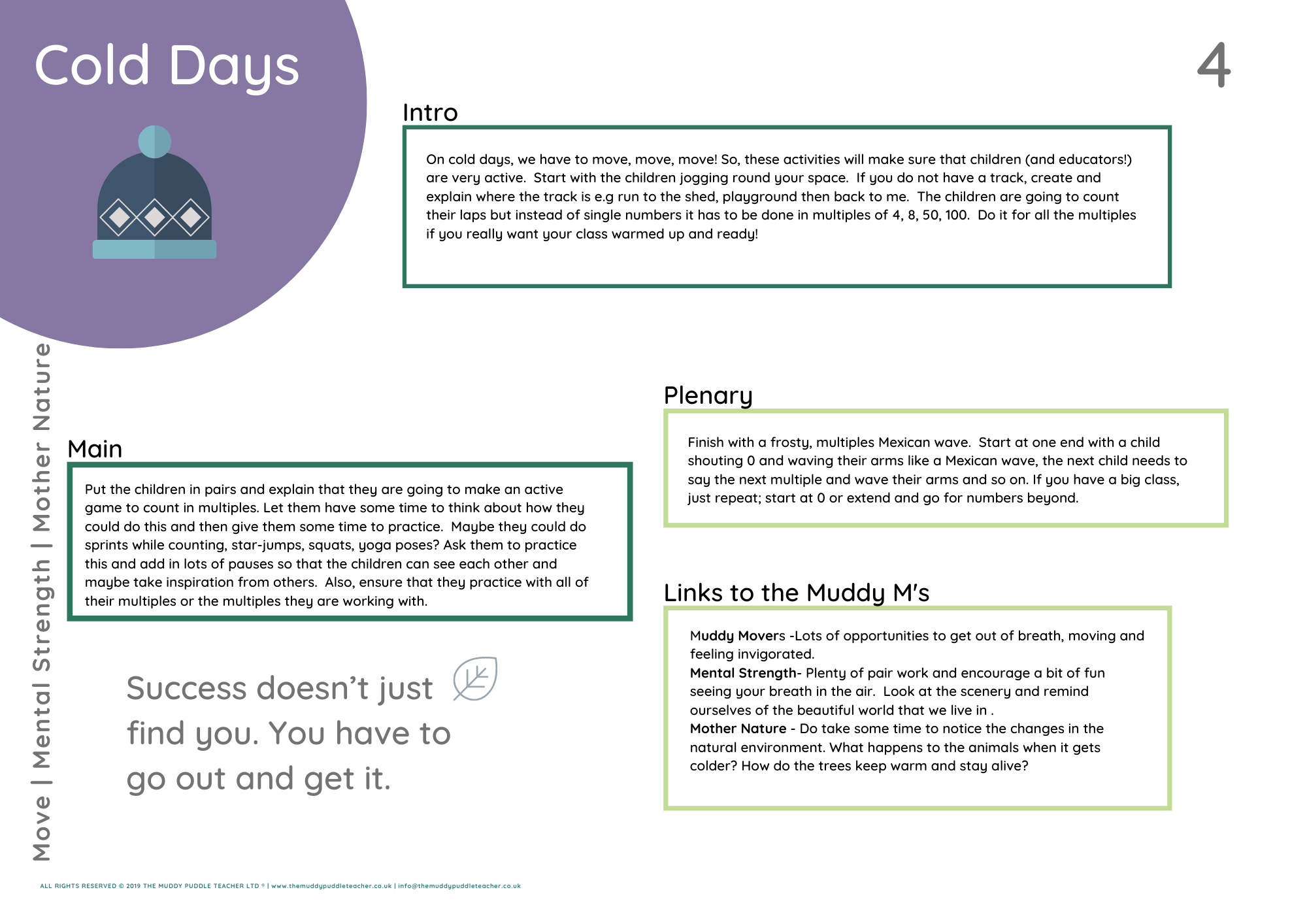
They might count in 2s while hopping, count in 5s while clapping, count in 10s while marching, count in 3s while tapping their shoulders or count in 4s while stepping around a square.
Movement helps some children remember number patterns because the rhythm supports recall.
You can also let children choose the movement. This gives them ownership and often makes the activity more memorable.
For example, count in 2s with frog jumps, count in 5s with star jumps, count in 10s with giant steps, count in 3s with spins, count in 4s with robot steps.
This is a lovely quick starter before a maths lesson, especially if children have come in from play unsettled or need to wake their brains up.
Outdoor Idea 4: Chalk Number Ladders
Draw a long ladder on the playground with chalk. Each rung is the next multiple.
Children climb the ladder by stepping from one rung to the next. They can say the number, write the missing number, place an object on the number or explain the pattern.
You can make this easier by filling in every number.
You can make it harder by leaving gaps.
For example, 5, 10, blank, 20, 25, blank, 35.
Children then work out the missing multiples.
This is a strong activity for KS2 because you can extend it to larger multiples, negative numbers, decimal steps or counting backwards.
You could link this page to Counting Through Negative Numbers Outdoor Ideas if you have that page live.
Outdoor Idea 5: Cone Counting
Place cones around the playground. Each cone has a number card attached.
Children move from cone to cone in the correct order, counting in multiples as they go.
To make this more active, children can work in teams. One child finds the next multiple, one child checks the number, one child says the full pattern aloud and one child records the sequence with chalk or on a clipboard.
This works well for children who enjoy a challenge and need maths to feel purposeful.
You can also use cones to create mistakes. Add one wrong number and ask children to find the number that does not belong.
For example, 3, 6, 9, 13, 15.
Children then explain why 13 is not part of the counting pattern.
Let the Muddy Puddle Teacher TV help you with what maths looks outside for KS2:
Outdoor Idea 6: Multiples Treasure Hunt
Hide number cards around the outdoor space.
Children have to find the cards that belong to a specific multiple pattern.
For example, if the focus is counting in 4s, they collect 4, 8, 12, 16, 20 and leave behind the numbers that do not belong.
Once they have collected the cards, they put them in order and read the sequence aloud.
This helps children practise recognition, ordering, reasoning and fluency.
It also gives you a quick way to assess who understands the pattern and who is guessing.
This would link nicely to KS2 Outdoor Maths Activities, Outdoor Times Tables Games and Maths Treasure Hunt Resources.
Outdoor Idea 7: Human Number Line
Give children number cards and ask them to become the number line.
Some children hold multiples and some children hold distractor numbers.
The class has to organise the children into the correct order.
For example, the children holding 6, 12, 18, 24 and 30 stand in the counting in 6s line. The children holding 7, 13 and 25 explain why they do not belong.
This is great for talk. Children can explain their thinking, spot patterns and correct misconceptions together.
It also supports children who need maths to be visual and social.
Outdoor Idea 8: Count and Collect
Give children a target multiple and ask them to collect objects in equal groups.
For example, collect 30 objects in groups of 5, collect 24 objects in groups of 6, collect 40 objects in groups of 10.
Children then arrange their objects and count them aloud in multiples.
This supports the bridge between skip counting and multiplication facts.
It also makes a good outdoor plenary because children can show their groups and explain what they have made.
You could ask, how many groups did you make, how many were in each group, what did you count in, what was your total, could you make the same total another way?
How to Support Children Who Find Counting in Multiples Difficult
Some children can chant multiples but do not understand them.
Some children lose track.
Some children struggle to hear the pattern.
Some children find times tables stressful.
Outdoor learning can help because it slows the learning down and makes it concrete.
Start with real objects before expecting children to work mentally. Keep the numbers small at first. Use the same multiple several times across the week. Add movement and rhythm. Let children build the groups. Use visuals, hoops, chalk, cones and natural objects. Count forwards before counting backwards. Say the pattern aloud together before asking children to do it independently.
The aim is not to rush children into harder times tables.
The aim is to help them understand what is happening.
For children with SEND, keep the activity short, predictable and successful. Use one clear instruction at a time. Give children a visual start and finish point. Allow them to point, move, build, say, tap or show the answer in different ways.
For more support, visit our SEND Outdoors Resource Hub, Outdoor Dyscalculia Handbook.
Counting in Multiples Across KS1 and KS2
In KS1, counting in multiples often begins with 2s, 5s and 10s. Children need lots of practice making equal groups, counting objects, using number lines and spotting patterns.
In lower KS2, children build on this with 3s, 4s and 8s, then strengthen their times table knowledge through repeated practice.
In upper KS2, counting in multiples supports factors, common multiples, fractions, decimals, measures and problem solving.
Outdoor maths can support all of these stages because the same activity can be made easier or harder.
A hoop trail can be used for counting in 2s in Year 1, counting in 8s in Year 3, counting backwards in 6s in Year 4 or counting in decimal steps in Year 5.
That is why simple outdoor maths ideas are so useful. You do not need a completely different activity for every year group. You need flexible activities that can grow with the children.
Want Ready-to-Use Counting in Multiples Outdoor Resources?
The Muddy Puddle Teacher® Club helps busy teachers take maths outside without spending hours planning.
Inside, you can find outdoor learning resources, maths activity ideas, curriculum-linked lessons, SEND-friendly resources, play-based ideas, lanyards, outdoor phonics, outdoor English, outdoor science and seasonal learning ideas.
You can start with a simple activity like counting in multiples outdoors, then build towards a whole-school outdoor learning approach over time.
For more ideas like this, explore our 60-Day Free Trial, Sign up for a FREE Magazine.
FAQs
What are counting in multiples outdoor ideas?
Counting in multiples outdoor ideas are practical maths activities that help children practise skip counting outside. They might include jumping along number trails, making equal groups with natural objects, using hoops as multiples, chalking number ladders or playing outdoor times table games.
What age is counting in multiples suitable for?
Counting in multiples is suitable for EYFS children who are beginning to notice number patterns, KS1 children learning to count in 2s, 5s and 10s and KS2 children building times table fluency. The activity can be adapted by changing the multiple, the numbers used and the level of support.
How can I teach counting in multiples without worksheets?
You can teach counting in multiples without worksheets by using movement, rhythm, objects and outdoor space. Children can jump, step, clap, collect, build equal groups, follow chalk trails, order number cards and use natural objects to show each multiple.
Can outdoor counting in multiples help children with SEND?
Yes. Outdoor counting in multiples can support children with SEND because it is active, visual, sensory and practical. Children can move, touch, build and see the number pattern rather than only trying to remember it verbally or write it on paper.
Do I need special equipment for outdoor maths?
No. You can teach counting in multiples outside with chalk, hoops, cones, sticks, stones, leaves, number cards or playground markings. The most important part is helping children experience the pattern through movement and equal groups.
Author Box
Written by Sarah Seaman PGCE MA
Founder of The Muddy Puddle Teacher®
Teacher for over 19 years
Bloomsbury author
Trainer of thousands of teachers across the UK