
a

Training & Resources

muddy puddle teacher logo

The Muddy Puddle Teacher ®

Leading with Outdoor Learning and Outdoor Play

jungle counting

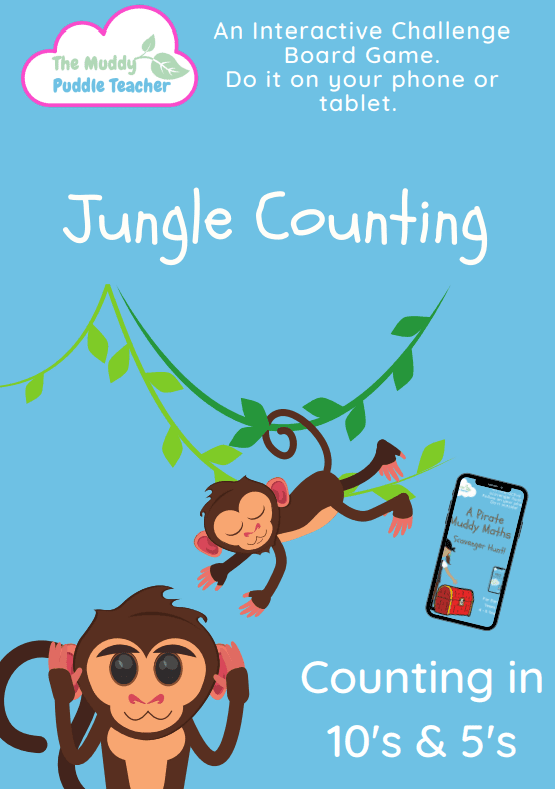
Counting in 10’s and 5’s EBook

Download

Counting in 10’s and 5’s EBook: Outdoor Maths Learning Activities

Looking for simple maths outdoor learning ideas for counting in 10’s and 5’s? This Counting in 10’s and 5’s EBook helps children practise skip counting through movement, play and hands-on outdoor learning.

Counting in 5s and 10s can feel abstract when children only see numbers on a worksheet. Taking maths outdoors gives children space to move, jump, count, collect, group and see number patterns in a practical way. New to teaching outdoors? Let us help you fast-track with the Beginner’s Guide to Outdoor Learning. 

This resource is ideal for teachers looking for outdoor maths activities, active maths lessons, early number pattern work and practical ways to teach counting in 5s and 10s.

New to Outdoor Maths Learning? Start Here

If outdoor maths learning feels overwhelming, start small.

Try:

  1. One 10-minute counting activity

  2. One number trail outdoors

  3. One practical grouping task using natural materials

You do not need expensive resources. You can use:

  • chalk

  • cones

  • hoops

  • sticks

  • stones

  • leaves

  • number cards

  • buckets

  • beanbags

  • skipping ropes

  • playground markings

  • natural loose parts

The aim is not to create a complicated outdoor maths lesson. The aim is to help children physically experience number patterns so counting in 5s and 10s becomes meaningful.

Outdoor maths can support children to:

  • practise counting in 5s

  • practise counting in 10s

  • recognise number patterns

  • develop fluency

  • understand grouping

  • build confidence

  • learn through movement

  • connect maths to real objects

Fractions KS1 Halves & Quarters

Try This Tomorrow

If you only do one thing, try this:

Counting in 10s Number Trail

Use chalk or number cards to create a counting in 10s trail outside.

Write or place:

10, 20, 30, 40, 50, 60, 70, 80, 90, 100

Children move along the trail and say each number aloud.

Then try:

  • jump on each number

  • clap on each number

  • collect 10 leaves at each stop

  • match bundles of 10 sticks to the numbers

  • hide one number and ask children what is missing

Time: 10–15 minutes
Prep: Low
Learning: Counting in 10s, number patterns, place value, movement and mathematical language

This is a brilliant quick win because children can see, say and move through the number pattern.

Outdoor Maths Activities for Counting in 10’s and 5’s

1. Counting in 5s Hop Trail

Create a simple hop trail using chalk, hoops or number cards.

Write:

5, 10, 15, 20, 25, 30, 35, 40, 45, 50

Children hop, step or jump along the numbers while counting aloud.

Ask:

  • What number comes next?

  • What number came before?

  • Can you find 25?

  • Which number is halfway to 50?

  • What do you notice about the numbers?

This supports counting in 5s, number recognition, sequencing and active recall.

2. Groups of 10 Nature Count

Ask children to collect natural objects and organise them into groups of 10.

They could collect:

  • leaves

  • sticks

  • stones

  • conkers

  • petals

  • pine cones

  • shells

  • pebbles

Children can then count:

10, 20, 30, 40, 50

This helps children understand that counting in 10s is not just a chant. It is a way of counting groups quickly.

Extend by asking:

  • How many groups of 10 do we have?

  • How many altogether?

  • What if we add one more group?

  • What if we take one group away?

3. Counting in 5s Hands and Fingers Game

Counting in 5s links naturally to hands and fingers.

Take children outside and ask them to work in small groups.

Each child holds up one hand.

Count:

5, 10, 15, 20, 25

Then try:

  • draw hands in chalk

  • make handprint trails

  • count groups of 5 sticks

  • create 5-stone circles

  • match number cards to groups of 5

This supports visual understanding, grouping, counting and mathematical talk.

4. Outdoor Skip Counting Relay

Create a simple relay where children collect number cards in order.

For counting in 10s, use:

10, 20, 30, 40, 50

For counting in 5s, use:

5, 10, 15, 20, 25

Children run, walk or skip to collect the next number and bring it back to the group.

This is ideal for children who need movement to stay engaged in maths.

You can make it easier by using fewer numbers or harder by mixing the cards up.

5. Missing Number Maths Hunt

Hide number cards outdoors and ask children to find the missing numbers in a counting sequence.

For example:

10, 20, __, 40, 50

or:

5, 10, 15, __, 25

Children can search for the missing number and place it in the correct space.

This supports reasoning, sequencing, number recognition and problem-solving.

SEND Support for Counting in 10’s and 5’s Outdoors

Small Step Counting Station

Some children need more repetition and a calmer structure when learning to count in 5s and 10s.

Set up a small counting station outdoors with:

  • one hoop

  • a small number of objects

  • number cards

  • visual prompts

  • a clear start and finish point

Start with counting real groups.

For example:

  • 5 stones in one hoop

  • 5 stones in another hoop

  • count 5, 10

Or:

  • 10 sticks in one pile

  • 10 sticks in another pile

  • count 10, 20

Use short instructions:

“Make a group of 5.”
“Make another group of 5.”
“Now count 5, 10.”

This can support:

  • working memory

  • confidence

  • number understanding

  • fine motor skills

  • visual learning

  • repetition

  • sensory regulation

Outdoor maths can be especially helpful for children who need to move, touch and see concepts in order to understand them.

Why Teach Counting in 5’s and 10’s Outdoors?

Counting in 5s and 10s outdoors helps children move from chanting numbers to understanding number patterns.

Outdoor maths learning gives children the chance to:

  • physically step through number sequences

  • group real objects

  • see repeated patterns

  • use their whole body to learn

  • talk through their thinking

  • practise maths in a playful way

  • build confidence before recording

  • reduce worksheet pressure

This is especially useful for children who find abstract maths difficult or who need active, practical learning opportunities.

Want Ready-to-Teach Outdoor Maths Resources?

The Muddy Puddle Teacher Club helps busy teachers save planning time with:

  • ready-to-use outdoor maths activities

  • counting in 5s and 10s resources

  • active maths lesson ideas

  • curriculum-linked outdoor learning

  • EYFS and primary maths activities

  • SEND-friendly maths ideas

  • outdoor number trails and practical resources

You can start today with a 60-day free trial and explore outdoor maths learning resources straight away.

FAQs

How do you teach counting in 10s outdoors?

You can teach counting in 10s outdoors by using chalk number trails, groups of 10 natural objects, outdoor number cards, counting relays, missing number hunts and practical grouping activities.

How do you teach counting in 5s outdoors?

You can teach counting in 5s outdoors using hop trails, handprint counting, groups of 5 objects, outdoor number lines, counting songs, movement games and skip counting challenges.

What is maths outdoor learning?

Maths outdoor learning is when children explore mathematical ideas outside through movement, natural materials, practical activities and real-world experiences. It can include counting, measuring, sorting, pattern, shape, number trails and problem-solving.

Why is outdoor maths good for children?

Outdoor maths helps children see and feel maths in a practical way. It supports movement, confidence, collaboration, language and deeper understanding, especially for children who find sitting at a table difficult.

What outdoor resources can I use for counting?

You can use chalk, cones, hoops, sticks, stones, leaves, buckets, number cards, beanbags, playground markings and natural loose parts for outdoor counting activities.

Are outdoor maths activities good for KS1?

Yes. Outdoor maths activities are excellent for KS1 because they help children practise number facts, counting patterns, place value, measuring, shape, problem-solving and mathematical language in an active way.

Can outdoor maths support SEND learners?

Yes. Outdoor maths can support SEND learners by making abstract concepts more visual, physical and sensory. Activities can be broken into small steps with repetition, movement, visual prompts and real objects.

What age is counting in 5s and 10s suitable for?

Counting in 5s and 10s is often introduced in early primary maths, especially in KS1. Some EYFS children may also begin exploring simple counting patterns through songs, movement and playful grouping.

What are good long-tail keywords for outdoor maths learning?

Useful long-tail keywords include outdoor maths activities, maths outdoor learning, counting in 10s outdoor activities, counting in 5s outdoor activities, outdoor maths KS1, practical maths activities outdoors, active maths lessons and outdoor number activities.

Ready for More Outdoor Maths Ideas?

If you want more simple, curriculum-linked outdoor maths activities, join The Muddy Puddle Teacher Club.

Start your 60-day free trial today and access ready-to-use outdoor maths resources, counting activities, number trails and active maths ideas you can use straight away.

You need a subscription to download this file. Log in/Upgrade or Take a 60 Day Free Trial. Feel free to Send us a message if you need help.

New in